





Best Probiotic Powders UK
Posted on:
Aug 05, 2026
Authored by


Written and medically reviewed by Dr Zeeshan Afzal (MBBS) — Medical Doctor & Medical Content Lead, Welzo
Evidence-based · Honest about what's proven and what isn't · UK-focused
Last updated: July 2026 · Reading time: ~11 minutes
Part of our Digestive Health hub — buy gut health supplements
Popular probiotics: Akkermansia · Citrus Pectin · Berberine · TUDCAProbiotic powders are the most expensive way to buy bacteria in the UK, and the reason to choose one has almost nothing to do with potency. It is about control — the ability to take a fraction of a normal dose, which no capsule allows.
For someone with a genuinely reactive gut, that matters enormously. Starting at an eighth of a scoop and building up over a month is the difference between tolerating a probiotic and abandoning it in week one. For everyone else, a powder is usually an expensive way to buy something a capsule delivers for a fraction of the price.
This guide explains who powders are actually for, ranks every probiotic powder at Welzo with verified prices and stock, and is blunt about the cost. For the wider range, see best probiotics UK or browse gut health supplements.
Table of contents
Be honest with yourself about which group you fall into, because it determines whether the price is justified.
| Feature | Powder | Capsule |
|---|---|---|
| Dose control | Excellent — any fraction you like | Fixed per capsule |
| Excipients | Often none at all | Capsule shell plus fillers |
| Cost | High to very high | Low to moderate |
| Acid protection | None — no coating possible | Delayed-release options available |
| Convenience | Needs a scoop, and ideally scales | Swallow and go |
| Suits children | Yes — mixes into cool food | Only if openable |
The acid-protection row deserves a note. A powder cannot be enterically coated, so it has no built-in defence against stomach acid. That is a genuine drawback compared with delayed-release capsules or spore-based probiotics, which sidestep the problem entirely — see do probiotics survive stomach acid. Taking powder on an empty stomach with water, when acid output is lower, partially compensates.
Several premium powders are marketed as D-lactate free, and it is worth understanding what that does and doesn't mean.
Lactic acid comes in two mirror-image forms, L-lactate and D-lactate. Humans metabolise L-lactate efficiently but clear D-lactate slowly. Some Lactobacillus species produce mostly D-lactate; others produce mainly L-lactate. A D-lactate free formula deliberately selects only the latter.
D-lactic acidosis is a real, recognised condition — but it is rare, and occurs almost exclusively in people with short bowel syndrome or extensive small intestinal resection, where undigested carbohydrate reaches an overgrown colon. In that specific population, avoiding D-lactate producers is a sensible precaution and should be managed with a specialist.
None of these listings publishes a scoop size or CFU per serving, so a reliable cost-per-day figure cannot be calculated. What can be compared exactly is cost per gram:
| Powder | Price | Per gram |
|---|---|---|
| Custom Probiotics D-Lactate Free, 50g | £148.49 | £2.97 |
| Custom Probiotics L. Plantarum, 50g | £148.44 | £2.97 |
| Custom Probiotics B. Longum, 50g | £103.25 | £2.07 |
| Metabolics B. Longum, 100g | £48.55 | £0.49 |
The spread is striking: the Metabolics powder costs roughly a sixth per gram of the Custom Probiotics powders. Some of that gap reflects declared strain codes, allergen testing and stability testing — but not, on the face of it, a six-fold difference. Note also that the D-Lactate Free powder is the single most expensive product in Welzo's entire probiotics range.
For context, a capsule such as Swanson's L. rhamnosus with FOS runs at about 19p a day. Powders are a specialist purchase, and should be treated as one.
Best Overall: Custom Probiotics D-Lactate Free, 50g — £148.49
Best Value: Metabolics Bifidobacterium Longum Powder, 100g — £48.55
Best Single Strain: Custom Probiotics L. Plantarum Powder, 50g — £148.44
Best for Bifidobacteria: Custom Probiotics B. Longum Powder, 50g — £103.25
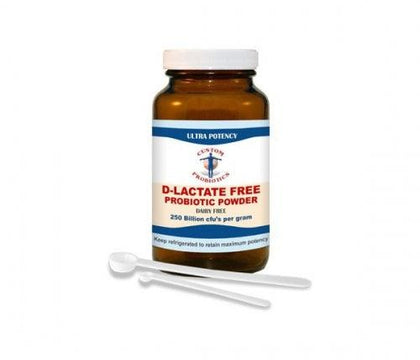
Price: £148.49 · Reviews: 114 · Stock: In stock · Where to buy: Available from Welzo
Why it tops the list: It is the clearest answer to the question "why buy a powder at all?" This is a specialist formulation built for people who react badly to standard probiotics — a D-lactate free strain selection in a plain powder with no capsule shell, no fillers and nothing to titrate around. Combined with the format's dose flexibility, it is the most tolerable option here for a genuinely reactive gut. Custom Probiotics also runs stability testing on its powders, which matters for a product with no protective capsule.
The price is very hard to justify unless you need it. At £148.49 for 50g — £2.97 a gram — this is the most expensive product in Welzo's probiotics range. If you have short bowel syndrome and a specialist has recommended avoiding D-lactate producers, that premium buys something specific. If you simply have IBS or a sensitive stomach, a cheaper powder taken in small doses will very likely serve you just as well. See supplements for IBS.
| Pros | Cons |
|---|---|
| Purpose-built for reactive and sensitive guts D-lactate free strain selection No capsule shell or fillers Full dose titration possible Stability tested In stock |
Most expensive product in the range (£2.97/g) D-lactate benefit is narrow outside short bowel syndrome No serving size or CFU published Needs a scoop and ideally scales |
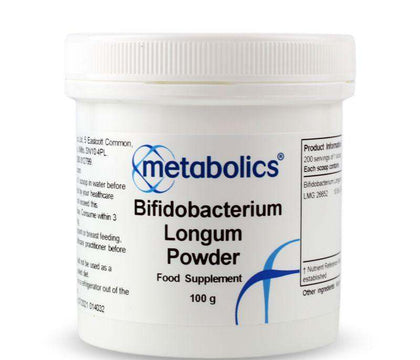
Price: £48.55 · Reviews: 98 · Stock: In stock · Where to buy: Available from Welzo
Why we like it: On pure economics this is the standout. £48.55 for 100g works out at 49p a gram — roughly a sixth of the Custom Probiotics powders — and it comes in the largest pack here. It is a straightforward single-species Bifidobacterium longum powder from a UK manufacturer, and it delivers exactly what most people want from this format: a plain powder you can dose in any quantity, without a capsule.
If you have decided you want a probiotic powder for daily maintenance rather than to meet a specialist requirement, this is the sensible purchase.
The trade-off is transparency. The listing doesn't declare a strain code, so the strain-level evidence discussed in our Bifidobacterium longum guide does not attach to it, and no CFU per gram is stated. You are buying a species at a good price, not a researched strain.
| Pros | Cons |
|---|---|
| By far the best value here (49p/g) Largest pack at 100g UK manufacturer Simple single-species powder Full dosing flexibility In stock |
No strain code declared CFU per gram not stated No allergen or stability detail published Not matched to any specific trial |
Price: £148.44 · Reviews: 86 · Stock: In stock · Where to buy: Available from Welzo
Why we like it: A genuinely single-strain powder using LP-115, free from dairy, gluten, soy, corn, casein, yeast, sugar, artificial additives and GMOs, with two-year temperature stability testing behind it. If you want one named organism and nothing else — no blend, no capsule, no excipients — this is the cleanest expression of that on the catalogue. See single vs multi-strain probiotics.
Same pricing problem as number one. At £148.44 for 50g it matches the D-Lactate Free powder almost exactly at £2.97 a gram, and LP-115 — while a properly characterised commercial strain — does not carry the published record that Lp299v does. Our L. plantarum guide covers that distinction and the cheaper alternatives.
| Pros | Cons |
|---|---|
| Names its strain (LP-115) Free from nine common allergens and additives Two-year temperature stability testing Truly single strain, no fillers In stock |
£2.97 per gram LP-115 has a thinner record than Lp299v No serving size or CFU published Hard to justify for general use |
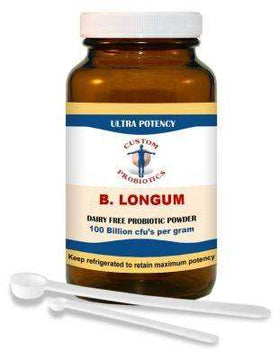
Price: £103.25 · Reviews: 80 · Stock: Currently sold out — check listing · Where to buy: Available from Welzo
Why we like it: A single-strain Bifidobacterium longum powder using BL-05 at a stated 100 billion CFU per gram — the only powder here that publishes a potency figure, which is a meaningful point of transparency. Dairy-free, sugar-free, gluten-free and non-GMO.
The direct comparison is unflattering. At £103.25 for 50g (£2.07/g) it costs more than four times per gram what the Metabolics B. longum powder does for the same species. What you get for the difference is the named BL-05 strain and a declared CFU. Whether that is worth four times the price is a judgement call — for most people it isn't.
| Pros | Cons |
|---|---|
| Names its strain (BL-05) Only powder here to state CFU (100 billion/g) Dairy-free, sugar-free, gluten-free, non-GMO Single strain, no fillers |
Currently sold out Over 4x the per-gram price of the Metabolics equivalent Only 50g BL-05 has a limited published record |
None of these listings publishes a serving size, so follow the pack instructions rather than any figure from an article. A powder at 100 billion CFU per gram and one with no stated potency are not interchangeable by volume.
Start far lower than you think. This is the whole reason to buy a powder. If you have reacted badly to probiotics before, begin with a small fraction of the stated serving — an eighth or a quarter — and increase every four or five days over a month. Ramping up too quickly wastes the format's main advantage.
Mix into something cool. Water, cool food or a cold drink. Heat kills the bacteria, so never add powder to anything hot. Take it on an empty stomach with water where possible, since powders have no acid protection — see when to take probiotics.
Store it properly. Powders are hygroscopic and draw in moisture, which degrades the culture. Keep the lid tightly closed, use a dry scoop every time, and follow the storage instructions — some require refrigeration once opened. See shelf-stable probiotics.
Allow four weeks before judging, longer if you are titrating slowly — see how long probiotics take to work.
Probiotic powders have the same safety profile as capsules. Mild bloating, wind or altered stools in the first week or two are common and usually settle — and are less likely if you build up slowly. See probiotic side effects.
Speak to a doctor before taking a probiotic powder if you
Because powders make it easy to take more than intended, measure carefully rather than estimating by eye. Further detail in probiotics safety.
On labelling: probiotics carry no authorised health claim in GB or the EU, so they are sold as food supplements and cannot legally be marketed as treating any condition.
See your GP — or seek urgent care — if you have:
A reactive gut that has not been investigated should be assessed rather than managed with supplements. Read more on when to see a GP about stomach symptoms and bowel cancer screening in the UK.
Custom Probiotics D-Lactate Free at £148.49 is the strongest specialist option, built for reactive guts with no capsule shell or fillers. For most people the Metabolics B. longum powder at £48.55 is the more sensible buy — roughly a sixth of the price per gram.
Not more effective, but more flexible. The advantage is dose control — you can take a fraction of a serving, which no capsule allows. Capsules win on cost, convenience and acid protection.
Partly strain licensing, allergen testing and stability testing; partly that they serve a small specialist market. The gap is stark though — the powders here range from 49p to £2.97 a gram for broadly similar formats.
Almost certainly not, unless you have short bowel syndrome or extensive small bowel resection, where D-lactic acidosis is a recognised risk. Outside that setting the evidence is limited and the premium is difficult to justify. Discuss it with a specialist rather than self-selecting.
Mix into water, a cold drink or cool food — never anything hot, which kills the bacteria. Take on an empty stomach with water where possible, since powders have no acid protection.
Powders are the easiest format for children because they mix into cool food, but check the product is suitable for the age in question and speak to your GP or health visitor before starting.
Use the scoop supplied and follow the pack. If you are titrating up from a very small starting dose, kitchen scales accurate to 0.1g make it far easier to be consistent.
Some do once opened. Follow the label. Regardless of storage temperature, keep the container sealed and always use a dry scoop, because moisture degrades the culture.
Several don't, which is a genuine limitation — only the Custom Probiotics B. longum powder states a figure (100 billion per gram). Without it you cannot compare potency between products or against capsules. See CFU vs AFU.
Only if you have a specific reason — reacting to capsules or their fillers, needing a smaller dose than a capsule provides, or being unable to swallow them. If capsules suit you, switching will cost considerably more for no clear gain.
Medical disclaimer: This article is for general information and education only and does not constitute medical advice, diagnosis or treatment. Food supplements are not a substitute for a varied and balanced diet, and are not intended to diagnose, treat, cure or prevent any disease. D-lactic acidosis is a recognised complication of short bowel syndrome and should be managed by a specialist; do not self-select probiotics if this applies to you. Probiotics should be discussed with a doctor before use if you are immunocompromised, critically unwell, have an indwelling venous line, have inflammatory bowel disease, or are pregnant or breastfeeding, and supplements for children should be discussed with a GP or health visitor. Prices, review counts and availability are correct at the time of writing; cost-per-gram figures are calculated from those prices and stated pack sizes. Always seek advice from your GP or pharmacist before starting a new supplement.
About the author
Dr Zeeshan Afzal (MBBS) is a practising medical doctor and Welzo's Medical Content Lead. He writes and reviews Welzo's health content to ensure it is accurate, evidence-based and aligned with current UK clinical guidance, translating complex research into practical advice patients can trust.


