

Related products




Best Vegan Probiotics UK
Posted on:
Aug 05, 2026
Authored by


Written and medically reviewed by Dr Zeeshan Afzal (MBBS) — Medical Doctor & Medical Content Lead, Welzo
Evidence-based · Honest about what's proven and what isn't · UK-focused
Last updated: July 2026 · Reading time: ~11 minutes
Part of our Digestive Health hub — buy gut health supplements
Popular probiotics: Akkermansia · Citrus Pectin · Berberine · TUDCAA probiotic can say "suitable for vegetarians" on the front and still have been grown on a dairy-based medium. That single fact explains most of the confusion in this category, and it is why vegan buyers so often end up with something that doesn't meet their standard.
There are two separate questions, and most labels only answer one: what the capsule is made of, and what the bacteria were grown in. A product can pass the first and fail the second.
This guide explains how to check both, then ranks six probiotics — stating exactly what each listing claims, because "vegan", "vegetarian" and "dairy-free" are three different promises. See also vegan gut health and gut health supplements.
Table of contents
Every probiotic has two potential animal-derived components, and they are entirely independent.
A capsule can be perfectly plant-based while the organism inside it was grown in dairy. That is exactly why "suitable for vegetarians" appears far more often than "vegan" — the first claim only covers the shell.
Lactic acid bacteria are, as the name suggests, historically associated with milk. Many commercial strains are still propagated on dairy-derived media because it suits them, and traces of milk protein can remain in the finished product.
The practical rule: if a manufacturer has gone to the trouble of stating "dairy-free" or "vegan", they have generally had to substantiate it. If the label is silent, assume nothing and ask.
| Claim on the label | What it actually tells you |
|---|---|
| Vegan / suitable for vegans | The strongest claim — should cover both shell and inputs |
| Dairy-free | An allergen statement about the finished product |
| Powder / no capsule | Removes the shell question entirely — medium still unknown |
| Vegetarian / vegetarian capsule | Usually only about the shell — not the growth medium |
| No dietary claim at all | Assume nothing; contact the manufacturer |
Then apply the usual probiotic checks — a named strain beats a species name, and a stated CFU beats "billions of live cultures". See how to choose a probiotic and CFU vs AFU. A vegan product with an unnamed strain is still a poorly specified probiotic.
One product deserves a mention here rather than a ranking. BioCare BioPlantarum Plus Sterols (£31.01, 94 reviews, in stock) is the only probiotic in the range whose listing says "vegan-friendly" outright, alongside "dairy-free". It names its strain, L. plantarum CUL-66, and guarantees 10 billion CFU to shelf life rather than at manufacture — a stronger promise than most. It is a combination product with plant sterols for cholesterol support, which won't suit everyone, and sterols are not recommended for children or in pregnancy without advice. On the vegan claim alone it is arguably the best option here, and worth a look.
Best Overall: Swanson L. plantarum Probiotic, 30 DR caps — £5.93
Best Value: Swanson L. Rhamnosus with FOS, 60 DR caps — £11.22
Best Researched Strain: Culturelle Lactobacillus GG, 30 caps — £47.09
Best Capsule-Free: Metabolics B. Longum Powder, 100g — £48.55
Best Clean Formulation: Pure Encapsulations ProFloraGG 25B, 30 caps — £20.47
Best for Multiple Allergies: Custom Probiotics B. Longum Powder, 50g — £103.25
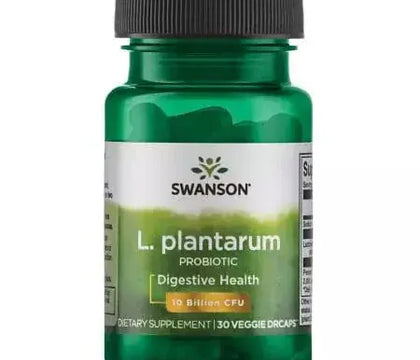
Price: £5.93 · Reviews: 132 · Stock: In stock · Dietary claim: Suitable for vegans · Where to buy: Available from Welzo
Why it's the best: It is one of very few probiotics here whose listing makes the full vegan claim rather than settling for "vegetarian" — and it does so at under six pounds a month. The capsules are 100% vegetarian, and the product is described as free from artificial additives, allergens and preservatives.
On the probiotic side it delivers 10 billion CFU of L. plantarum in a DRcaps delayed-release shell, which helps it through the stomach — see do probiotics survive stomach acid. At roughly 20p a day it is easily the cheapest way to trial a vegan probiotic properly, and it is reliably in stock.
Two honest caveats. The label names the species, not the strain, so no specific clinical evidence attaches to it — the point we make in our L. plantarum guide. And the 10 billion CFU is guaranteed at manufacture rather than to shelf life, which is a softer promise. At this price both are fair trades.
| Pros | Cons |
|---|---|
| States "suitable for vegans", not just vegetarian Cheapest option here (~20p/day) 10 billion CFU, delayed-release capsule Free from artificial additives and allergens Reliably in stock Well reviewed (132) |
Species named, not strain CFU guaranteed at manufacture, not shelf life Only 30 capsules Single species |
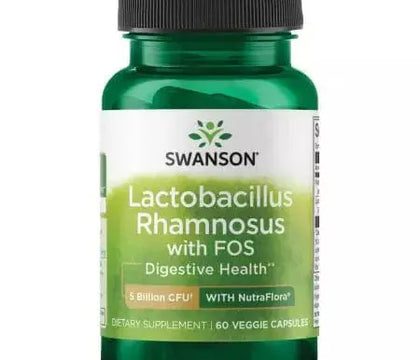
Price: £11.22 · Reviews: 158 · Stock: In stock · Dietary claim: Vegetarian capsule · Where to buy: Available from Welzo
Why we like it: The best cost per day of anything here — roughly 19p — for a two-month supply in a delayed-release vegetarian capsule, with added FOS as a prebiotic. It is also the most-reviewed product in this guide at 158, and reliably in stock.
Check the claim carefully. The listing describes a vegetarian capsule rather than making a full vegan claim, so on the framework above it addresses the shell but not the growth medium. If you are vegan for ethical reasons and want certainty, number one is the better fit. If dairy-free is your practical requirement, contact Swanson to confirm before buying. The label also names the species rather than the strain.
| Pros | Cons |
|---|---|
| Lowest cost per day (~19p) 60 capsules — two-month supply Delayed-release vegetarian capsule Includes FOS prebiotic Most reviewed here (158) In stock |
"Vegetarian" only — no full vegan claim Growth medium not stated Species named, not strain FOS may not suit sensitive guts |
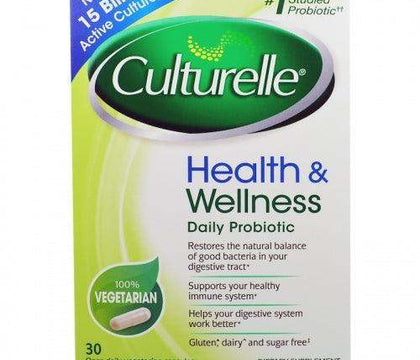
Price: £47.09 · Reviews: 86 · Stock: Intermittent — check listing · Dietary claim: Vegetarian; free from gluten, dairy, soy and wheat · Where to buy: Available from Welzo
Why we like it: The probiotic itself is the strongest here by a distance. Lactobacillus rhamnosus GG is the most heavily researched probiotic strain in existence, with several hundred human trials behind it and a place in clinical guidance for preventing antibiotic-associated diarrhoea — see our LGG guide. Each capsule supplies 10 billion CFU with inulin, and potency is guaranteed to expiry rather than manufacture.
Importantly for this article, the listing states dairy-free alongside vegetarian — which addresses the allergen question directly, even though it stops short of a full vegan claim.
The price is steep. At £47.09 for 30 capsules — around £1.57 a day — it costs roughly eight times the Swanson capsule. You are paying for the strain and its research record. Stock is also intermittent.
| Pros | Cons |
|---|---|
| Most researched probiotic strain available States dairy-free explicitly 10 billion CFU guaranteed to expiry Also free from gluten, soy and wheat No refrigeration needed |
Most expensive per day (~£1.57) "Vegetarian" rather than a full vegan claim Stock is intermittent Contains inulin — may not suit IBS |
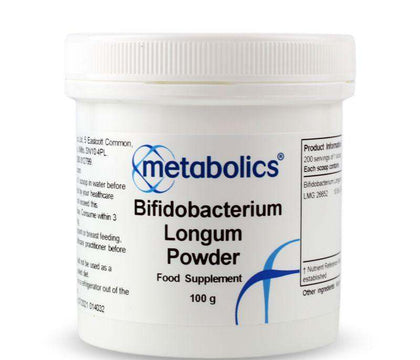
Price: £48.55 · Reviews: 98 · Stock: In stock · Dietary claim: Powder — no capsule shell · Where to buy: Available from Welzo
Why we like it: A powder removes the capsule question altogether — there is no shell to check for gelatin. It is also the only Bifidobacterium option here at a sensible price, which matters because most vegan probiotic ranges lean heavily on Lactobacillus, and bifidobacteria are among the most abundant organisms in a healthy colon. See our B. longum guide.
At £48.55 for 100g it works out at 49p a gram — roughly a quarter of the per-gram price of the Custom Probiotics powder at number six — and it comes in the largest pack here. Powder format also lets you start at a fraction of a serving, which helps if you react to probiotics. See probiotic powders.
The gap in the label. No capsule means one question answered, but the listing makes no dairy-free or vegan statement and does not declare a strain code or CFU. If dairy avoidance is medical rather than ethical, contact Metabolics before buying.
| Pros | Cons |
|---|---|
| No capsule shell to check at all Best value powder here (49p/g) Largest pack at 100g Covers Bifidobacteria, not just Lactobacillus Full dose titration possible UK manufacturer · In stock |
No vegan or dairy-free claim on the listing No strain code declared CFU per gram not stated Needs a scoop and ideally scales |
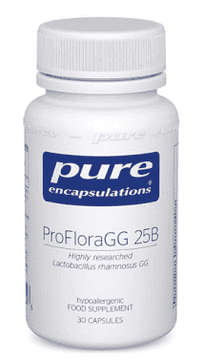
Price: £20.47 · Reviews: 138 · Stock: Currently sold out — check listing · Dietary claim: Vegetarian, gluten-free, dairy-free; HPMC capsule · Where to buy: Available from Welzo
Why we like it: The shortest ingredient list of any capsule here — the named L. rhamnosus GG strain at 25 billion CFU, microcrystalline cellulose as a hypoallergenic carrier, and an HPMC (plant-derived) capsule. Nothing else. The listing states dairy-free and gluten-free explicitly.
For anyone who reacts to excipients, that combination of a named researched strain and a near-empty formulation is difficult to beat, and at £20.47 it is far better value per capsule than Culturelle for the same organism.
Availability is the problem. It goes out of stock frequently. Like Culturelle it is described as vegetarian rather than vegan, so the growth medium isn't addressed — though the explicit dairy-free statement covers the allergen question.
| Pros | Cons |
|---|---|
| Plant-derived HPMC capsule States dairy-free and gluten-free Names the GG strain at 25 billion CFU Only three ingredients Far better value than Culturelle for the same strain Well reviewed (138) |
Currently sold out "Vegetarian" rather than a full vegan claim Only 30 capsules Growth medium not stated |
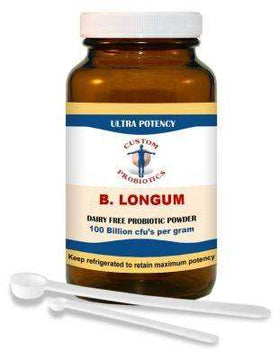
Price: £103.25 · Reviews: 80 · Stock: Currently sold out — check listing · Dietary claim: Dairy-free, sugar-free, gluten-free, non-GMO; no capsule · Where to buy: Available from Welzo
Why we like it: It answers both questions at once — no capsule shell, and an explicit dairy-free declaration alongside sugar-free, gluten-free and non-GMO. It also names its strain, BL-05, and states a potency of 100 billion CFU per gram, which almost no powder does. If you are vegan and also managing multiple sensitivities, this is the most comprehensively specified product here.
The price is the obstacle. At £103.25 for 50g — about £2.07 a gram — it costs roughly four times per gram what the Metabolics powder does for the same species. The difference buys the named strain, the declared CFU and the free-from statements. Whether that is worth four times the money depends entirely on how strict your requirements are. It is also currently sold out.
| Pros | Cons |
|---|---|
| Explicit dairy-free, sugar-free, gluten-free, non-GMO No capsule shell Names its strain (BL-05) States CFU (100 billion per gram) Covers Bifidobacteria |
Currently sold out ~£2.07 per gram 4x the per-gram price of the Metabolics powder BL-05 has a limited published record |
Follow the label for the specific product — a 10 billion CFU capsule and a 100 billion CFU per gram powder are not interchangeable. Most capsules here are once daily.
Timing: consistency matters more than precision. With or just before food is fine for capsules; powders are best on an empty stomach with water, as they have no acid protection. See when to take probiotics.
Give it four weeks before judging — see how long probiotics take to work. Most of these are shelf stable and travel well: shelf-stable probiotics.
Food sources. A vegan diet already lends itself to fermented foods — sauerkraut, kimchi, miso, tempeh and water kefir all supply live organisms, though in variable and unquantified amounts. A good habit alongside a supplement rather than a replacement. See fermented foods.
Probiotics are well tolerated by most people. Mild bloating, wind or altered stools in the first week or two are common and usually settle — see probiotic side effects.
Speak to a doctor before taking a probiotic if you
Products containing plant sterols are unsuitable for children and in pregnancy or breastfeeding without medical advice. Further detail in probiotics safety.
One further point for vegan readers: if you follow a plant-based diet, vitamin B12 is the nutrient that genuinely requires supplementation, and no probiotic replaces it. Colonic bacteria do produce B12, but it is not absorbed there. Discuss B12 with your GP if you are not already supplementing.
On labelling: probiotics carry no authorised health claim in GB or the EU, so they are sold as food supplements and cannot legally be marketed as treating any condition.
See your GP — or seek urgent care — if you have:
Read more on when to see a GP about stomach symptoms and bowel cancer screening in the UK.
Swanson L. plantarum Probiotic at £5.93 — it is one of the few whose listing states "suitable for vegans" rather than merely vegetarian, and it costs about 20p a day. BioCare BioPlantarum Plus Sterols at £31.01 also states vegan-friendly and names its strain, if you want the cholesterol support that comes with it.
Not automatically. Two things can make them non-vegan: a gelatin capsule shell, and a dairy-based fermentation medium. Many are fine on both counts, but you have to check rather than assume.
No, and this is the most common mistake. "Vegetarian capsule" usually refers only to the shell being plant-based rather than gelatin. It says nothing about whether the bacteria were grown on a dairy medium.
Many traditionally are, because lactic acid bacteria grow well on milk-based media, and residual traces can remain. If it matters to you, buy something with an explicit vegan or dairy-free claim.
Usually yes — residual quantities are typically far too small to cause symptoms. A diagnosed milk protein allergy is a different matter and warrants checking the allergen declaration carefully.
They remove the capsule question entirely, which helps, and both powders here state or imply no animal-derived shell. They cost more per serving, so they suit people who also have allergies or want dose control.
Custom Probiotics B. Longum Powder — dairy-free, sugar-free, gluten-free, non-GMO, with no capsule and a declared strain and CFU. It is expensive and currently sold out, so Pure Encapsulations ProFloraGG is the capsule alternative when back in stock.
No. A varied plant-based diet is typically high in fibre and fermented foods, which supports the microbiome well. The nutrient vegans genuinely need to supplement is vitamin B12, and no probiotic substitutes for it.
Sauerkraut, kimchi, miso, tempeh and water kefir all contain live organisms, but in variable amounts with no named strains. Excellent as a dietary habit; not equivalent to a targeted supplement.
Contact the manufacturer and ask specifically about both the capsule material and the fermentation medium. Reputable brands answer this readily, and one that won't tells you something too.
Medical disclaimer: This article is for general information and education only and does not constitute medical advice, diagnosis or treatment. Food supplements are not a substitute for a varied and balanced diet, and are not intended to diagnose, treat, cure or prevent any disease. Dietary suitability claims are reported exactly as stated on product listings at the time of writing and have not been upgraded or inferred; always check the current pack, and contact the manufacturer directly if you have a diagnosed food allergy. Probiotics should be discussed with a doctor before use if you are immunocompromised, critically unwell, have an indwelling venous line, have inflammatory bowel disease, or are pregnant or breastfeeding. Plant sterol products are unsuitable for children and in pregnancy without medical advice. People following a plant-based diet should discuss vitamin B12 with their GP. Prices, review counts and availability are correct at the time of writing and may change.
About the author
Dr Zeeshan Afzal (MBBS) is a practising medical doctor and Welzo's Medical Content Lead. He writes and reviews Welzo's health content to ensure it is accurate, evidence-based and aligned with current UK clinical guidance, translating complex research into practical advice patients can trust.
 Beoordeeld uitstekend door 28,951+ beoordelingen
 100% geld -terug -garantie
Onze geld -terug -garantie zorgt ervoor dat u uw artikelen ontvangt of een volledige terugbetaling krijgt.


