





Best Slippery Elm Supplements UK


Related products
Written and medically reviewed by Dr Zeeshan Afzal (MBBS) — Medical Doctor & Medical Content Lead, Welzo
Part of our digestive health guides · Shop gut health supplements
Evidence-based · Honest about what's proven and what isn't · UK-focused
Last updated: July 2026 · Reading time: ~14 minutes
Slippery elm is the inner bark of Ulmus rubra. Unlike most of the probiotics aisle, it isn't absorbed and doesn't alter your microbiome — it forms a gel that physically coats irritated tissue, like a throat lozenge applied further down.
We'll be straight with you from the start: slippery elm has the weakest evidence base of any popular gut supplement. A standard herbal reference concludes plainly that scientific research on its medicinal properties is lacking. That doesn't mean it's useless — but it does change how you should buy it and what to expect.
It also means the form matters more than the brand. We've ranked every slippery elm product currently stocked at Welzo, and explained why one format makes far more mechanistic sense than the other.

Table of contents
- What is slippery elm?
- Powder vs capsules — why it matters
- What the evidence actually shows
- How we chose
- Our top picks
- Cost per gram compared
- 1. NOW Foods Slippery Elm Powder — Best Overall
- 2. Swanson Slippery Elm Bark — Best Budget
- 3. NOW Foods Slippery Elm 400mg — Best Value Capsule
- 4. Nature's Way Slippery Elm Bark — Best Vegan Capsule
- 5. BioCare Slippery Elm Complex — Best Combination
- 6. BioCare Slippery Elm Intensive — Best Comprehensive Powder
- Dosage and how to take it
- Side effects and who should avoid it
- When to see a doctor
- Frequently asked questions
What is slippery elm?
Slippery elm is the dried inner bark of Ulmus rubra, also called red elm. It earns its name honestly — the bark turns genuinely slippery when chewed or mixed with water. It was a staple of Native American medicine and was used by soldiers during the American Revolution as a wound salve.
Mucilage — the active ingredient
The bark is mostly dietary fibre: cellulose, lignin, gums and, crucially, mucilage. This is a highly branched long-chain polysaccharide made of D-galactose, L-rhamnose and D-galacturonic acid, and its chemistry was characterised as far back as 1946.
On contact with water the mucilage swells into a viscous gel. That gel adheres to the mucosal surfaces of the mouth, throat, oesophagus and stomach, forming a temporary physical barrier. It also stimulates mucus and saliva production. That is the entire mechanism — there is no systemic absorption and no metabolic activity. Slippery elm is a demulcent: a substance that soothes by coating.
This makes it fundamentally different from most gut supplements. It isn't repairing tissue biochemically the way zinc carnosine does, and it isn't altering bacteria. It's a barrier, and it lasts as long as it's in contact with the tissue.
Powder vs capsules — why it matters
This is the single most useful thing to understand before buying, and almost no guide mentions it.
Traditional use was always as a gruel or drink — powder stirred into warm water and sipped. That isn't nostalgia; it's mechanistically sensible. Mixing the powder first means you swallow an already-formed gel that coats on the way down.
When capsules do make sense: if your target is the stomach or lower gut rather than the throat, capsules are a reasonable convenience trade-off, and considerably more palatable — slippery elm drink has a texture many people dislike. But for anything involving reflux or the throat, powder is the form that matches how the compound actually works. See our comparison of acid reflux supplements.
What the evidence actually shows
Sore throat — the one regulatory recognition
Slippery elm inner bark is recognised in the US FDA's over-the-counter monograph as a safe demulcent for throat irritation. In the UK, slippery elm indigestion products have held Traditional Herbal Registration (THR) with the MHRA — a registration based on traditional use, not on clinical trial evidence. That distinction matters and is worth understanding when you see "registered" on a pack.
IBS — small pilot data only
The most-cited human study is a 2010 pilot by Hawrelak and Myers, which tested two multi-herb formulas in patients meeting Rome II criteria for IBS. The constipation-predominant formula was associated with reductions in bloating, abdominal pain and overall symptom severity.
Two important caveats. It was an open-label pilot with a small sample and no placebo control, and — critically — slippery elm was one ingredient among several, so the effect cannot be attributed to it specifically. If IBS is your concern, compare against options with stronger data in our IBS supplements guide and peppermint oil for IBS.
Inflammatory bowel disease — laboratory only
An in vitro study incubated mucosal biopsies from patients with active ulcerative colitis with slippery elm and found a dose-dependent reduction in oxygen free radicals. That is a test-tube finding on tissue samples, not evidence that taking slippery elm helps people with colitis.
The honest summary
A standard pharmacy herbal monograph states directly that scientific research on the medicinal properties of slippery elm is lacking. There are essentially no placebo-controlled trials of slippery elm alone for any gut condition. What exists is: a well-characterised physical mechanism, centuries of traditional use, one regulatory recognition for sore throat, and a handful of small multi-herb pilot studies.
That's a reasonable basis for trying an inexpensive, low-risk demulcent for symptomatic comfort. It is not a basis for expecting it to heal a gut lining — read is leaky gut real for context on that claim.
| Use | Evidence | Basis |
|---|---|---|
| Sore throat / throat irritation | Recognised | FDA OTC demulcent monograph |
| Indigestion / heartburn comfort | Traditional | UK Traditional Herbal Registration |
| IBS symptoms | Preliminary | One small open-label multi-herb pilot |
| Ulcerative colitis | Preclinical | In vitro biopsy study only |
| Gut lining repair / "leaky gut" | Not supported | No human trial evidence |
How we chose
- Format first — powder scores higher for upper-GI symptoms because of how the mucilage works.
- Cost per gram of slippery elm, not price per pot. Capsule strengths vary widely.
- Single ingredient vs complex — both are valid, but you should know which you're buying.
- Label clarity — particularly whether a stated milligram figure is per capsule or per serving.
- Manufacturing standards — GMP, non-GMO, vegan suitability.
Every product below is available to buy now.
Our top picks
Best Overall: NOW Foods Slippery Elm Powder, 113g — £14.23
Best Budget: Swanson Slippery Elm Bark 400mg, 60 Capsules — £5.06
Best Value Capsule: NOW Foods Slippery Elm 400mg, 100 vcaps — £10.48
Best Vegan Capsule: Nature's Way Slippery Elm Bark, 100 Vegan Capsules — £13.49
Best Combination Formula: BioCare Slippery Elm Complex, 90 Capsules — £18.31
Best Comprehensive Powder: BioCare Slippery Elm Intensive, 90g — £37.75
Cost per gram compared
Slippery elm is sold by capsule count and by weight, which makes shelf prices hard to compare. Normalising to cost per gram of bark shows a nearly four-fold spread.
| Product | Price | Total slippery elm | Cost per gram |
|---|---|---|---|
| NOW Foods Powder | £14.23 | 113g | £0.13 |
| Swanson 400mg caps | £5.06 | 24g (60 × 400mg) | £0.21 |
| NOW Foods 400mg caps | £10.48 | 40g (100 × 400mg) | £0.26 |
| Nature's Way caps | £13.49 | 40g (100 × 400mg) | £0.34 |
| BioCare Intensive | £37.75 | 90g (blend) | £0.42 (blend) |
Prices correct at time of writing. BioCare products are multi-ingredient blends, so their per-gram figure is not directly comparable to single-ingredient bark. BioCare Slippery Elm Complex is excluded as the per-capsule bark content is not stated on the collection listing — check the product page.
1. NOW Foods Slippery Elm Powder, 113g — Best Overall
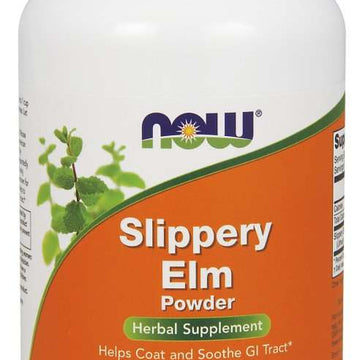
Price: £14.23 (reduced from £16.89) · Reviews: 84 · Where to buy: Available from Welzo
Pure slippery elm inner bark powder, single ingredient, no additives. Vegan, non-GMO verified and Kosher, made in a GMP-compliant facility by a family-owned brand operating since 1968.
Why it's the best: Two reasons, and the first is the important one. This is the format that matches the mechanism. Mixed into water it forms the gel before you swallow it, coating the throat and oesophagus on the way down — which capsules simply cannot do. For the symptoms most people actually buy slippery elm for, that isn't a minor preference, it's the difference between using it correctly and not.
Second, it's comfortably the cheapest source of slippery elm here at £0.13 per gram — roughly half the price of the capsule options and a third of the priciest. A single ingredient with nothing else in the tub also means you can dose it exactly as you like.
The honest downside is the texture. Slippery elm drink is thick and slightly slimy, and some people never get on with it. If that's likely to stop you taking it, a capsule you'll actually use beats a powder you won't.
| Pros | Cons |
|---|---|
| Format matches the mechanism — coats throat and oesophagus Cheapest per gram here (£0.13) Single ingredient, no additives Vegan, non-GMO, Kosher, GMP |
Thick, slimy texture some dislike Needs mixing — less convenient Not practical for travel No standardised mucilage content |
2. Swanson Slippery Elm Bark 400mg, 60 Capsules — Best Budget
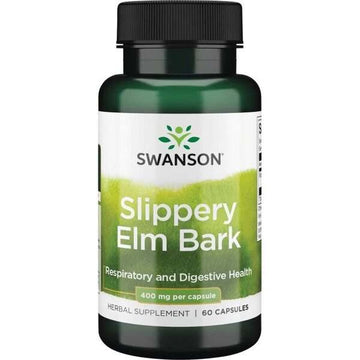
Price: £5.06 (reduced from £6.62) · Reviews: 84 · Where to buy: Available from Welzo
Why we like it: At just over five pounds this is the cheapest way to find out whether slippery elm does anything for you, and given the modest evidence base, spending little to test it is a rational approach. 400mg per capsule is a clearly stated, standard strength, and Swanson is a long-established manufacturer.
It's also the second-cheapest per gram at £0.21. If you want the convenience of capsules and your symptoms are stomach-level rather than throat-level, this is the sensible starting point — try it for a month before spending more.
| Pros | Cons |
|---|---|
| Cheapest entry point by far (£5.06) Clear 400mg per capsule Second-best cost per gram (£0.21) Low-risk way to trial it |
Capsule format bypasses throat and oesophagus Only 60 capsules Little use for reflux symptoms |
3. NOW Foods Slippery Elm 400mg, 100 vcaps — Best Value Capsule
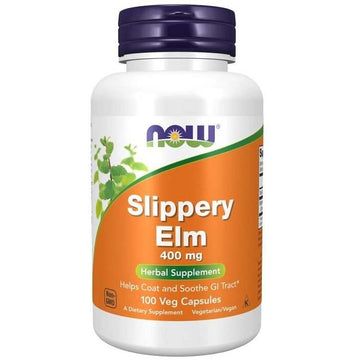
Price: £10.48 (reduced from £10.83) · Reviews: 82 · Where to buy: Available from Welzo
Why we like it: The same NOW Foods quality standards as our overall pick, in vegetarian capsules, with a 100-count bottle that lasts noticeably longer than the 60-capsule alternatives. At £0.26 per gram it sits mid-table on value while offering the largest capsule supply from a single-ingredient product.
Worth noting for anyone comparing: NOW sells both the powder and these capsules, and the powder is half the price per gram. If format isn't a barrier for you, the powder is the better buy from the same manufacturer.
| Pros | Cons |
|---|---|
| 100 vegetarian capsules — longest capsule supply Single ingredient, no fillers GMP, non-GMO verified Clear 400mg per capsule |
Twice the per-gram cost of NOW's own powder Capsule format bypasses upper GI tract No standardised mucilage content |
4. Nature's Way Slippery Elm Bark, 100 Vegan Capsules — Best Vegan Capsule
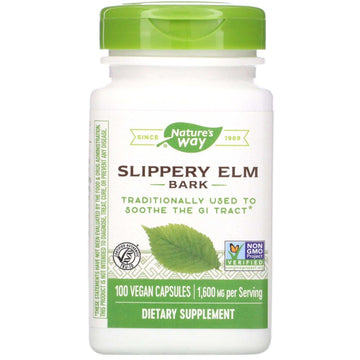
Price: £13.49 · Reviews: 116 · Where to buy: Available from Welzo
Why we like it: The most reviewed slippery elm product Welzo stocks, from a well-known heritage brand, in fully vegan capsules and Non-GMO Project Verified.
Read the label carefully. This is marketed as "1600mg", but that figure is the serving size — four capsules — not the strength of a single capsule. Each capsule contains 400mg, the same as the NOW and Swanson products. It's a common source of confusion across the category, and it's why this works out as the most expensive capsule option per gram at £0.34. The manufacturer's suggested use of four capsules three times daily is also a substantial twelve capsules a day.
| Pros | Cons |
|---|---|
| Most reviewed here (116) Fully vegan capsules Non-GMO Project Verified Established heritage brand |
"1600mg" is per 4-capsule serving, not per capsule Most expensive capsule per gram (£0.34) Suggested use is up to 12 capsules daily |
5. BioCare Slippery Elm Complex, 90 Capsules — Best Combination Formula
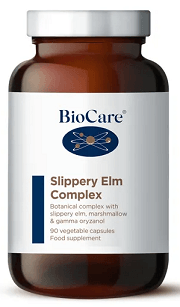
Price: £18.31 · Reviews: 88 · Where to buy: Available from Welzo
Why we like it: BioCare pairs slippery elm with marshmallow root (Althaea officinalis) — another traditional demulcent with the same mucilage-forming property — plus gamma oryzanol from rice bran. Stacking two demulcents is a coherent idea if soothing is the goal, and BioCare is a respected UK manufacturer with vegan-friendly formulation.
The trade-off is transparency: with a blend you can't easily tell how much slippery elm you're getting per capsule, which makes cost-per-gram comparison impossible. If you want to know exactly what you're taking, a single-ingredient product is clearer. Check the current label for suitability details before buying, particularly if you are pregnant or breastfeeding — see the safety section below.
| Pros | Cons |
|---|---|
| Two demulcents combined — coherent formulation Respected UK manufacturer Vegan and vegetarian friendly 90 capsules |
Slippery elm content per capsule not stated Cannot compare on cost per gram More expensive than single-ingredient options |
6. BioCare Slippery Elm Intensive, 90g — Best Comprehensive Powder
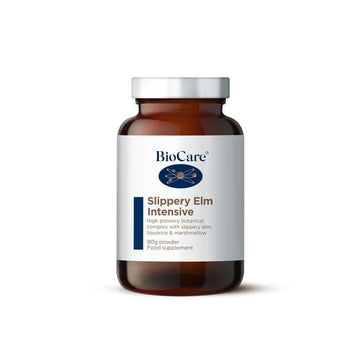
Price: £37.75 · Reviews: 72 · Where to buy: Available from Welzo
Why we like it: The most thought-through formula in the category. It combines slippery elm inner bark powder with deglycyrrhizinated liquorice (DGL), marshmallow, gamma oryzanol, zinc and sunflower lecithin — and it's a powder, so it retains the mechanistic advantage of pre-hydration. DGL in particular has its own traditional use in gastric comfort, and the added zinc is a sensible inclusion for mucosal support.
The price is the sticking point. At £37.75 for 90g it is nearly three times the cost of NOW's 113g of pure bark, and the additional ingredients — while reasonable — don't carry strong trial evidence either. Buy it if you specifically want the multi-ingredient demulcent approach in powder form; if you just want slippery elm, you're paying a large premium for the formulation.
| Pros | Cons |
|---|---|
| Powder format — keeps the demulcent advantage DGL, marshmallow and zinc included Most comprehensive formulation here Respected UK manufacturer |
Most expensive product here (£37.75) ~3× the cost of pure bark powder Added ingredients lack strong trial evidence Slippery elm content per serving not stated |
Dosage and how to take it
There is no established clinical dose, because there are no dose-ranging trials. Traditional and manufacturer guidance converges on roughly the following:
| Format | Typical use | Timing |
|---|---|---|
| Powder | 1–2 teaspoons stirred into warm water | Before meals, or as symptoms occur |
| Capsules | 400–1600mg, up to three times daily | With a full glass of water, with meals |
Mix powder immediately before drinking — leave it standing and it thickens considerably. Always take it with plenty of water; like any bulk-forming fibre, taking it with too little fluid can worsen rather than help symptoms. Because it works by physical contact rather than absorption, effects are felt fairly quickly and don't build up over weeks the way a probiotic might.
Side effects and who should avoid it
Slippery elm is generally well tolerated and there is no evidence it causes liver problems. Side effects are uncommon and usually limited to mild bloating, wind or nausea — largely a fibre effect.
The interaction everyone should know about
Slippery elm's mucilage coats the gut — and that includes coating anything else in there. It may reduce absorption of oral medicines taken at the same time. Standard herbal guidance is to take other medication at least one hour before, or several hours after, slippery elm.
This matters most for medicines where dose precision counts: thyroid hormone, anticoagulants, anticonvulsants, oral contraceptives and diabetes medication. If you take any regular prescription, speak to your pharmacist about spacing before you start.
Who should avoid it. Standard herbal reference guidance advises against slippery elm in pregnancy and breastfeeding, in children and adolescents under 18, and in people with liver disease, gallstones or other biliary disorders — in each case because safety data is lacking rather than because harm has been shown. Some UK products state they are suitable in pregnancy; given the absence of good safety data either way, we'd suggest checking with your midwife or GP rather than relying on packaging.
On labelling: slippery elm food supplements make no authorised health claims in the UK. Products holding a Traditional Herbal Registration are registered on the basis of long-standing traditional use, not clinical trial evidence — a distinction worth understanding.
When to see a doctor
Slippery elm soothes symptoms; it doesn't diagnose or treat their cause. Using a demulcent to manage persistent reflux or abdominal pain can delay finding out what's actually going on.
See your GP — or seek urgent care — if you have:
- Difficulty or pain when swallowing, or a sensation of food sticking
- Blood in your stool, or black tarry stools
- Vomiting blood, or vomit resembling coffee grounds — seek urgent care
- Unexplained weight loss
- Persistent indigestion or reflux, especially if you are over 55
- A change in bowel habit lasting three weeks or more
Persistent reflux needs assessment rather than ongoing self-management. Read more on when to see a GP about stomach symptoms and gastritis.
Frequently asked questions
What is the best slippery elm supplement in the UK?
NOW Foods Slippery Elm Powder at £14.23 is the strongest overall choice. Powder is the format that matches how slippery elm actually works — the mucilage hydrates before you swallow it, coating the throat and oesophagus — and at £0.13 per gram it's also the cheapest source here. If you prefer capsules, Swanson at £5.06 is the best-value way to try it.
Is slippery elm powder better than capsules?
For upper-GI symptoms, yes. Slippery elm works by forming a gel that physically coats tissue, and a capsule doesn't hydrate until it reaches the stomach — so it bypasses the throat and oesophagus entirely. For stomach or lower-gut symptoms, capsules are a reasonable convenience trade-off.
Does slippery elm actually work?
Its mechanism is real and well characterised — the mucilage genuinely forms a coating gel. But formal evidence is limited. It's recognised by the FDA as a sore-throat demulcent, and UK products hold Traditional Herbal Registration based on traditional use rather than trials. For IBS there is one small open-label pilot of a multi-herb formula. There are essentially no placebo-controlled trials of slippery elm alone.
Can slippery elm help acid reflux?
It may provide symptomatic comfort by coating the oesophagus, and this is one of its traditional uses. Use the powder rather than capsules for this, since capsules bypass the oesophagus. It is not a treatment for the underlying cause, and persistent reflux should be assessed by a GP.
Does slippery elm interfere with medication?
It can. The mucilage may reduce absorption of oral medicines taken at the same time. Take other medication at least one hour before, or several hours after, slippery elm — and check with your pharmacist if you take anything where dose precision matters.
How much slippery elm should I take?
There is no established clinical dose. Typical use is one to two teaspoons of powder in warm water, or 400–1600mg in capsules up to three times daily. Always take it with plenty of fluid.
Can I take slippery elm during pregnancy?
Standard herbal guidance advises against it in pregnancy and breastfeeding because safety data is lacking. Some UK products state otherwise on their labels. Given the uncertainty, check with your midwife or GP before using it.
Is slippery elm safe for children?
Standard herbal reference guidance does not recommend it for children and adolescents under 18, again due to insufficient safety data rather than evidence of harm. Speak to a pharmacist or GP first.
Can I take slippery elm with probiotics?
Yes — they work through unrelated mechanisms and there's no known interaction. Slippery elm coats the gut lining, probiotics introduce live organisms. Browse the best probiotics UK guide for options.
What's the difference between slippery elm and marshmallow root?
Both are traditional demulcents that form mucilage gels, and they're often combined for that reason. Marshmallow root (Althaea officinalis) works on the same principle, so pairing them is a coherent approach rather than duplication — though neither has strong clinical trial evidence.
Medical disclaimer: This article is for general information and education only and does not constitute medical advice, diagnosis or treatment. Food supplements are not a substitute for a varied and balanced diet or a healthy lifestyle, and are not intended to diagnose, treat, cure or prevent any disease. Slippery elm may reduce the absorption of oral medicines taken at the same time — speak to your pharmacist about spacing. Product specifications, prices and availability are correct at the time of writing and may change. Always seek advice from your GP, pharmacist or another suitably qualified clinician before starting a new supplement, particularly if you are pregnant, breastfeeding, taking prescription medication or have an existing health condition.
About the author
Dr Zeeshan Afzal (MBBS) is a practising medical doctor and Welzo's Medical Content Lead. He writes and reviews Welzo's health content to ensure it is accurate, evidence-based and aligned with current UK clinical guidance, translating complex research into practical advice patients can trust.
References
- Hawrelak JA, Myers SP. Effects of two natural medicine formulations on irritable bowel syndrome symptoms: a pilot study. J Altern Complement Med. 2010;16(10):1065–1071. Link
- Langmead L, Dawson C, Hawkins C, et al. Antioxidant effects of herbal therapies used by patients with inflammatory bowel disease: an in vitro study. Aliment Pharmacol Ther. 2002;16(2):197–205. Link
- Slippery Elm. In: Phytopharmacy: An Evidence-Based Guide to Herbal Medicinal Products. Wiley. Link
- Slippery Elm. LiverTox: Clinical and Research Information on Drug-Induced Liver Injury. NCBI Bookshelf. Link
- Slippery Elm. Memorial Sloan Kettering Cancer Center — About Herbs. Link
- NHS — Heartburn and acid reflux. Link


 Оценено отлично от 28,951+ отзива
 100% гаранция за връщане на парите