

Live vs Pasteurised Akkermansia: Does It Matter?
Posted on:
Aug 05, 2026
Authored by


Written and medically reviewed by Dr Zeeshan Afzal (MBBS) — Medical Doctor & Medical Content Lead, Welzo
Evidence-based · Honest about what's proven and what isn't · UK-focused
Last updated: July 2026 · Reading time: ~9 minutes
In the key human trial of Akkermansia muciniphila, the bacteria deliberately killed by heat outperformed the ones still alive. That's genuinely surprising — and it's led a lot of people to ask whether they've bought the wrong form.
The short version: it matters less than the label makes you think, and it's not the thing that should decide your purchase. Here's why, and what to judge instead.

Table of contents
Depommier and colleagues published the study in Nature Medicine in 2019. Around thirty overweight or obese, insulin-resistant volunteers completed three months on live A. muciniphila, pasteurised A. muciniphila, or placebo.
Its stated primary purpose was safety and tolerability, and on that it succeeded. The headline-grabbing results sat in the exploratory outcomes: the pasteurised group showed improvements in insulin sensitivity, along with reductions in insulinaemia and plasma total cholesterol, and modest reductions in weight and fat mass. The live group did not reach the same significance.
No percentage figures are quoted here deliberately. Numbers from this trial circulate widely online and are frequently misattributed, and we would rather describe the findings accurately than repeat a statistic we can't check against the source.
The leading explanation is that the useful part isn't the living cell — it's a structural protein on the bacterium's outer membrane that survives heat intact and interacts with receptors on the gut lining. If that's right, pasteurisation removes the organism's metabolism while leaving the part doing the signalling.
There's a second, more prosaic possibility. Akkermansia is a strict anaerobe that oxygen kills readily. A live preparation may contain far fewer viable organisms by the time you swallow it than the label suggests, while a pasteurised one is stable by design. Part of the apparent advantage may simply be that pasteurised reliably delivers what it claims.
Definitions matter here. The ISAPP consensus defines a probiotic as live microorganisms conferring a health benefit — so pasteurised Akkermansia fails at the first word.
It fits a different category precisely: ISAPP's 2021 statement defines a postbiotic as "a preparation of inanimate microorganisms and/or their components that confers a health benefit on the host". Heat-killed Akkermansia is arguably the best-known example. See probiotics vs prebiotics vs postbiotics.
Here's the part that gets lost in the online debate, and it's the practical crux.
The trial tested Akkermansia on its own. Live single organism against pasteurised single organism. That's a clean scientific comparison, and it tells you something real about the organism.
What it does not tell you is which product to buy — because most Akkermansia supplements aren't single-organism preparations. They're formulas containing several actives, and the live-versus-pasteurised distinction is one variable among many.
The one thing the finding should change: don't pay a premium for "live" on the assumption it's superior. On current evidence that assumption runs backwards, and live is the harder, costlier form to manufacture — so you may be paying more for the less-evidenced version.
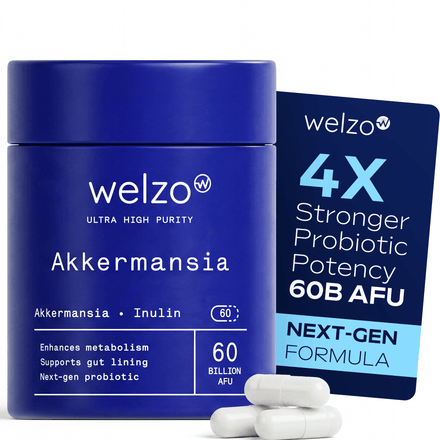
Judged on the criteria above rather than on the live/pasteurised question, this is what the formula contains per two-capsule serving:
| Ingredient | Amount | What it's there for |
|---|---|---|
| Akkermansia | 60 billion AFU | Mucus-layer organism |
| Lactobacillus acidophilus | 64 billion CFU | Lumen-dwelling organism — different niche |
| Berberine | 700 mg | Plant alkaloid — check interactions |
| Inulin | 200 mg | Prebiotic substrate (formulation-level) |
| Astaxanthin | 2.4 mg | Carotenoid antioxidant |
| Chromium | 10 µg | Trace mineral |
What's good about it. Every quantity is disclosed — no proprietary blend. The two organisms occupy genuinely different territory: Akkermansia lives in the mucus layer against the gut wall, L. acidophilus in the lumen, so they aren't competing for the same ground. See Akkermansia vs traditional probiotics. The 64 billion CFU of acidophilus is also a substantial figure in its own right. Capsules are vegetable cellulose (HPMC), so vegan-suitable.
Three honest caveats. The inulin is 200mg — milligrams, not grams — so treat it as helping the formulation rather than delivering a true prebiotic dose; prebiotic research uses gram quantities. The berberine at 700mg is a meaningful dose with a real interaction profile, covered in the safety section below. And the listing doesn't state whether the Akkermansia is live or pasteurised — almost no UK product does, but it's worth asking if it matters to you.
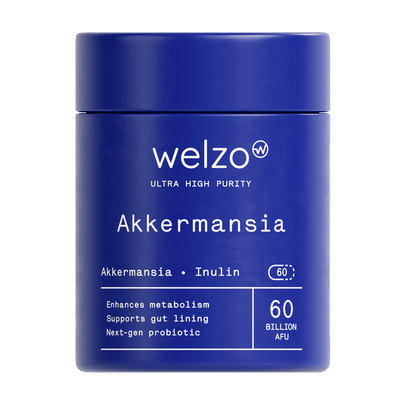
Welzo Ultra Purity Akkermansia |

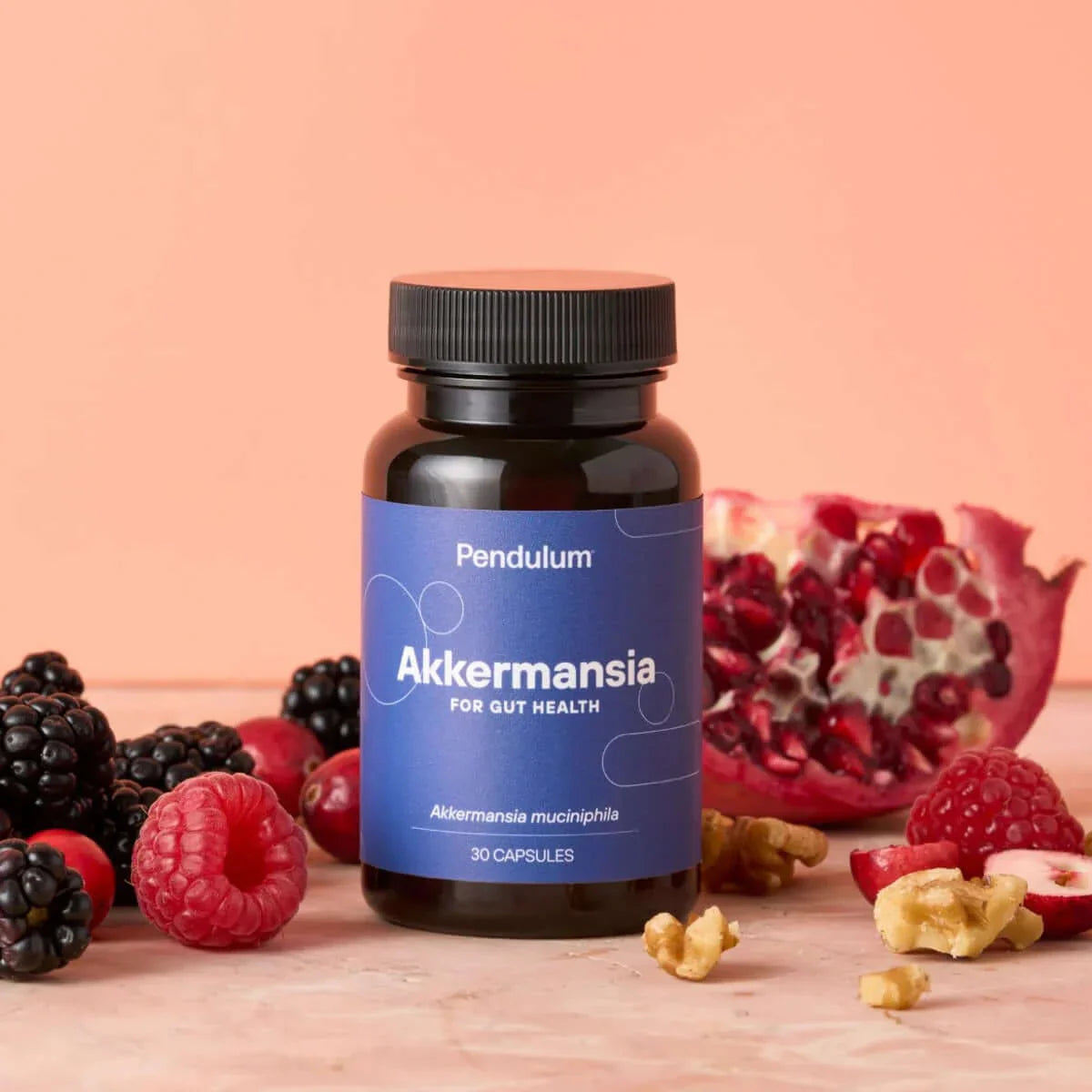
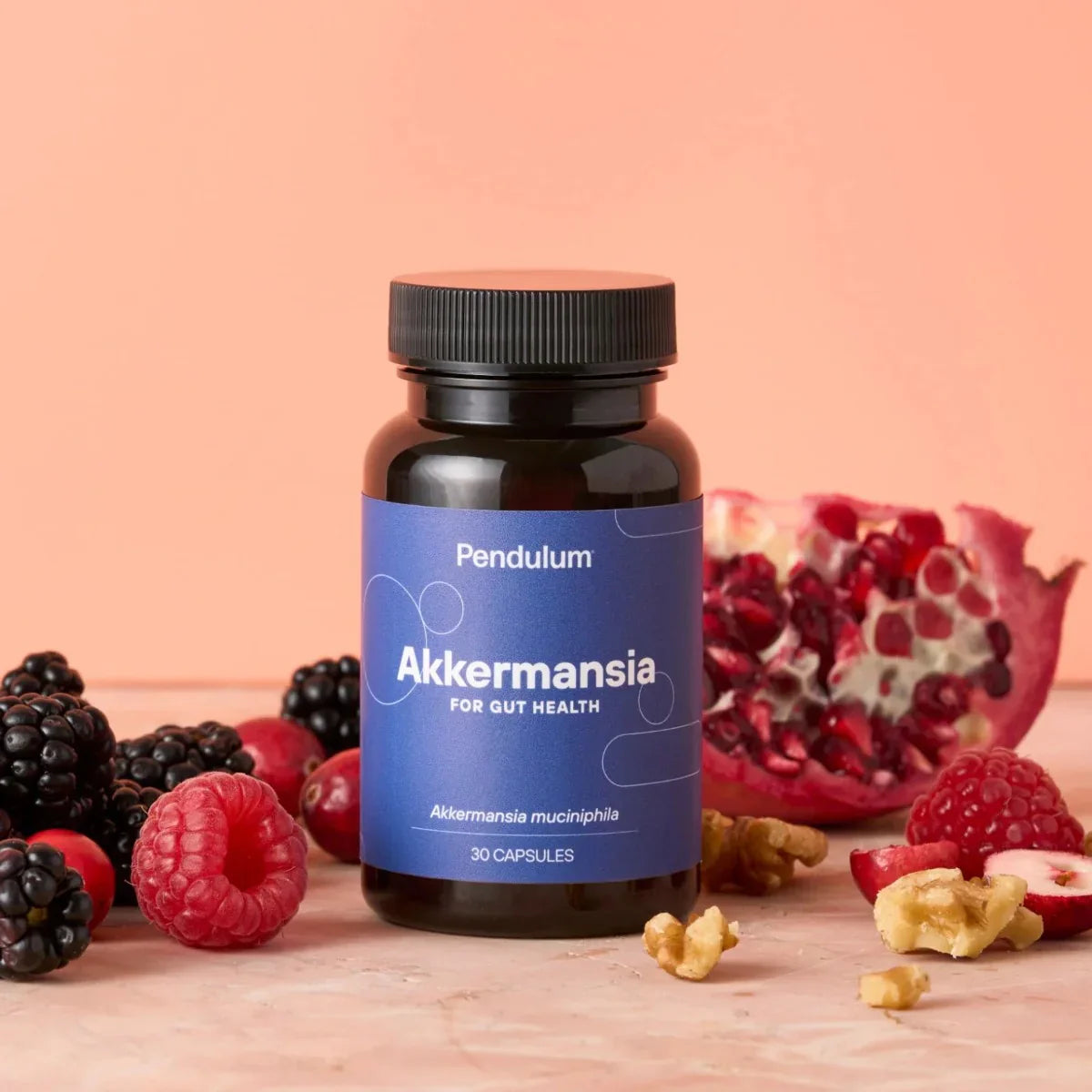
Pendulum Akkermansia |
These are two different propositions rather than better and worse versions of the same thing.
Choose the single-organism option if you want Akkermansia and nothing else — no berberine to check against your medication, no additional actives to account for. That simplicity is a genuine advantage if you take multiple prescriptions. It costs around £2.50 a day.
Choose the multi-component formula if you want two organisms covering different parts of the gut plus a substrate, in one capsule, at roughly a third of the price. The trade-off is that you're taking berberine as well, which needs checking.
Akkermansia was well tolerated in the trial described above, with mild bloating or altered stools the usual reports — see probiotic side effects.
Speak to a doctor before taking this if you
Berberine is the ingredient to check here, not the bacteria. If you take anything on prescription, ask a pharmacist before starting — they can check your full list in minutes. Never adjust prescribed medication on the basis of a supplement.
On labelling: Akkermansia products carry no authorised health claim in GB or the EU. They are sold as food supplements and cannot legally be marketed as treating any condition, including any metabolic one.
See your GP — or seek urgent care — if you have:
Insulin resistance, prediabetes and type 2 diabetes need medical management. A supplement is not a substitute for assessment or treatment. See when to see a GP.
In the key trial the pasteurised form showed metabolic improvements the live form didn't. But that's one small, short study in a specific population, with safety as its primary endpoint. It's a promising signal, not a settled verdict — and not enough on its own to choose between products.
The leading explanation is that the active component is a structural protein on the outer membrane which survives heat and interacts with the gut lining. If so, the living metabolism isn't the part that matters.
No — probiotics must be alive by definition. It's a postbiotic: a preparation of inanimate microorganisms conferring a health benefit, and probably the best-known example of that category.
The listing doesn't specify, which is standard across the UK market. If it matters to you, contact the manufacturer and ask directly before buying.
Not on the basis of one study. If you're taking it and tolerating it, there's no safety reason to stop. Just don't assume "live" means better, or pay extra expecting it does.
Akkermansia is a strict anaerobe that's difficult to culture on a plate, so colony counting is impractical. AFU counts cells by fluorescence instead. The units aren't directly comparable.
It's included as an additional active alongside the two organisms. It's also the ingredient with the most significant interaction profile in the formula, so check it against any prescription medication before starting.
No. Prebiotic research uses gram quantities, so 200mg is roughly a hundredth of a studied dose. Treat it as supporting the formulation rather than delivering a prebiotic effect — food is the realistic route to a genuine prebiotic intake.
The trial showed modest reductions in weight and fat mass in a small group of insulin-resistant volunteers over three months. That's preliminary, not an established weight-loss treatment, and no product should be bought on that basis.
Quite possibly. This is a young field resting on a small number of human studies, and conclusions may shift as larger trials report. Anyone claiming certainty either way is ahead of the evidence.
Medical disclaimer: This article is for general information and education only and does not constitute medical advice, diagnosis or treatment. Food supplements are not a substitute for a varied and balanced diet, and are not intended to diagnose, treat, cure or prevent any disease. Akkermansia is an emerging area of research with limited human data; findings described here come from a small, short, proof-of-concept study whose primary endpoint was safety and tolerability, and should not be read as established treatment effects. No percentage figures are quoted because they could not be verified against source publications at the time of writing. Products containing berberine interact with numerous medicines via CYP3A4 and P-glycoprotein, including diabetes medication, statins and anticoagulants, and berberine must be avoided in pregnancy and breastfeeding. Insulin resistance, prediabetes and diabetes require medical management — do not use a supplement in place of prescribed treatment, and do not alter medication without medical advice. Ingredient quantities, prices, review counts and availability are correct at the time of writing and may change; always check the current pack.
About the author
Dr Zeeshan Afzal (MBBS) is a practising medical doctor and Welzo's Medical Content Lead. He writes and reviews Welzo's health content to ensure it is accurate, evidence-based and aligned with current UK clinical guidance.
 Оценено отлично от 28,951+ отзива
 100% гаранция за връщане на парите
Нашата гаранция за връщане на парите гарантира, че получавате артикулите си или ще получите пълно възстановяване.