


Die besten Fisetin-Nahrungsergänzungsmittel


Související produkty
Überprüft von Dr. Muhammad Zeeshan Afzal (MBBS | FCPS | MRCP) – unabhängiger Produktgutachter und Autor von Inhalten für Welzo. Zuletzt aktualisiert am 3. Juli 2026.
Kurze Antwort: Das beste Fisetin-Präparat für die meisten Käufer in Großbritannien ist das „Welzo Ultra Purity Fisetin 500“. Es liefert eine hohe Dosis von 500 mg pro Portion – vielseitig einsetzbar für den täglichen Gebrauch und regelmäßige senolytische Protokolle –, wird von einer unabhängigen Stelle in einer GMP-Anlage geprüft und aus Großbritannien versandt. Es gehört zur breiteren „Welzo Ultra Purity“-Produktreihe und zur Kollektion der Langlebigkeitspräparate.
Fisetin hat sich innerhalb weniger Jahre von einem unbekannten Pflanzenfarbstoff zu einem der meistdiskutierten Moleküle in der Langlebigkeitsforschung entwickelt. Der Grund dafür ist eine einzige, bemerkenswerte Erkenntnis: In einer bahnbrechenden Studie aus dem Jahr 2018 erwies es sich unter zehn untersuchten Flavonoiden als das wirksamste Senolytikum – eine Verbindung, die alternde „seneszente“ Zellen beseitigt – und verlängerte sowohl die Gesundheitsspanne als auch die Lebensdauer bei Mäusen. Dieses Ergebnis löste eine Welle von Forschungsarbeiten, eine ganze Reihe von Nahrungsergänzungsmitteln und ein wachsendes Programm klinischer Studien am Menschen aus. Es löste zudem einen enormen Hype aus.
Dieser Leitfaden soll das Gegenteil von Hype sein. Wir bewerten sechs seriöse Fisetin-Nahrungsergänzungsmittel anhand der Kriterien, auf die es tatsächlich ankommt, und stellen anschließend die wohl umfassendste und in leicht verständlicher Sprache verfasste Informationsquelle zum Thema Fisetin bereit, die Sie finden können: die Biologie seneszenter Zellen, wie Fisetin mit den anerkannten „Kennzeichen des Alterns“ in Zusammenhang steht, was genau die bahnbrechende Studie gezeigt hat (und was nicht), die derzeit laufenden Studien am Menschen, wie Fisetin auf molekularer Ebene wirkt, die beiden sehr unterschiedlichen Dosierungsansätze mit den tatsächlichen Forschungszahlen, warum Fisetin so schwer resorbierbar ist und was man dagegen tun kann, wie es im Vergleich zu Quercetin und anderen Senolytika abschneidet, wer es einnehmen sollte und wer nicht, sowie die Sicherheitslage. Wenn Sie sich mit diesem Themenbereich noch nicht auskennen, ist unser Überblick über die besten Nahrungsergänzungsmittel für ein langes Leben ein nützlicher Begleiter, ebenso wie unsere Erklärung dazu, wie der Alterungsprozess funktioniert.
Inhaltsverzeichnis
- Vergleichstabelle
- Bestes Fisetin-Nahrungsergänzungsmittel nach Kategorie
- Wie wir bewertet haben
- Die 6 besten Fisetin-Nahrungsergänzungsmittel im Test
- Was ist Fisetin? Quellen & chemische Zusammensetzung
- Fisetin und die Kennzeichen des Alterns
- Seneszente Zellen, SASP und „Inflammaging“
- Die bahnbrechende Senolytika-Studie im Detail
- Klinische Studien mit Fisetin am Menschen (2026)
- Wie Fisetin wirkt: Wirkmechanismen
- Fisetin in den verschiedenen Körpersystemen
- Vorteile nach Körperbereich
- Was die wissenschaftlichen Erkenntnisse belegen – und was nicht
- Dosierung: tägliche Einnahme vs. senolytische Pulstherapie
- Bioverfügbarkeit, Stoffwechsel und Resorption
- Fisetin im Vergleich zu Quercetin und anderen Senolytika
- Wie Fisetin in eine Langlebigkeitsroutine passt
- Wer sollte es einnehmen (und wer nicht)
- So treffen Sie die richtige Wahl
- Sicherheit und Wechselwirkungen
- Häufige Fehler & Mythen vs. Fakten
- Einnahme: Praktische Anleitung
- Glossar
- Weiterführende Literatur
- Häufig gestellte Fragen
- Referenzen & Studien
Die besten Fisetin-Nahrungsergänzungsmittel in Großbritannien 2026: Vergleichstabelle
| # | Produkt | Fisetin pro Portion | Form | Von unabhängigen Stellen geprüft | Versand aus Großbritannien | Gesamtbewertung /5 |
|---|---|---|---|---|---|---|
| 1 | Welzo Ultra Purity Fisetin 500 | 500 mg | Kapsel | Ja | Ja | 4,8 |
| 2 | ProHealth Fisetin Pro | Für Langlebigkeit entwickelt | Kapsel mit verbesserter Resorption | Ja (CoA) | Versand nach Großbritannien | 4,5 |
| 3 | Double Wood Fisetin | ~100 mg (98 %) | Kapsel | Ja | Versand nach Großbritannien | 4,4 |
| 4 | Codeage Liposomales Fisetin + Resveratrol + Luteolin | Mischung | Liposomal | Ja | Versand nach Großbritannien | 4,1 |
| 5 | Nutricost Fisetin | 100 mg | Kapsel | Ja (GMP) | Versand nach Großbritannien | 4,0 |
| 6 | Neurogan Fisetin | Kapsel | Kapsel | Ja | Versand nach Großbritannien | 3,9 |
Spezifikationen und Preise können sich ändern; bitte überprüfen Sie vor dem Kauf die aktuellen Angaben, einschließlich des genauen Fisetin-Gehalts, auf der jeweiligen Produktseite.
Das beste Fisetin-Präparat nach Kategorie
| Kategorie | Gewinner |
|---|---|
| Bester Gesamteindruck / beste hohe Konzentration | Welzo Ultra Purity Fisetin 500 |
| Am besten für die Aufnahme geeignet | ProHealth Fisetin Pro |
| Bestes Preis-Leistungs-Verhältnis (standardisiert) | Double Wood Fisetin |
| Beste liposomale senolytische Mischung | Codeage Liposomales Fisetin + Resveratrol + Luteolin |
| Beste preisgünstige Variante mit einem einzigen Wirkstoff | Nutricost Fisetin |
| Beste einfache Kapsel für den täglichen Gebrauch | Neurogan Fisetin |
So haben wir die besten Fisetin-Nahrungsergänzungsmittel bewertet
Wir haben jedes Produkt anhand von sieben Faktoren bewertet: die Fisetin-Dosis pro Portion (im Verhältnis zur tatsächlichen Anwendung von Fisetin); Reinheit und Standardisierung (der prozentuale Anteil an aktivem Fisetin); Bioverfügbarkeit (Darreichungsform und etwaige Absorptionstechnologien, was bei Fisetin eine größere Rolle spielt als bei den meisten anderen Nahrungsergänzungsmitteln); unabhängige Tests durch Dritte auf Identität, Wirksamkeit und Verunreinigungen; Transparenz (klare Kennzeichnung, keine proprietären Mischungen); Verfügbarkeit in Großbritannien; sowie das Preis-Leistungs-Verhältnis (Kosten pro Milligramm). Da Fisetin sowohl schlecht resorbiert wird als auch auf zwei verschiedene Arten eingenommen wird – täglich oder in Intervallen –, wurden Flexibilität bei der Dosierung und Resorption besonders stark gewichtet. Die Bewertungen sind redaktionelle Einschätzungen auf der Grundlage veröffentlichter Produktinformationen; überprüfen Sie vor dem Kauf die aktuellen Angaben.
Die 6 besten Fisetin-Nahrungsergänzungsmittel im Test
1. Welzo Ultra Purity Fisetin 500 – Bester Gesamteindruck (4,8/5)
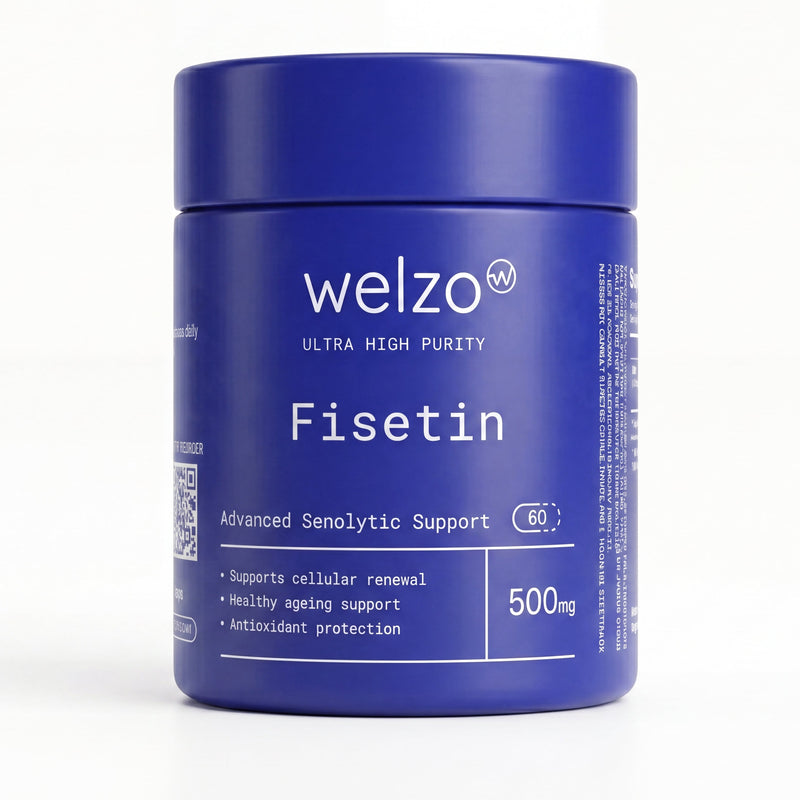
| Fisetin | 500 mg | Form | Kapsel |
| Prüfung | Durch unabhängige Dritte, GMP | Versand aus Großbritannien | Ja |
| Etikett | Rein, keine Mischungen | Gesamt | 4,8 / 5 |
Das Welzo Ultra Purity Fisetin 500 ist unsere erste Wahl, da seine Dosis von 500 mg die vielseitigste in dieser Kategorie ist. Die meisten Fisetin-Kapseln enthalten 100 mg – das ist für eine sanfte tägliche Einnahme in Ordnung, aber unpraktisch, wenn Sie einmal eine höhere Dosis einnehmen möchten (dann müssten Sie fünf Kapseln schlucken). Die höhere Dosierung von Welzo deckt eine sinnvolle Tagesdosis in einer einzigen Kapsel ab, und da die fraktionierte Resorption von Fisetin gering ist, gleicht eine höhere Dosis dies teilweise aus. Es ist zudem ein praktischer Baustein für die zeitweise Anwendung höherer Dosierungen, die manche Menschen zu senolytischen Zwecken nutzen (unter ärztlicher Aufsicht – siehe Abschnitt zur Dosierung).
Was die Qualität angeht, erfüllt es alle Anforderungen an ein Nahrungsergänzungsmittel, das man über Jahre hinweg einnehmen kann. Es ist Teil der Welzo Ultra Purity-Reihe: von unabhängigen Stellen auf Identität, Wirksamkeit und Schadstoffe (einschließlich Schwermetalle) geprüft, transparent gekennzeichnet ohne proprietäre Mischungen oder unnötige Füllstoffe und nach GMP-Standards hergestellt. Der Versand erfolgt aus Großbritannien mit schneller Lieferung und einem 14-tägigen Rückgaberecht – so vermeiden Käufer aus Großbritannien die Importgebühren und Zollverzögerungen, die bei US-amerikanischen Langlebigkeitsmarken oft auftreten. Preislich unterbietet es die Premium-Nischenkonkurrenten und bietet gleichzeitig die höchste einfache Dosis im Test. Seine einzige relative Schwäche ist, dass es sich um eine Standardkapsel und nicht um ein liposomales oder absorptionsverbessertes Format handelt – was sich jedoch leicht durch die Einnahme zusammen mit einer fettreichen Mahlzeit beheben lässt.
Vorteile: höchste Dosis im Test; hohe Reinheit; von unabhängigen Stellen geprüft; transparentes „Clean Label“; Versand und Rückgabe aus Großbritannien; gutes Preis-Leistungs-Verhältnis.
Zu beachten: Standardkapsel (zur Unterstützung der Resorption mit Fett einnehmen); bei erster Einnahme von Fisetin mit einer niedrigeren Dosis beginnen.
Am besten geeignet für: die Mehrheit der britischen Käufer, die ein hochwertiges, hochdosiertes Fisetin zu einem vernünftigen Preis suchen. Welzo Ultra Purity Fisetin 500 ansehen →
2. ProHealth Fisetin Pro – Am besten für die Resorption (4,5/5)
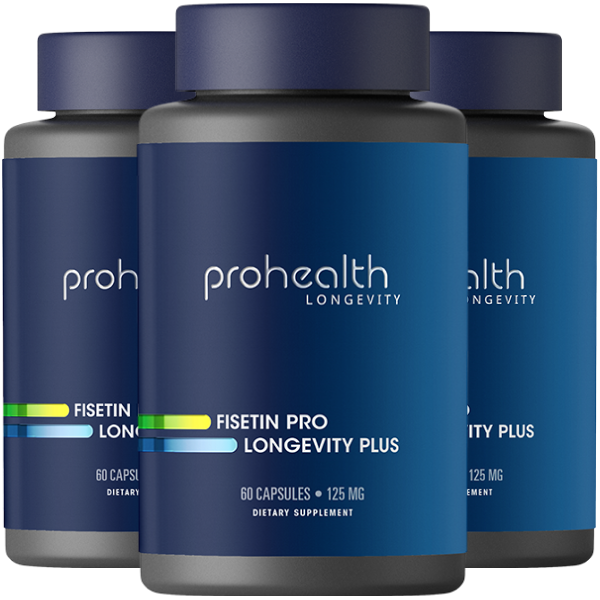
Warum es hier aufgeführt ist: ProHealth ist eine auf Langlebigkeit ausgerichtete Marke mit einer großen Anhängerschaft in der Biohacking-Community, und ihr Fisetin Pro wurde speziell im Hinblick auf die Resorption entwickelt – ein wirklich sinnvoller Ansatz angesichts der geringen natürlichen Bioverfügbarkeit von Fisetin, die wohl die größte Schwäche des Wirkstoffs darstellt. Das Unternehmen veröffentlicht Analysezertifikate und positioniert das Produkt eindeutig im Kontext von „Healthspan“ und Senolyse, sodass Sie genau wissen, was Sie kaufen und warum.
Die Nachteile sind eher praktischer Natur und betreffen nicht die Qualität: Das Produkt hat einen hohen Preis und wird international versandt, statt aus dem britischen Lager zu kommen; berücksichtigen Sie daher die Lieferzeit und mögliche Einfuhrgebühren.
Vorteile: auf die Resorption ausgerichtete Formel; etablierte Marke im Bereich Langlebigkeit; veröffentlichte Analysezertifikate.
Zu beachten: hoher Preis; internationaler Versand.
Am besten geeignet für: auf die Resorption bedachte Käufer, die gerne für ein formuliertes Produkt einer Marke im Bereich Langlebigkeit bezahlen. Überprüfen Sie die aktuelle Dosierung auf der Produktseite.
3. Double Wood Fisetin – Bestes Preis-Leistungs-Verhältnis, standardisiert (4,4/5)
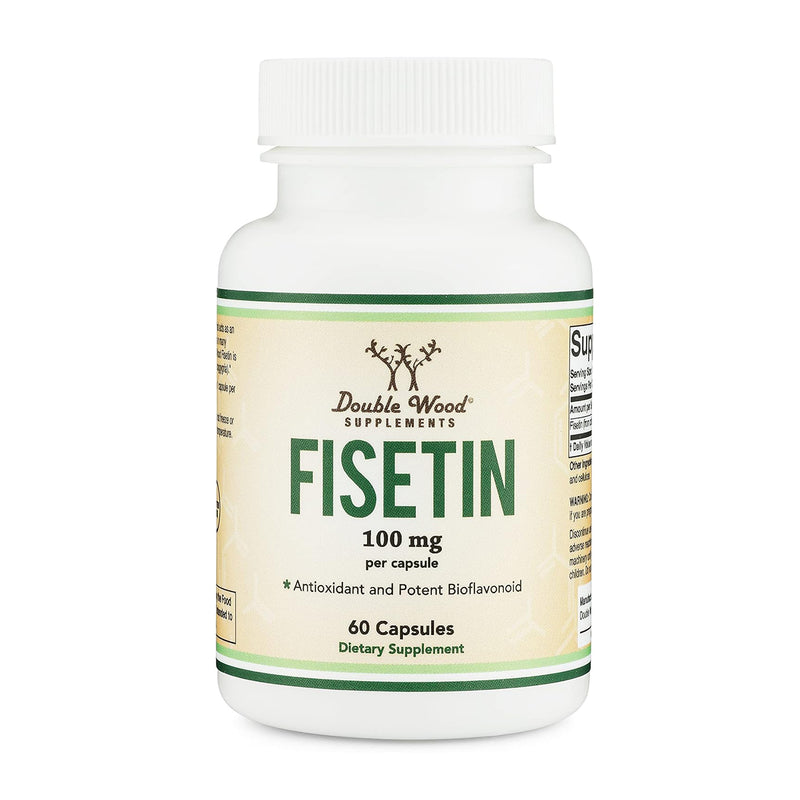
Warum es hier aufgeführt ist: Double Wood hat sich einen guten Ruf für transparente, schnörkellose Nahrungsergänzungsmittel mit nur einem Wirkstoff erarbeitet, und sein Fisetin ist ein gutes Beispiel dafür – ein hochreiner Extrakt (in der Regel auf etwa 98 % standardisiert), cGMP-konform hergestellt und von unabhängigen Labors auf Identität, Wirksamkeit und Schadstoffe – einschließlich Schwermetalle – geprüft, und das zu einem der niedrigsten Preise pro Flasche hier.
Der Hauptnachteil gegenüber unserem Testsieger ist die geringere Dosis pro Portion, sodass eine höhere Einnahme mehr Kapseln erfordert und sich der Preisvorteil verringert.
Vorteile: hohe Reinheit (~98 %); sehr gutes Preis-Leistungs-Verhältnis; transparente Prüfverfahren.
Zu beachten: geringere Dosis pro Portion.
Am besten geeignet für: preisbewusste Käufer, die ein hochreines, gut geprüftes Fisetin für den täglichen Gebrauch suchen.
4. Codeage Liposomales Fisetin + Resveratrol + Luteolin – Beste senolytische Mischung (4,1/5)
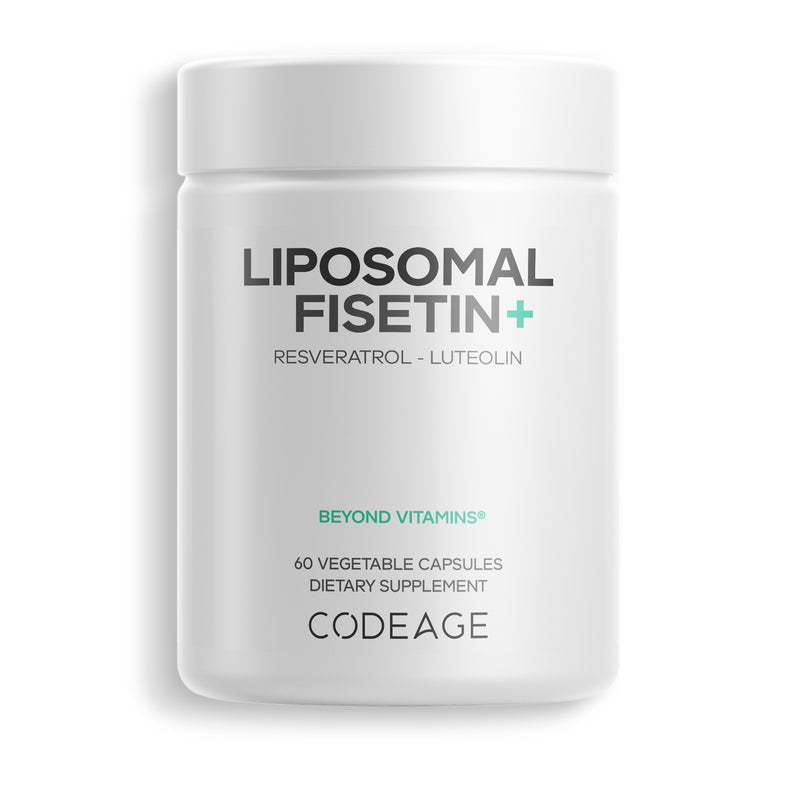
Warum es hier aufgeführt ist: Anstatt Fisetin allein zu verwenden, kombiniert Codeage es mit zwei weiteren, mit Langlebigkeit in Verbindung gebrachten Polyphenolen – Resveratrol und Luteolin – in einer liposomalen Form, die die Aufnahme verbessern soll. Alle drei werden im Bereich der Seneszenz und des gesunden Alterns erforscht, und die liposomale Verabreichung zielt direkt auf das Absorptionsproblem von Fisetin ab. Für jemanden, der lieber ein umfassendes Polyphenol-Produkt einnehmen möchte, als verschiedene Produkte zu kombinieren, ist dies eine praktische Lösung.
Der Kompromiss ist bei Mischungen unvermeidlich: Die individuelle Fisetin-Dosis ist geringer als bei einer speziellen hochdosierten Kapsel. Wenn also Fisetin Ihr spezifischer Schwerpunkt ist, bietet ein Produkt mit nur einem Wirkstoff mehr Kontrolle.
Vorteile: liposomale Resorption; drei Polyphenole in einem; praktisch.
Zu beachten: geringere individuelle Fisetin-Dosis; höherer Preis.
Am besten geeignet für: alle, die eine liposomale Langlebigkeitsformel mit mehreren Polyphenolen anstelle von reinem Fisetin wünschen.
5. Nutricost Fisetin – Bestes preisgünstiges Produkt mit einem einzigen Wirkstoff (4,0/5)
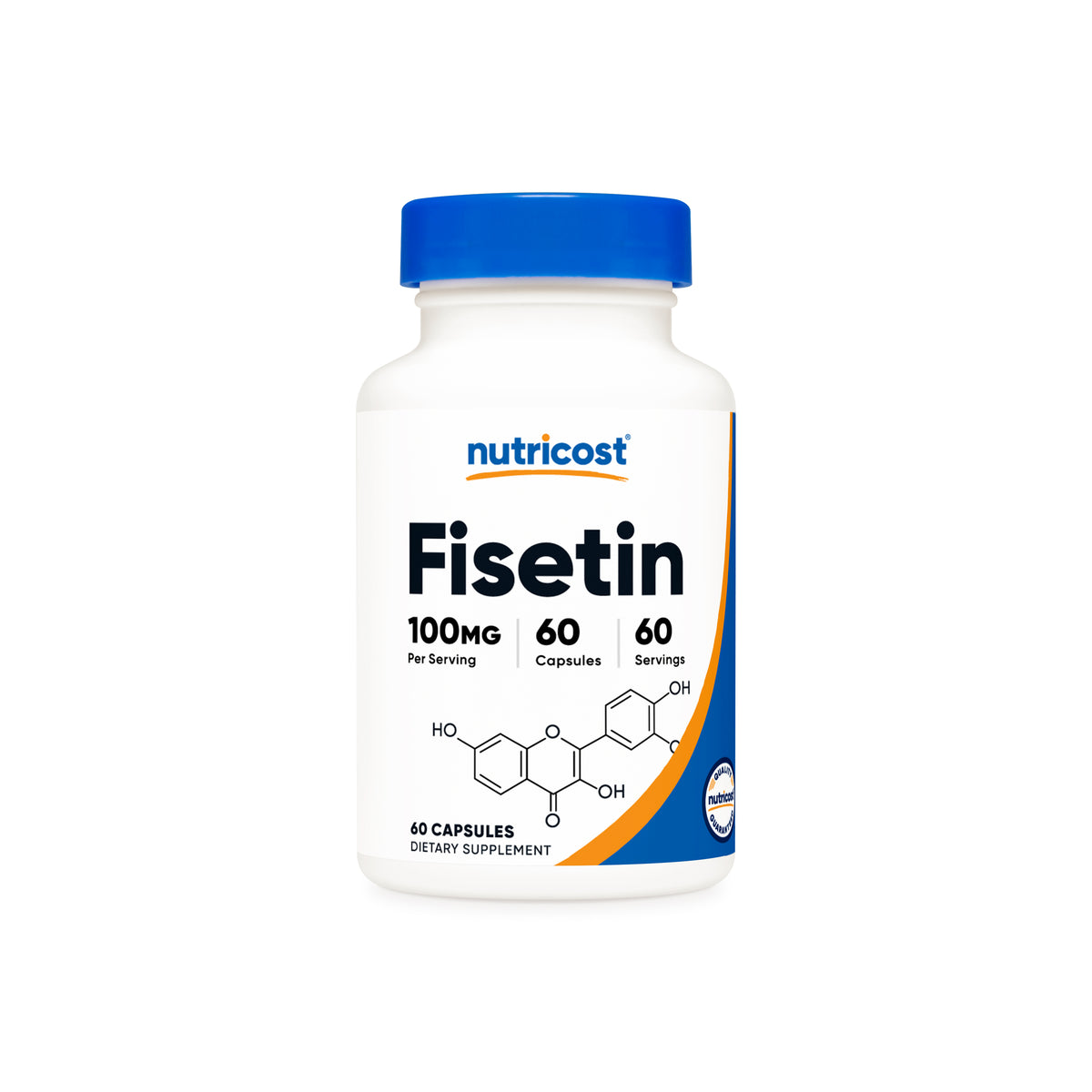
Warum es hier aufgeführt ist: reines Fisetin zu einem günstigen Preis – 100 mg pro Portion, gentechnikfrei, glutenfrei, hergestellt in einer GMP-konformen, bei der FDA registrierten Anlage und von unabhängigen Stellen geprüft. Das gesamte Geschäftsmodell von Nutricost basiert auf großvolumigen, kostengünstigen Basisprodukten, und sein Fisetin passt genau dazu: keine zusätzlichen Inhaltsstoffe, keine Premium-Formulierung, sondern einfach eine zuverlässige, erschwingliche Kapsel.
Die Kehrseite ist eine Standardkapsel mit 100 mg ohne Technologie zur Verbesserung der Resorption; kombinieren Sie sie daher mit einer fettreichen Mahlzeit und rechnen Sie mit ein paar Kapseln für eine höhere Tagesdosis.
Vorteile: niedrigster Einstiegspreis pro Milligramm; zuverlässige Basisprodukte.
Zu beachten: niedrige Dosierung; keine Absorptionshilfe.
Am besten geeignet für: preisbewusste Käufer, die sich ihr eigenes Produktpaket zusammenstellen.
6. Neurogan Fisetin – Beste einfache Kapsel für den Alltag (3,9/5)
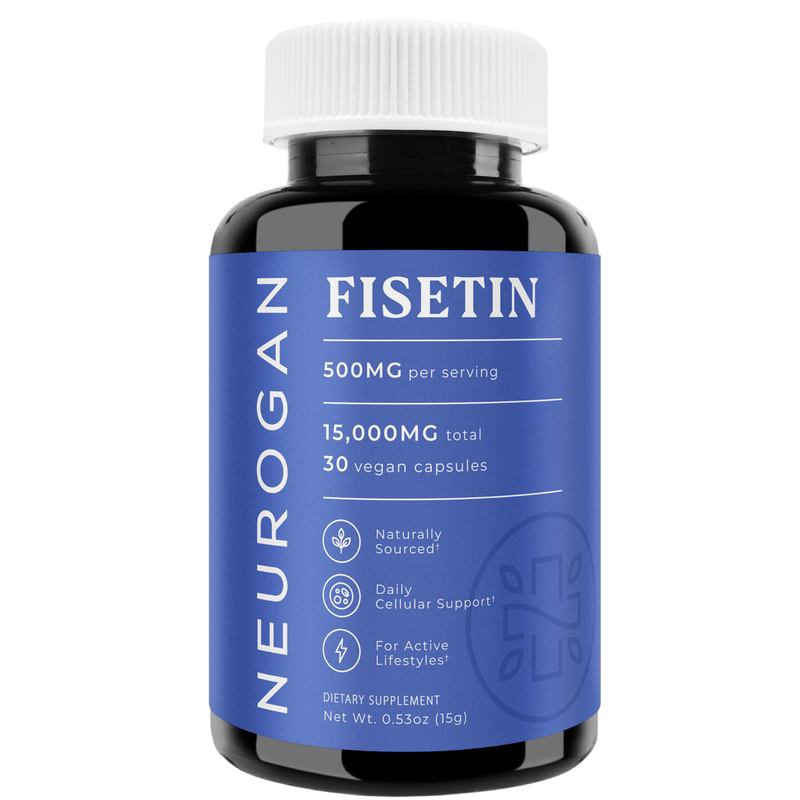
Warum sie hier aufgeführt ist: Neurogan bietet eine reine, ansprechend gestaltete Fisetin-Kapsel von einer Marke mit einem übersichtlichen, transparenten Sortiment und einem starken Fokus auf Präsentation und Qualität. Es ist eine unkomplizierte, alltagstaugliche Option für Menschen, denen die Ästhetik der Marke gefällt. Wichtig ist, die Dosis pro Portion zu überprüfen, da diese im Vergleich zu den hochdosierten Produkten den Preis-Leistungs-Faktor bestimmt.
Am besten geeignet für: alle, die ein reines, einfaches Fisetin für den täglichen Gebrauch von einer ansprechenden Marke suchen.
Was ist Fisetin? Quellen & Chemie
Fisetin (3,3′,4′,7-Tetrahydroxyflavon) ist ein Flavonol – ein Flavonoid aus derselben Familie wie Quercetin und Luteolin – und der gelbe Farbstoff in einer Reihe von Pflanzen. Es trägt vier Hydroxylgruppen an seinem Flavon-Grundgerüst, und genau diese Struktur verleiht ihm eine starke antioxidative Wirkung sowie die Fähigkeit, gleichzeitig mit mehreren zellulären Signalwegen zu interagieren. Die reichhaltigste Nahrungsquelle sind Erdbeeren, gefolgt von Äpfeln, Kakis, Trauben, Zwiebeln, Kiwis und Gurken.
Eine wichtige Klarstellung, bevor man die Ernährung mit Nahrungsergänzungsmitteln vergleicht: Man kann über die Nahrung keine Fisetin-Menge erreichen, die dem in Studien verwendeten Niveau entspricht. Selbst Erdbeeren enthalten nur eine geringe Menge pro Gramm, sodass man täglich Kilogramm davon essen müsste, um eine Dosis aus Nahrungsergänzungsmitteln – geschweige denn eine Forschungsdosis – zu erreichen. Deshalb gibt es konzentrierte Extrakte, die in der Regel aus dem Rauchbaum (Cotinus coggygria) oder ähnlichen Quellen auf einen hohen Anteil an aktivem Fisetin standardisiert sind. Die Reinheit ist entscheidend, denn ein Extrakt mit geringem Fisetin-Anteil liefert proportional weniger von dem, wofür man bezahlt – weshalb dies eines der Kriterien ist, die wir bewerten.
Fisetin und die Kennzeichen des Alterns
Die moderne Alterungsforschung gliedert die Biologie des Älterwerdens in eine Reihe miteinander verknüpfter „Kennzeichen“ – zelluläre Seneszenz, chronische Entzündung, mitochondrialer Verfall, Verlust der Proteostase und mehr. Was Fisetin interessant macht, ist, dass es mehrere dieser Kennzeichen gleichzeitig anspricht, anstatt nur ein einziges eng gefasstes Ziel:
- Zelluläre Seneszenz – seine Hauptwirkung (Beseitigung seneszenter Zellen).
- Chronische Entzündung („Inflammaging“) – Reduzierung der Entzündungssignale, die seneszente Zellen aussenden.
- Oxidativer Stress / Verlust der Widerstandsfähigkeit – direkte antioxidative Wirkung sowie Aktivierung der körpereigenen Abwehrmechanismen.
Dies ist auch der Grund, warum Fisetin in der Regel als Teil einer umfassenderen Routine und nicht als Wundermittel betrachtet wird: Verschiedene Wirkstoffe wirken auf unterschiedliche Kennzeichen ein. NAD+-Vorläufer wie NMN unterstützen die zelluläre Energieversorgung und Reparatur; Spermidin unterstützt die Autophagie; Urolithin A unterstützt die mitochondriale Qualitätskontrolle. Der Beitrag von Fisetin liegt vor allem im Bereich der Seneszenz und Entzündung.
Seneszente Zellen, SASP und „Inflammaging“
Um zu verstehen, warum Fisetin so großes Interesse weckt, muss man die zelluläre Seneszenz verstehen. Wenn eine Zelle irreparabel geschädigt oder gestresst ist – durch DNA-Schäden, oxidativen Stress oder einfach durch das Erreichen ihrer Replikationsgrenze –, kann sie in die Seneszenz übergehen: Sie hört dauerhaft auf, sich zu teilen (was schützend wirkt, da es verhindert, dass sich geschädigte Zellen vermehren und möglicherweise krebsartig werden), stirbt aber nicht ab. Stattdessen verweilt sie im Zellkörper und wird manchmal als „Zell-Zombie“ bezeichnet.
Das Problem ist, was diese Zellen tun. Seneszente Zellen scheiden einen Cocktail aus entzündungsfördernden Zytokinen, Wachstumsfaktoren und Enzymen aus, der als seneszenzassoziierter sekretorischer Phänotyp (SASP) bekannt ist – Signale, die Entzündungen auslösen und benachbartes gesundes Gewebe schädigen. In jungen Jahren beseitigt das Immunsystem seneszente Zellen effizient. Mit zunehmendem Alter steigt deren Produktion und ihre Beseitigung nimmt ab, sodass sie sich ansammeln – in Haut, Gelenken, Blutgefäßen, Fettgewebe, Muskeln, im Gehirn und an anderen Stellen – und ihre SASP-Sekrete treiben die chronische, schwachgradige Entzündung voran, die Forscher als „Inflammaging“ bezeichnen. Mithilfe genetischer und pharmakologischer Methoden konnte in Tiermodellen nachgewiesen werden, dass seneszente Zellen eine ursächliche Rolle bei vielen Merkmalen des Alterns spielen, von Gebrechlichkeit bis hin zu Stoffwechsel- und Herz-Kreislauf-Verfall.
Dies betrachtet das Altern in einem neuen Licht als etwas, gegen das man potenziell etwas unternehmen kann. Ein Senolytikum ist eine Verbindung, die selektiv seneszente Zellen beseitigt, während gesunde Zellen verschont bleiben – im Grunde werden die „Zombie-Zellen“ entfernt, damit sich das Gewebe erneuern kann. Das ist ein ehrgeizigerer Ansatz als die bloße Zufuhr von Antioxidantien: Anstatt Schäden abzufedern, zielt er darauf ab, eine der Hauptursachen des Alterns zu beseitigen. Fisetin ist einer der führenden natürlichen Kandidaten für diese Aufgabe.
Die bahnbrechende Senolytika-Studie im Detail
Die wegweisende Arbeit ist die Studie von Yousefzadeh und Kollegen aus dem Jahr 2018, die in EBioMedicine veröffentlicht wurde.1 Das Team machte sich auf die Suche nach Flavonoiden mit stärkerer senolytischer Aktivität als die damals führende Kombination aus Dasatinib und Quercetin. Sie untersuchten eine Auswahl von zehn Flavonoidverbindungen hinsichtlich ihrer Wirkung auf seneszente Zellen, und Fisetin erwies sich als das wirksamste Mittel, um seneszente Zellen selektiv abzutöten und dabei gesunde Zellen zu schonen.
Entscheidend war, dass sich die Wirkung auch über die Petrischale hinaus bestätigte. Bei gealterten Mäusen reduzierte Fisetin Seneszenzmarker in mehreren Geweben, und in menschlichen Gewebeproben (Fettexplantaten) verringerte es ebenfalls die Belastung durch seneszente Zellen – ein früher Hinweis auf die translationale Relevanz. Und das wichtigste Ergebnis: Eine chronische Verabreichung im fortgeschrittenen Alter verlängerte sowohl die mediane als auch die maximale Lebensdauer bei Mäusen, selbst wenn die Behandlung erst in fortgeschrittenem Alter begann, und das bei wenigen Nebenwirkungen. Die Verlängerung sowohl der Gesundheitsspanne als auch der Lebensdauer durch ein Naturprodukt, das erst spät verabreicht wurde, war es, was der Studie so viel Aufmerksamkeit verschaffte und die aktuelle Welle an Forschung und Produkten ins Rollen brachte.
Es lohnt sich, klar darzulegen, was diese Studie ist und was sie nicht ist. Es handelt sich um strenge Untersuchungen an Tieren und menschlichem Gewebe, die einen Wirkmechanismus und einen Effekt auf die Lebensdauer bei Mäusen nachweisen. Es ist kein Nachweis dafür, dass Fisetin die Lebensdauer des Menschen verlängert oder menschliche Krankheiten behandelt. Genau diese Lücke – zwischen überzeugenden Daten an Mäusen und nachgewiesenem Nutzen für den Menschen – sollen die unten aufgeführten klinischen Studien schließen.
Klinische Studien mit Fisetin am Menschen (Stand 2026)
Ein Grund, Fisetin ernster zu nehmen als das durchschnittliche „Langlebigkeits“-Nahrungsergänzungsmittel, ist, dass es nun in echte klinische Studien am Menschen übergegangen ist, von denen mehrere von führenden akademischen Zentren durchgeführt werden. Hier ist ein ehrlicher Überblick – wobei zu beachten ist, dass die meisten noch laufen und die Teilnahme an einer Studie nicht gleichbedeutend ist mit dem Nachweis eines Nutzens.
| Studie (Kennung) | Was wird untersucht? | Status |
|---|---|---|
| AFFIRM (NCT03430037, Mayo Clinic) | Ob Fisetin Gebrechlichkeit und Entzündungsmarker bei älteren Frauen reduziert | Phase 2 |
| COVID-FIS (NCT04537299) | Fisetin als Senolytikum zur Verringerung des Schweregrads und der Komplikationen von COVID-19 bei älteren Bewohnern von Pflegeheimen | Phase-2-Pilotstudie |
| Gefäßfunktion (NCT06133634, Univ. Colorado) | Untersuchung, ob eine intermittierende Fisetin-Gabe die Endothelfunktion und die arterielle Steifigkeit bei älteren Erwachsenen verbessert | Phase 1/2 |
| Brustkrebsüberlebende (NCT05595499) | Untersuchung, ob Fisetin die körperliche Funktionsfähigkeit bei Überlebenden der Stadien I–III verbessert (mit Fokus auf behandlungsbedingte Seneszenz) | Phase 2, Teilnehmerrekrutierung läuft |
| Pharmakokinetik und Sicherheit / Multimorbidität (NCT06431932) | Pharmakokinetik und Sicherheit von Fisetin in einer Dosierung von 20 mg/kg/Tag über 2 Tage | Pilotstudie |
| FIS-AD (NCT07279714) | Sicherheit/Verträglichkeit bei leichter kognitiver Beeinträchtigung / leichter Alzheimer-Erkrankung | Phase 2, geplant |
| FITCATS (NCT05416515) | Fisetin (100 mg × 2 Tage, nach einem Monat wiederholt) bei Karpaltunnelsyndrom | Phase 2, abgeschlossen |
Fisetin wurde für mehrere dieser Studien gerade deshalb ausgewählt, weil es bereits seit Langem sicher beim Menschen angewendet wird, oral verabreicht werden kann und eine kurze Halbwertszeit aufweist – Eigenschaften, die sich für eine intermittierende „Hit-and-Run“-Dosierung von Senolytika eignen. Das ehrliche Fazit zu all dem: Fisetin ist ein ernstzunehmender Forschungskandidat mit einem aktiven klinischen Programm, doch die veröffentlichten Ergebnisse zur Wirksamkeit beim Menschen sind nach wie vor begrenzt. Kaufen und verwenden Sie es als vielversprechendes Nahrungsergänzungsmittel, nicht als bewährte Therapie – und schließen Sie nicht daraus, dass eine Studie beispielsweise zu Alzheimer oder Krebs bedeutet, dass Fisetin diese Erkrankungen „behandelt“. Das tut es nicht; diese Studien stellen die Frage, sie beantworten sie nicht.
Wie Fisetin wirkt: Wirkmechanismen
Fisetin ist ein echtes Multi-Target-Molekül. In der Laborforschung wirkt es über mehrere sich ergänzende Signalwege:
- Senolytische Clearance: Es treibt seneszente Zellen in Richtung des programmierten Zelltods (Apoptose), unter anderem durch die Störung der überlebensfördernden Netzwerke, auf die diese Zellen angewiesen sind, um dem Absterben zu widerstehen – wodurch ihre Anzahl und die von ihnen ausgesendeten entzündlichen SASP-Signale reduziert werden.
- Direkte antioxidative Wirkung + Nrf2-Aktivierung: Fisetin fängt freie Radikale direkt ab und aktiviert gleichzeitig Nrf2, den Hauptregulator der zelleigenen antioxidativen Abwehr, wodurch endogene Schutzstoffe wie Glutathion gestärkt werden. Dieser Mechanismus, der „der Zelle hilft, sich selbst zu schützen“, ist oft bedeutender als die direkte Radikalfängerwirkung allein. Entdecken Sie verwandte Antioxidantien-Nahrungsergänzungsmittel.
- Entzündungshemmend (NF-κB): Es dämpft die NF-κB-Signalübertragung, einen zentralen Schalter für die Expression entzündungsfördernder Gene – was in direktem Zusammenhang mit dem Phänomen des „Inflammaging“ steht.
- Unterstützung der Sirtuine: Fisetin wurde als Modulator der Sirtuine untersucht, jener mit Langlebigkeit assoziierten Enzyme, die an der DNA-Reparatur und der Stoffwechselregulation beteiligt sind – Enzyme, die ebenfalls von NAD+ abhängig sind.
- Neuroprotektion: Es kann die Blut-Hirn-Schranke überwinden und unterstützt in Tiermodellen Signalwege, die am Gedächtnis beteiligt sind (einschließlich der Modulation entzündlicher und p25/CDK5-bezogener Signalwege), und schützt Neuronen vor oxidativem und entzündlichem Stress.3
Die Beseitigung seneszenter Zellen, die Stärkung der körpereigenen Abwehrkräfte und die Linderung von Entzündungen sind der Grund, warum Fisetin sowohl als „Senolytikum“ als auch im weiteren Sinne als „Senotherapeutikum“ bezeichnet wird und warum es in so vielen Langlebigkeits-Kombinationen enthalten ist.
Fisetin in den verschiedenen Körpersystemen
Da sich seneszente Zellen überall ansammeln, wird Fisetin in verschiedenen Körpersystemen untersucht. Zugeordnet zur oben dargestellten Studienlandschaft:
- Bewegungsapparat und Gebrechlichkeit: Der Schwerpunktbereich – Verringerung der Belastung durch seneszente Zellen und von Entzündungen, die zu Gebrechlichkeit und zum Verlust körperlicher Funktionen beitragen (Schwerpunkt der AFFIRM-Studie und der Studie mit Brustkrebsüberlebenden).
- Gefäßgesundheit: Seneszenzzellen führen zu einer Verhärtung der Blutgefäße und beeinträchtigen das Endothel; in einer speziellen Studie wird untersucht, ob die intermittierende Einnahme von Fisetin die Gefäßfunktion bei älteren Erwachsenen verbessert.
- Gehirn und Kognition: Neuroprotektion in Tiermodellen und eine geplante Studie bei leichter kognitiver Beeinträchtigung bzw. Alzheimer im Frühstadium.
- Stoffwechselgesundheit: Präklinische Arbeiten deuten auf Auswirkungen auf den Blutzuckerstoffwechsel und diabetische Komplikationen hin.
- Immun- und Entzündungsresilienz: Die Begründung für die COVID-19-Senolytika-Pilotstudie bei gefährdeten älteren Erwachsenen.
- Haut und Bindegewebe: Mit zunehmendem Alter sammeln sich seneszente Zellen in der Haut an, was Senolytika für die Hautalterung interessant macht – ein Thema, das wir in unserem Leitfaden zu den besten Anti-Aging-Seren aus topischer Sicht behandeln.
Der rote Faden ist die Seneszenz – derselbe zugrunde liegende Mechanismus, der in verschiedenen Geweben getestet wird. Vielversprechend als Forschungsprogramm; als Therapie beim Menschen noch unbewiesen.
Vorteile von Fisetin nach Anwendungsbereich
Ehrlich betrachtet und auf der Grundlage der Forschungsergebnisse wird Fisetin am häufigsten für folgende Zwecke eingenommen:
- Langlebigkeit und zelluläre Seneszenz: sein Vorzeigebereich – Beseitigung seneszenter Zellen und Verringerung des „Inflammaging“ (stärkste, wenn auch größtenteils präklinische Belege).
- Gehirn und kognitive Gesundheit: In Tiermodellen auf Neuroprotektion und Erhaltung der kognitiven Fähigkeiten untersucht; passiert die Blut-Hirn-Schranke.
- Antioxidative und entzündungshemmende Wirkung: Ein starkes Antioxidans, das zudem die körpereigenen Abwehrkräfte stärkt.
- Unterstützung des Stoffwechsels: In präklinischen Modellen hinsichtlich der Blutzuckerregulation untersucht.
- Haut- und Gewebealterung: Seneszenzzellen reichern sich in Haut und Bindegewebe an (erste Hinweise).
- Gefäß- und körperliche Funktionen: wird derzeit am Menschen aktiv untersucht (siehe Studien).
Dies sind Bereiche, in denen Unterstützung und aktive Forschung stattfinden, jedoch keine nachgewiesenen Behandlungsmethoden. Fisetin ist ein Nahrungsergänzungsmittel, kein Arzneimittel.
Was die wissenschaftlichen Erkenntnisse zeigen – und was nicht
| Behauptung | Stand der Evidenz |
|---|---|
| Beseitigt seneszente Zellen in Zellen und Tieren | Gut belegt (einschließlich menschlicher Gewebeexplantate). |
| Wirksamstes von 10 untersuchten Flavonoiden | Belegt (Yousefzadeh 2018). |
| Verlängert die Lebensdauer bei Mäusen, selbst bei spätem Beginn | Bei Mäusen belegt – beim Menschen nicht nachgewiesen. |
| Neuroprotektive, metabolische und vaskuläre Wirkungen | Präklinische Studien sowie Studien am Menschen laufen. |
| Gut verträglich / nachweislich sichere Anwendung beim Menschen | Bei den untersuchten Dosierungen belegt. |
| Verlängert die Gesundheitsspanne des Menschen / behandelt Krankheiten | Noch nicht nachgewiesen – wird derzeit untersucht. |
Dosierung: Tägliche Einnahme vs. senolytischer Impuls (mit konkreten Zahlen)
Fisetin ist insofern ungewöhnlich, als es zwei wirklich unterschiedliche Dosierungsansätze gibt, und diese zu verwechseln ist der häufigste Fehler, den Menschen begehen.
| Ansatz | Typische Menge | Begründung & Anmerkungen |
|---|---|---|
| Tägliche Einnahme | ~100–500 mg pro Tag, dauerhaft | Zur allgemeinen Unterstützung durch antioxidative und entzündungshemmende Wirkung sowie für gesundes Altern. Der gängige, risikoarme Ansatz und die sinnvolle Standarddosierung für die meisten Menschen. |
| Senolytischer „Puls“ (Hit-and-Run) | In der Forschung werden ~20 mg/kg/Tag an zwei aufeinanderfolgenden Tagen verabreicht, was nur in regelmäßigen Abständen wiederholt wird (≈1.400 mg/Tag für einen 70 kg schweren Erwachsenen) | Spiegelt die Wirkungsweise von Senolytika wider – periodische Beseitigung, keine kontinuierliche Präsenz. Dies ist die Dosis, die in Studien am Menschen wie der pharmakokinetischen/Sicherheitsstudie verwendet wurde; einige Protokolle (z. B. die Karpaltunnel-Studie) verwendeten eine niedrigere Dosis von 100 mg × 2 Tage, die monatlich wiederholt wurde. Experimentell – im Bereich der klinischen Studien, keine Routine zur Selbstmedikation. |
Die „Puls“-Logik ist entscheidend: Da ein Senolytikum darauf abzielt, seneszente Zellen zu entfernen, anstatt eine Wirkung aufrechtzuerhalten, muss es nicht täglich verabreicht werden – man beseitigt die Zellen in einem kurzen Impuls, unterbricht die Einnahme und wiederholt den Vorgang gelegentlich. Die kurze Halbwertszeit von Fisetin eignet sich hierfür gut. Beachten Sie jedoch die beiden sehr unterschiedlichen Dosierungsstufen: Die in der Forschung verwendeten „Puls“-Dosen (20 mg/kg) sind weitaus höher als die alltägliche Nahrungsergänzung, und ihre langfristige Sicherheit beim Menschen ist noch nicht erwiesen.
Klare Empfehlung: Für die meisten Menschen ist eine tägliche Einnahme in einer angemessenen Dosis die vernünftige Standardvorgehensweise. Wenn Sie sich zu einem hochdosierten Puls-Protokoll hingezogen fühlen, sollten Sie dies mit einem Arzt besprechen – idealerweise unter ärztlicher Überwachung –, anstatt es einfach aus einem Forum zu übernehmen. Die Stärke von 500 mg des „Welzo Ultra Purity Fisetin 500“ eignet sich für die tägliche Einnahme im höheren Dosierungsbereich und bietet eine praktische Dosierform für überwachte Protokolle. Unabhängig vom Ansatz sollten Sie Fisetin zusammen mit fettreichen Mahlzeiten einnehmen und die tägliche Einnahme mindestens 4–8 Wochen lang beibehalten, bevor Sie eine Bewertung vornehmen.
Bioverfügbarkeit, Stoffwechsel und Aufnahme
Die größte praktische Schwäche von Fisetin ist seine schlechte orale Bioverfügbarkeit. Drei Faktoren wirken dem entgegen: Es ist schlecht wasserlöslich, wird schnell metabolisiert (durch Glucuronidierung und Sulfatierung im Darm und in der Leber konjugiert) und hat eine kurze Halbwertszeit, sodass die Blutspiegel schnell ansteigen und wieder abfallen. Die praktische Konsequenz ist, dass zwei Produkte mit derselben auf dem Etikett angegebenen Dosis je nach Formulierung sehr unterschiedliche Mengen an verwertbarem Fisetin liefern können.
Möglichkeiten zur Verbesserung der Resorption, in grober Reihenfolge nach Einfachheit:
- Nehmen Sie es zusammen mit einer fettreichen Mahlzeit ein. Fisetin ist fettlöslich, daher unterstützt Nahrungsfett (Olivenöl, Avocado, Nüsse, Vollfettjoghurt) die Aufnahme erheblich – die einfachste und kostenlose Maßnahme.
- Wählen Sie ein speziell formuliertes Produkt – liposomal (wie in der Mischung von Codeage) oder eine Formulierung mit verbesserter Resorption (wie ProHealth sein „Fisetin Pro“ vermarktet). Siehe auch unsere Auswahl an liposomalen Nahrungsergänzungsmitteln.
- Ziehen Sie Piperin (Schwarzpfeffer-Extrakt) in Betracht, das den Stoffwechsel einiger Polyphenole verlangsamen kann.
- Gleichen Sie dies durch die Dosierung aus – eine hochdosierte Standardkapsel liefert mehr Fisetin insgesamt und gleicht so teilweise die geringere Absorptionsrate aus. Dies ist ein Grund, warum eine 500-mg-Kapsel eine praktische Wahl ist.
Dies ist auch der Grund, warum die genaue Dosierung beim Menschen und die Formulierung derzeit aktiv erforscht werden: Die pharmakokinetische Teilstudie im Rahmen der aktuellen Pilotstudien misst, wie viel Fisetin (und welche Metaboliten) nach oraler Einnahme tatsächlich in den Blutkreislauf gelangen.
Fisetin im Vergleich zu Quercetin und anderen Senolytika
Fisetin gehört zu einer kleinen Familie senolytischer Verbindungen, die von Menschen mit Interesse an Langlebigkeit verglichen und kombiniert werden:
| Wirkstoff | Typ | Anmerkungen |
|---|---|---|
| Fisetin | Flavonoid (Nahrungsergänzungsmittel) | Das wirksamste natürliche Senolytikum im Screening von 2018; überzeugende Tierversuchsdaten; laufende klinische Studien am Menschen. |
| Quercetin | Flavonoid (Nahrungsergänzungsmittel) | Das begleitende senolytische Flavonoid; wird in der Forschungskombination Dasatinib+Quercetin (D+Q) eingesetzt – dem am besten untersuchten senolytischen Protokoll am Menschen. |
| Dasatinib | Verschreibungspflichtiges Medikament | Wird in der Forschung zusammen mit Quercetin (D+Q) eingesetzt. Kein Nahrungsergänzungsmittel; ausschließlich für medizinische Zwecke bestimmt. |
| Spermidin | Polyamin (Nahrungsergänzungsmittel) | Wirkt über Autophagie (zelluläre „Selbstreinigung“) – ergänzend, kein Konkurrent. |
| Navitoclax & andere | Prüfpräparate | Wirksame Senolytika, die in der Forschung untersucht werden; verschreibungspflichtig/experimentell, mit aussagekräftigen Nebenwirkungsprofilen. |
Das Fazit in der Praxis: Fisetin ist das natürliche Senolytikum mit den aussagekräftigsten Tierdaten für einen einzelnen Wirkstoff, Quercetin verfügt über die Tradition menschlicher Studien durch D+Q, und beide werden oft als komplementär angesehen. Andere Langlebigkeitswirkstoffe wie Resveratrol und Urolithin A werden häufig im Zusammenhang mit Fisetin diskutiert, obwohl sie über unterschiedliche Wirkmechanismen wirken. Wenn Sie mehrere Wirkstoffe kombinieren, führen Sie diese nacheinander ein und holen Sie ärztlichen Rat ein, bevor Sie eine hochdosierte senolytische Therapie beginnen.
Wie Fisetin in eine Routine zur Förderung der Langlebigkeit passt
Fisetin ist einer von mehreren Hebeln in einer Routine für gesundes Altern. Die besten Kombinationen vereinen Wirkstoffe, die auf unterschiedliche Kennzeichen des Alterns einwirken, anstatt denselben Mechanismus zu duplizieren. Diese geprüften Welzo Ultra Purity-Optionen decken sich ergänzende Signalwege ab:
| Kombination | Komplementäre Rolle | Option |
|---|---|---|
| Spermidin | Autophagie – Zellerneuerung, zu unterscheiden von der Senolyse | Welzo Ultra Purity Spermidin |
| NMN | NAD+ zur Unterstützung der zellulären Energieversorgung und Reparatur | Welzo Ultra Purity NMN |
| Liposomales NAD+ | Direkte NAD+-Auffüllung | Welzo Ultra Purity Liposomales NAD+ |
| Urolithin A | Mitophagie – mitochondriale Qualitätskontrolle | Welzo Ultra Purity Urolithin A |
| Luteolin | Verwandtes Flavonoid; von Interesse als Antioxidans und Senolytikum | Welzo Ultra Purity Luteolin |
| Astaxanthin | Unterstützung durch fettlösliche Antioxidantien | Welzo Ultra Purity Astaxanthin |
| Berberin / TMG | Unterstützung des Stoffwechsels und der Methylierung | Berberin · TMG |
Führen Sie jeweils nur eine Substanz ein, damit Sie die Verträglichkeit beurteilen können. Stöbern Sie im gesamten Welzo Ultra Purity-Sortiment, in der Langlebigkeitskollektion, den speziellen NMN-, Resveratrol- und Spermidin-Kollektionen oder in allen Nahrungsergänzungsmitteln und Vitaminen, um eine Routine aufzubauen. Ein Beispiel aus der Praxis, wie Langlebigkeitsbegeisterte Wirkstoffe kombinieren, finden Sie in unserer Aufschlüsselung der Nahrungsergänzungsmittel und des Protokolls von David Sinclair. Und denken Sie daran: Training, Schlaf und Ernährung bilden nach wie vor die Grundlage für jede Kombination.
Wer sollte es einnehmen (und wer nicht)?
Fisetin spricht vor allem Menschen an, die sich auf gesundes Altern und Langlebigkeit konzentrieren, eine Routine mit Antioxidantien und entzündungshemmenden Mitteln aufbauen möchten oder an der Unterstützung der Gehirn-, Gefäß- oder körperlichen Funktionen interessiert sind. Als gut verträgliches Flavonoid mit einer langen Geschichte sicherer Anwendung beim Menschen ist es für viele gesunde Erwachsene eine sinnvolle Option.
Es ist jedoch nicht für jeden geeignet. Beginnen Sie nicht ohne ärztlichen Rat mit der Einnahme von Fisetin, wenn Sie schwanger sind oder stillen, wenn Sie Blutverdünner oder andere regelmäßig eingenommene Medikamente einnehmen, wenn Sie eine Krebserkrankung in der Vorgeschichte haben (Senolytika wirken auf die Überlebens- und Absterbenswege von Zellen ein) oder wenn Sie unter 18 Jahre alt sind. Und kein Nahrungsergänzungsmittel ersetzt die Grundlagen – Bewegung, Schlaf und Ernährung bleiben die wirksamsten Hebel für gesundes Altern.
So wählen Sie ein Fisetin-Nahrungsergänzungsmittel aus
| Was Sie beachten sollten | Warum das wichtig ist |
|---|---|
| Dosis pro Portion | Variiert stark (100–500 mg+). Passen Sie die Dosierung an Ihren Bedarf an und vergleichen Sie die Kosten pro Milligramm. |
| Reinheit / Standardisierung | Eine höhere Standardisierung (z. B. 98 %) bedeutet mehr aktives Fisetin pro Kapsel. |
| Resorption / Darreichungsform | Angesichts der geringen Bioverfügbarkeit von Fisetin machen liposomale/formulierte Produkte oder die Einnahme zusammen mit Fett einen echten Unterschied. |
| Unabhängige Prüfungen | Unabhängige Prüfungen auf Identität, Wirksamkeit und Schadstoffe (Schwermetalle) sind eine Grundvoraussetzung. |
| Clean Label | Vermeiden Sie firmeneigene Mischungen, bei denen die Mengenangaben verschleiert werden, sowie unnötige Füllstoffe. |
| Versand aus Großbritannien | Vermeidet Einfuhrgebühren und beschleunigt Lieferung und Rücksendungen für Käufer in Großbritannien. |
Sicherheit, Nebenwirkungen und Wechselwirkungen
Fisetin wurde in Studien bei üblichen Dosierungen gut vertragen, wobei leichte Verdauungsbeschwerden die am häufigsten berichtete Nebenwirkung waren, und es kann auf eine lange Geschichte sicherer Anwendung beim Menschen zurückblicken – was mit ein Grund dafür war, dass es für klinische Studien ausgewählt wurde. Da es sich um einen Wirkstoff zur Lebensverlängerung handelt, der manchmal in hohen Dosen eingenommen wird, sollten Sie folgende Vorsichtsmaßnahmen ernst nehmen:
- Wechselwirkungen mit Medikamenten: Fisetin kann Cytochrom-P450-Enzyme beeinflussen und möglicherweise Wechselwirkungen mit Blutverdünnern, Thrombozytenaggregationshemmern und anderen Arzneimitteln eingehen – sprechen Sie vor Beginn der Einnahme mit Ihrem Hausarzt oder Apotheker.
- Hohe „senolytische“ Dosen (z. B. 20 mg/kg als Pulstherapie) sind hinsichtlich ihrer langfristigen Sicherheit beim Menschen noch nicht vollständig charakterisiert. Führen Sie keine Selbstversuche mit aggressiven Online-Protokollen durch; lassen Sie die Einnahme hoher Dosen unter ärztlicher Aufsicht erfolgen.
- Krebserkrankung in der Vorgeschichte: Da Senolytika auf Signalwege des Zellüberlebens und des Zelltods einwirken, sollten Personen mit einer Krebserkrankung in der Vorgeschichte oder einer aktiven Krebserkrankung zunächst ihren Onkologen oder Hausarzt konsultieren – auch wenn Fisetin bei Krebsüberlebenden untersucht wird, geschieht dies im Rahmen einer überwachten Studie und nicht im Rahmen einer eigenständigen Anwendung.
- Schwangerschaft und Stillzeit: Die Sicherheit ist nicht erwiesen – ohne ärztlichen Rat nicht anwenden.
- Personen unter 18 Jahren: Nicht zur Anwendung bestimmt.
- Allgemeines: Führen Sie jeweils nur ein Nahrungsergänzungsmittel ein, verwenden Sie die niedrigste wirksame Dosis und lesen Sie das Etikett sowie die Packungsbeilage.
Nahrungsergänzungsmittel unterstützen – ersetzen jedoch nicht – eine ausgewogene Ernährung, einen gesunden Lebensstil und professionelle medizinische Beratung.
Häufige Irrtümer & Mythen vs. Fakten
- Mythos: „Fisetin verlängert nachweislich die Lebensdauer des Menschen.“ Fakt: Eine Verlängerung der Lebensdauer wurde bei Mäusen nachgewiesen; Studien am Menschen laufen noch und haben dies bislang nicht bestätigt.
- Fehler: Hochdosierte „senolytische Puls“-Protokolle aus dem Internet nachahmen. Forschungs-Pulse (20 mg/kg) sind Versuchsdosen; führen Sie diese nur unter ärztlicher Aufsicht durch.
- Irrtum: Die Resorption ignorieren. Die Einnahme von Fisetin auf nüchternen Magen als reines Pulver führt zu einer erheblichen Verschwendung der Dosis – nehmen Sie es zusammen mit Fett ein oder wählen Sie ein formuliertes Produkt.
- Mythos: „Man kann genug über Erdbeeren zu sich nehmen.“ Fakt: Die Mengen in der Nahrung machen nur einen winzigen Bruchteil der Dosierungen in Nahrungsergänzungsmitteln (geschweige denn der Forschungsdosierungen) aus.
- Fehler: Produkte allein anhand der in der Überschrift angegebenen Milligrammzahl zu beurteilen. Reinheit und Darreichungsform bestimmen, wie viel aktives, resorbiertes Fisetin man tatsächlich erhält.
- Mythos: „Mehr ist immer besser.“ Fakt: Senolytika folgen einer Logik der periodischen Ausscheidung, nicht dem Prinzip „Mehr ist besser“, und eine chronische Hochdosierung ist noch nicht ausreichend erforscht.
Einnahme: Praktisches Protokoll
- Zeitpunkt: Nehmen Sie Fisetin zusammen mit Ihrer größten, fettreichsten Mahlzeit des Tages ein, um eine optimale Aufnahme zu gewährleisten.
- Fang niedrig an: Wenn du noch keine Erfahrung damit hast, beginne am unteren Ende der Dosierung und steigere die Dosis schrittweise, wobei du auf eventuelle Verdauungsbeschwerden achten solltest.
- Seien Sie konsequent (tägliche Einnahme): Die antioxidativen und entzündungshemmenden Wirkungen bauen sich über Wochen auf – geben Sie dem Präparat 4–8 Wochen Zeit.
- Keine eigenmächtigen Kurzyklen: Wenn Sie an einem senolytischen Protokoll interessiert sind, besprechen Sie dies mit einem Arzt, anstatt eine im Internet gefundene Behandlungsanleitung zu kopieren.
- Beobachten und überprüfen: Notieren Sie, wie Sie sich fühlen, und überprüfen Sie regelmäßig, wie es Ihnen geht, anstatt das Präparat einfach automatisch einzunehmen.
- Kühl und trocken, lichtgeschützt und außerhalb der Reichweite von Kindern lagern.
Glossar
- Seneszenz: Ein Zustand, in dem eine geschädigte Zelle aufhört, sich zu teilen, aber nicht abstirbt.
- Senolytikum: Eine Verbindung, die selektiv seneszente Zellen beseitigt.
- Senotherapeutikum: Ein weiter gefasster Begriff für Wirkstoffe, die auf Seneszenz abzielen, sei es durch die Beseitigung von Zellen (senolytisch) oder durch die Hemmung ihrer Sekretion (senomorph).
- SASP: Seneszenz-assoziierter sekretorischer Phänotyp – die Entzündungssignale, die seneszente Zellen freisetzen.
- Inflammaging: chronische, leichtgradige Entzündung, die mit zunehmendem Alter zunimmt und teilweise durch seneszente Zellen verursacht wird.
- Nrf2: Ein Hauptregulator, der die zelleigenen antioxidativen Abwehrmechanismen aktiviert.
- Autophagie: der „selbstreinigende“ Recyclingprozess der Zelle (der Stoffwechselweg, den Spermidin unterstützt).
- Flavonol: die Unterklasse der Flavonoide, zu der Fisetin (und Quercetin) gehören.
Weiterführende Lektüre auf Welzo
Erweitern Sie Ihr Wissen zum Thema Langlebigkeit mit diesen Welzo-Ratgebern:
- Die besten Nahrungsergänzungsmittel für ein langes Leben – der umfassende Überblick – und wie der Alterungsprozess funktioniert.
- Die besten NMN-Nahrungsergänzungsmittel 2026, wie NMN wirkt und NMN vs. NR vs. NAD.
- Die besten NAD-Nahrungsergänzungsmittel (Großbritannien), 7 wissenschaftlich belegte Vorteile von NAD und: Kann NAD beim Anti-Aging helfen?
- Die besten Spermidin-Nahrungsergänzungsmittel sowie Vorteile und Nahrungsquellen von Spermidin.
- Die besten Quercetin-Nahrungsergänzungsmittel und die besten Luteolin-Nahrungsergänzungsmittel.
- Die besten Resveratrol-Nahrungsergänzungsmittel und NMN im Vergleich zu Resveratrol.
- Die besten Urolithin-A-Präparate und die besten Apigenin-Präparate.
- David Sinclairs Nahrungsergänzungsmittel und Protokoll.
Häufig gestellte Fragen
Was ist das beste Fisetin-Präparat?
Das „Welzo Ultra Purity Fisetin 500“ – eine hohe, flexibel dosierbare Dosis von 500 mg, von unabhängigen Stellen geprüft und aus Großbritannien versandt. „ProHealth Fisetin Pro“ ist führend in der Resorption; „Double Wood Fisetin“ in Bezug auf das Preis-Leistungs-Verhältnis.
Was bewirkt Fisetin?
Ein antioxidatives/entzündungshemmendes Flavonoid, das vor allem als Senolytikum bekannt ist – in Studien beseitigte es seneszente Zellen und verlängerte die Lebensdauer bei Mäusen. Die Vorteile für den Menschen werden derzeit noch in klinischen Studien untersucht.
Was ist die beste Fisetin-Dosierung?
Täglich: ~100–500 mg. Die in der Senolytik-Forschung am Menschen verwendete Dosis beträgt ~20 mg/kg an zwei aufeinanderfolgenden Tagen, periodisch wiederholt – dies ist experimentell und nur unter ärztlicher Aufsicht durchzuführen. Mit einer fettreichen Mahlzeit einnehmen.
Gibt es Studien am Menschen zu Fisetin?
Ja – darunter die AFFIRM-Studie (Gebrechlichkeit) der Mayo-Klinik, eine COVID-19-Pilotstudie, Studien zur Gefäßfunktion und zu Brustkrebsüberlebenden sowie pharmakokinetische/Sicherheitsstudien. Die meisten laufen noch, daher ist die Wirksamkeit noch nicht belegt.
Wird Fisetin schlecht resorbiert?
Ja – es ist schlecht wasserlöslich, wird schnell metabolisiert und hat eine kurze Halbwertszeit. Liposomale/formulierte Präparate, die Einnahme zusammen mit Fett, die Zugabe von Piperin oder eine höhere Dosis helfen dabei.
Fisetin oder Quercetin?
Beide sind senolytische Flavonoide; Fisetin zeigte im Screening von 2018 die größte Wirksamkeit, Quercetin hat den Hintergrund von Dasatinib+Quercetin. Manche kombinieren beide – nacheinander und nach Rücksprache vor der Einnahme hoher Dosen.
Wie lange dauert es, bis Fisetin wirkt?
Die tägliche antioxidative/entzündungshemmende Wirkung baut sich über Wochen auf; geben Sie dem Ganzen 4–8 Wochen Zeit. Die senolytische Clearance erfolgt eher durch einen kurzen „Impuls“ als durch eine spürbare tägliche Wirkung, und Zeitrahmen für den Menschen sind noch nicht festgelegt.
Kann ich über Erdbeeren genug Fisetin zu mir nehmen?
Nein – Erdbeeren sind zwar die reichhaltigste Quelle, enthalten aber viel zu wenig, um die in Studien verwendeten Dosen zu erreichen; deshalb werden konzentrierte Nahrungsergänzungsmittel verwendet.
Ist Fisetin sicher?
Bei üblichen Dosierungen gut verträglich und seit langem sicher beim Menschen angewendet; leichte Verdauungsbeschwerden treten am häufigsten auf. Mögliche Wechselwirkungen mit Blutverdünnern; konsultieren Sie einen Arzt, wenn Sie schwanger sind, Medikamente einnehmen oder eine Krebserkrankung in der Vorgeschichte haben.
Referenzen & klinische Studien
Wichtige Studien
- Yousefzadeh MJ, et al. Fisetin ist ein Senotherapeutikum, das Gesundheit und Lebensdauer verlängert. EBioMedicine. 2018;36:18–28. DOI
- Zhang J. et al. Fisetin und Quercetin: Modulatoren der zellulären Seneszenz. Exp Gerontol. 2023;174:112133. PubMed
- Currais A. et al. Die Modulation von p25 und Entzündungswegen durch Fisetin erhält die kognitiven Funktionen bei transgenen Mäusen mit Alzheimer-Krankheit aufrecht. Aging Cell. 2014.
- Verdoorn BP et al. Fisetin gegen COVID-19 in Pflegeeinrichtungen: Senolytika-Studien in der COVID-Ära. J Am Geriatr Soc. 2021. PMC
- Li H. et al. Das senolytische Fisetin reduziert das „Inflammaging“ und verlängert die Gesundheitsspanne (Übersichtsartikel). Nutrients. 2023;15(4):948.
Ausgewählte klinische Studien am Menschen (ClinicalTrials.gov)
- AFFIRM – Fisetin, Gebrechlichkeit und Entzündungen bei älteren Frauen. NCT03430037
- COVID-FIS – Pilotstudie zu Fisetin als Senolytikum bei COVID-19. NCT04537299
- Fisetin und Gefäßfunktion bei älteren Erwachsenen. NCT06133634
- Fisetin und körperliche Funktionsfähigkeit bei Brustkrebsüberlebenden. NCT05595499
- Pharmakokinetik und Sicherheit von Fisetin (20 mg/kg/Tag × 2 Tage). NCT06431932
- FITCATS – Fisetin bei Karpaltunnelsyndrom (abgeschlossen). NCT05416515
Über den Gutachter – Dr. Muhammad Zeeshan Afzal (MBBS | FCPS | MRCP). Dr. Afzal ist unabhängiger Produktgutachter und Autor von Inhalten für Welzo. Er bewertet Nahrungsergänzungsmittel hinsichtlich Dosierung, Reinheit, Bioverfügbarkeit, wissenschaftlicher Evidenz und praktischem Nutzen. Seine Artikel basieren auf begutachteten Forschungsarbeiten und registrierten klinischen Studien und sollen Lesern helfen, fundierte und sichere Entscheidungen zu treffen. Dieser Inhalt dient der allgemeinen Aufklärung und stellt keine individuelle medizinische Beratung dar.
Medizinischer Haftungsausschluss: Dieser Artikel dient ausschließlich der allgemeinen Information und Aufklärung und ist kein Ersatz für professionelle medizinische Beratung, Diagnose oder Behandlung. Nahrungsergänzungsmittel sollten eine abwechslungsreiche, ausgewogene Ernährung und einen gesunden Lebensstil nicht ersetzen. Lesen Sie stets das Produktetikett und konsultieren Sie Ihren Hausarzt, Apotheker oder eine qualifizierte medizinische Fachkraft, bevor Sie mit der Einnahme eines neuen Nahrungsergänzungsmittels beginnen – insbesondere, wenn Sie schwanger sind, stillen, Medikamente (einschließlich Blutverdünner) einnehmen oder an einer Erkrankung leiden, einschließlich einer Krebserkrankung in der Vorgeschichte. Hochdosierte „senolytische“ Protokolle sind experimentell und sollten nur unter ärztlicher Aufsicht durchgeführt werden. Verweise auf klinische Studien bedeuten, dass Fisetin für diese Erkrankungen untersucht wird, nicht jedoch, dass es sich um eine bewährte oder zugelassene Behandlung handelt. Aussagen zu Fisetin spiegeln den aktuellen Stand der Ernährungsforschung wider und dienen nicht der Diagnose, Behandlung, Heilung oder Vorbeugung von Krankheiten. Preise, Verfügbarkeit und Spezifikationen sind zum Zeitpunkt der Veröffentlichung korrekt und können sich ändern.
 Hodnoceno výborně o 28,951+ recenzí
 100% záruka vrácení peněz