

Best Aloe Vera Supplements for Digestion UK
Posted on:
Aug 05, 2026
Authored by


Written and medically reviewed by Dr Zeeshan Afzal (MBBS) — Medical Doctor & Medical Content Lead, Welzo
Part of our digestive health guides · Shop gut health supplements
Evidence-based · Honest about what's proven and what isn't · UK-focused
Last updated: July 2026 · Reading time: ~13 minutes
Aloe vera is the one gut health supplement where buying the wrong version can genuinely harm you. The plant yields two different substances, and only one belongs in an oral supplement.
The inner leaf gel is the soothing part — mostly water and polysaccharides. The latex, a bitter yellow sap just under the rind, contains aloin and related compounds that act as a harsh stimulant laxative. European regulators concluded these compounds were genotoxic and moved to prohibit them in food in 2021.
That's the distinction this guide is built around. Below, we've ranked every aloe vera supplement currently in stock at Welzo, and explained exactly what to check on a label.

Table of contents
Cut an aloe leaf across and you see three layers. The green rind on the outside. A thin layer of bitter yellow sap just beneath it — the latex. And the clear inner leaf gel filling the centre.
Around 99% water, with the remainder made up of polysaccharides (notably acemannan), glycoproteins, vitamins and enzymes. This is the fraction studied for soothing the gut lining, and the one used in the clinical trials. It has no laxative action.
Contains hydroxyanthracene derivatives (HADs), principally aloin, plus aloe-emodin and emodin. These are potent stimulant laxatives that irritate the bowel wall into contracting. They work, but crudely: cramping, urgency, watery stools and, with prolonged use, potassium loss.
Good manufacturers remove them. The process is called decolourisation or purification — typically activated charcoal filtration — and it strips the HADs down to trace levels. If you see "purified", "decolourised", "aloin-free" or a stated aloin limit, that's what happened. If you see "whole leaf" with no purification claim, be more careful. For a gentler approach to bowel regularity, magnesium or fibre are better-evidenced options than a stimulant.
This gets misreported constantly, so it's worth stating precisely.
But that isn't the end of the story. On 13 November 2024 the EU General Court annulled the operative provisions of that regulation for aloe preparations, on legal grounds, leaving the prohibition standing only for danthron. You will still find articles online stating flatly that aloin-containing aloe is "banned" — as a description of current law, that is no longer accurate.
What hasn't changed is the underlying safety assessment. EFSA's genotoxicity findings were never overturned by that judgment, and purified aloe with the HADs removed was never the target of the rule in the first place. The practical conclusion for a buyer is the same either way: choose purified inner leaf, not aloin-containing whole leaf.
Separately, the International Agency for Research on Cancer has classified whole-leaf extract of aloe vera as possibly carcinogenic to humans, following rodent studies. That classification applies to the non-decolourised whole-leaf extract, not to purified inner leaf gel.
| What it says | What it means |
|---|---|
| Inner leaf / inner fillet | Good — latex excluded at source |
| Decolourised / purified / aloin-free | Good — HADs filtered out |
| 200:1 concentrate | Concentration ratio — 1mg equals 200mg of fresh gel |
| Whole leaf, no purification stated | Check further — may contain aloin |
| Marketed for "cleansing" or "detox" | Often relies on the laxative fraction |
The concentration ratio matters more than the milligram figure. A 25mg softgel of 200:1 concentrate is equivalent to roughly 5,000mg of fresh gel — so a small number on the front is not necessarily a small dose.
The best-known study gave 100ml of oral aloe vera gel twice daily for four weeks to patients with mild-to-moderately active ulcerative colitis, against placebo. Clinical remission and improvement rates were higher in the aloe group, and the gel was well tolerated. It's a small trial and has not been convincingly replicated, but it's real randomised evidence. See our guide to ulcerative colitis diet.
Several small randomised trials have tested aloe vera in IBS with inconsistent results — some showing symptom improvement over placebo, others showing none. Trials in reflux have been small and generally not blinded to a high standard. The signal is plausible but nowhere near settled. Compare with better-evidenced options in supplements for IBS and acid reflux supplements.
Aloe vera has a plausible mechanism, one decent colitis trial and a scattering of small mixed studies. That places it well below peppermint oil or zinc carnosine in the evidence hierarchy, and it carries a safety consideration neither of those has. It's a reasonable thing to try; it isn't a first-line choice.
| Use | Evidence |
|---|---|
| Ulcerative colitis | One positive small RCT; not replicated |
| IBS | Small trials, mixed results |
| Reflux / indigestion | Preliminary, low quality |
| Constipation (via latex) | Works, but genotoxicity concerns — not recommended |
Every product below is available to buy now.
Best Overall: NOW Foods Aloe Vera Concentrate, 118ml — £7.56
Best Capsule: Now Foods Aloe Vera Gels, 100 Softgels — £16.46
Best Budget: Swanson Aloe Vera 25mg, 100 Softgels — £8.80
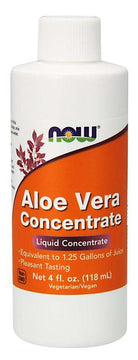
Price: £7.56 (reduced from £9.36) · Reviews: 80 · Where to buy: Available from Welzo
Why it's the best: Liquid concentrate is the format closest to what the research actually used. The colitis trial that gives aloe vera its best evidence used 100ml of oral gel twice daily — an intake you simply cannot approach with softgels. A concentrate lets you dilute and scale the dose rather than being locked to whatever a manufacturer put in a capsule.
It's also the cheapest option here at £7.56, from a GMP-certified family-owned manufacturer operating since 1968, and it mixes easily into water or juice.
Check the label before your first dose. Concentrates vary enormously in strength, and the dilution instructions matter — this is not a product to drink neat by the mouthful. Start at the lowest stated serving and give it a few days.
| Pros | Cons |
|---|---|
| Cheapest option here (£7.56) Liquid — flexible, scalable dosing Closest format to the trial evidence GMP manufacturer, non-GMO |
Must be diluted correctly Taste isn't for everyone Less convenient than capsules May need refrigerating after opening |
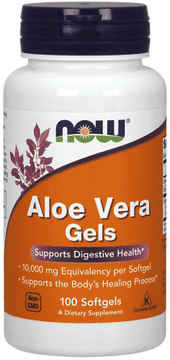
Price: £16.46 · Reviews: 80 · Where to buy: Available from Welzo
Why we like it: If you want aloe vera in your routine without measuring liquid every morning, a softgel is far more likely to actually get taken. NOW's aloe gels use concentrated inner leaf, and 100 softgels gives a long supply at typical dosing. Same manufacturer and quality standards as our top pick.
The trade-off is dose ceiling. No practical number of softgels approaches the intake used in the colitis trial, so treat capsules as general daily support rather than an attempt to replicate the research. At £16.46 it's also more than double the concentrate for a lower total aloe intake — you're paying for convenience.
| Pros | Cons |
|---|---|
| Convenient — no measuring or taste 100 softgels, long supply Concentrated inner leaf GMP manufacturer |
Most expensive here (£16.46) Can't reach trial-level intakes Softgel shell may not suit vegans — check label |
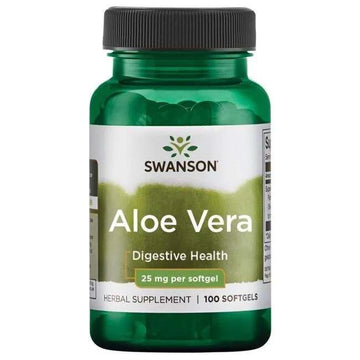
Price: £8.80 (reduced from £11.04) · Reviews: 76 · Where to buy: Available from Welzo
Why we like it: A hundred softgels for under nine pounds makes this the cheapest way to trial aloe vera in capsule form, from a long-established manufacturer. Given how modest the evidence base is, spending little to find out whether it does anything for you is a sensible approach.
Don't be misled by "25mg". Aloe softgels of this type are typically high-ratio concentrates, so the milligram figure on the front bears no relation to fresh gel equivalent — check the stated ratio on the label to understand what you're taking. It's the lowest-dose option here regardless, so set expectations accordingly.
| Pros | Cons |
|---|---|
| Cheap way to trial capsules (£8.80) 100 softgels Established manufacturer Currently reduced |
Lowest aloe dose here "25mg" is uninformative without the ratio Softgel shell may not suit vegans |
There's no established clinical dose for general digestive use. The colitis trial used 100ml of gel twice daily; everyday supplement dosing is far lower and set by the manufacturer, because concentrates differ so much in strength.
Practical guidance: follow the label rather than any figure you read online, since a 200:1 concentrate and a 1:1 juice are not comparable products. Start at the lowest stated serving. Take it with water, and with food if you find it unsettling. Give it two to four weeks before judging — and stop if you get cramping or loose stools, which usually indicates aloin content rather than a normal adjustment period.
Aloe vera is often stacked with other gut supplements. There's no known interaction with probiotics, and the combination is common in practice.
Purified inner leaf aloe is generally well tolerated. Most reported problems trace back to aloin-containing products: abdominal cramping, diarrhoea, and with prolonged use, potassium depletion. Rare cases of liver injury have been reported with oral aloe supplements.
Do not take oral aloe vera if you
Do not give oral aloe vera supplements to children. Never take neat aloe latex or "aloe bitters", and don't eat gel scraped from a houseplant — home preparation doesn't separate the latex.
On labelling: aloe vera carries no authorised health claim in GB or the EU, so it is sold as a food supplement and cannot legally be marketed as treating any condition.
See your GP — or seek urgent care — if you have:
Aloe vera is not a treatment for inflammatory bowel disease and should never replace prescribed therapy. Read more on when to see a GP about stomach symptoms.
NOW Foods Aloe Vera Concentrate at £7.56 is the strongest choice. Liquid concentrate is the format closest to what the clinical research used, it allows you to scale the dose, and it's the cheapest option here. If you'd rather have capsules, Now Foods Aloe Vera Gels at £16.46 are the convenient alternative.
Inner leaf gel is the clear centre of the leaf — mostly water and polysaccharides, with no laxative action, and it's the fraction studied for gut soothing. Aloe latex is the bitter yellow sap just under the rind, containing aloin, which acts as a harsh stimulant laxative and raised genotoxicity concerns with regulators.
Not currently. The EU prohibited aloe leaf preparations containing hydroxyanthracene derivatives in 2021, but the EU General Court annulled those provisions for aloe in November 2024, leaving the ban in place only for danthron. EFSA's underlying genotoxicity findings still stand, so purified inner leaf remains the sensible choice regardless of the legal position.
The evidence is modest. One small randomised trial found oral aloe gel improved outcomes in mild-to-moderate ulcerative colitis, but it hasn't been convincingly replicated. Trials in IBS have produced mixed results. The mechanism is plausible, but aloe sits well below peppermint oil or zinc carnosine in the evidence hierarchy.
Purified inner leaf aloe at label doses is generally intended for daily use. Aloin-containing products should not be taken regularly — stimulant laxatives cause dependence and potassium loss with prolonged use.
No. Aloin-containing preparations have been associated with uterine stimulation, and safety data for oral aloe in pregnancy is inadequate. Avoid it and speak to your midwife or GP about alternatives.
Yes. It may lower blood glucose, so monitor carefully if you take diabetes medication. Any laxative effect can deplete potassium, which matters if you take diuretics or digoxin. Check with your pharmacist if you take regular prescriptions.
Not for eating. Home preparation doesn't reliably separate the inner gel from the latex layer, so you risk ingesting aloin. Commercial supplements are filtered specifically to remove it.
It's the concentration ratio — 1mg of that extract is equivalent to 200mg of fresh gel. This is why a 25mg softgel isn't necessarily a small dose, and why milligram figures are meaningless without the ratio.
No. Ready-to-drink juices are typically close to single-strength gel, while concentrates are far stronger and must be diluted. Never substitute one for the other by volume.
Medical disclaimer: This article is for general information and education only and does not constitute medical advice, diagnosis or treatment. Food supplements are not a substitute for a varied and balanced diet, and are not intended to diagnose, treat, cure or prevent any disease. Oral aloe vera should be avoided in pregnancy and breastfeeding and should not be given to children. Aloe vera may lower blood glucose and may interact with diabetes medication, diuretics and digoxin. Product specifications, prices and availability are correct at the time of writing and may change. Always seek advice from your GP or pharmacist before starting a new supplement, particularly if you have an existing condition or take prescription medication.
About the author
Dr Zeeshan Afzal (MBBS) is a practising medical doctor and Welzo's Medical Content Lead. He writes and reviews Welzo's health content to ensure it is accurate, evidence-based and aligned with current UK clinical guidance, translating complex research into practical advice patients can trust.
 Bewertet mit 28,951+ Bewertungen ausgezeichnet
 100% Geld zurück
Unsere Geld -zurück -Garantie stellt sicher, dass Sie Ihre Artikel oder eine vollständige Rückerstattung erhalten.