






Best Spore-Based Probiotics UK 2026
Posted on:
Aug 05, 2026
Authored by


Written and medically reviewed by Dr Zeeshan Afzal (MBBS) — Medical Doctor & Medical Content Lead, Welzo
Evidence-based · Honest about what's proven and what isn't · UK-focused
Last updated: July 2026 · Reading time: ~13 minutes
Most probiotics have a delivery problem. You swallow billions of live bacteria, stomach acid destroys the majority, and what reaches your intestine is a fraction of what was on the label. Spore-based probiotics solve that problem by not being alive when you take them.
Bacillus species travel as dormant endospores — armoured, dehydrated survival capsules that ignore gastric acid entirely and only wake up once they reach the intestine. No refrigeration, no enteric coating, shelf life measured in years.
That's a genuine engineering advantage, and it has made "sporebiotics" one of the fastest-growing corners of the UK gut health market. It has also produced a lot of marketing that mistakes survivability for efficacy. This guide separates the two, ranks every spore product at Welzo with verified prices and stock, and shows you what the one decent human trial actually measured. Start with gut health supplements for the wider range.
Table of contents
Spore-based probiotics use bacteria from the genus Bacillus — most commonly B. subtilis, B. coagulans, B. clausii, B. licheniformis and B. indicus. These are entirely different organisms from the Lactobacillus and Bifidobacterium species in conventional probiotics.
When conditions are hostile, Bacillus species form endospores: dormant, dehydrated, tough-shelled structures that survive heat, desiccation, time and acid. They are not metabolically active, which is precisely why nothing can kill them in your stomach. Once they reach the small intestine, bile salts and the local environment trigger germination and the bacteria become active.
You'll also see "SBO" or soil-based organism products. These are typically Bacillus species too — the name reflects that they were originally isolated from soil rather than from the human gut, and the underlying argument is that humans historically ingested them constantly via unwashed food and untreated water. It's a plausible evolutionary story; it is not, on its own, clinical evidence.
| Feature | Spore-based (Bacillus) | Conventional (Lacto/Bifido) |
|---|---|---|
| Survives stomach acid | Yes — dormant spore | Partially; often needs coating |
| Refrigeration | Not required | Often required |
| Typical dose | 1–5 billion | 10–50 billion |
| Shelf life | Up to 5 years | Months to ~2 years |
| Depth of evidence | Smaller, newer body of work | Decades, many large trials |
That last row is the one the marketing skips. Conventional strains such as Lactobacillus rhamnosus GG have hundreds of human trials and appear in clinical guidelines. Spore probiotics have a far smaller literature. Better delivery does not compensate for thinner evidence — see spore vs Lactobacillus probiotics.
| What it says | What it means |
|---|---|
| HU58, SC-208, SC-109, SL-307, HU36 | Named strains — check which appear in the trial you're relying on |
| Low CFU (1–5 billion) | Normal for spores — not a weakness |
| "Proprietary blend" with no per-strain amounts | Standard in this category, but you can't see the split |
| "Soil-based" / "SBO" | Origin story, not an evidence claim |
| "Survives stomach acid" | True — but a property of spores, not a health benefit |
Don't be alarmed by the low CFU figures. A 3 billion spore product is not weaker than a 30 billion Lactobacillus product, because a far higher proportion arrives intact. The two numbers measure different things — see CFU vs AFU and how to choose a probiotic.
The key human study is McFarlin and colleagues, published in the World Journal of Gastrointestinal Pathophysiology in 2017. It is a genuinely interesting piece of work and worth understanding properly, because almost every claim made for spore probiotics traces back to it.
Researchers screened 75 apparently healthy adults with a high-fat challenge meal. Those whose blood endotoxin rose at least five-fold five hours afterwards — the "responders" — were randomised to 30 days of either a placebo or a commercial spore-based probiotic.
The results were striking. The probiotic group showed a 42% reduction in post-prandial endotoxin (p=0.011) and a 24% reduction in triglycerides (p=0.004). The placebo group moved in the opposite direction, with a 36% increase in endotoxin over the same period. Inflammatory markers IL-12p70 (p=0.017) and IL-1β (p=0.020) also fell significantly.
The formulation used in that trial contained five strains: B. indicus HU36, B. subtilis HU58, B. coagulans SC208, B. licheniformis SL-307 and B. clausii SC109. The MegaSporeBiotic listings below show four of those strains, without B. indicus HU36. Formulations do change over time, so check the current pack if matching the trial formulation matters to you.
B. coagulans has the strongest strain-level record in this group, with MTCC 5856 studied in diarrhoea-predominant IBS and GBI-30, 6086 in abdominal pain and bloating — covered in detail in our Bacillus coagulans guide. B. clausii has a long history of use in Europe for antibiotic-associated diarrhoea. B. subtilis HU58 has limited standalone human data. Much of the supporting work on these blends comes from laboratory gut-simulation models rather than people.
| Use | Evidence |
|---|---|
| Post-meal endotoxaemia | One 30-day RCT in screened responders; biomarkers only |
| IBS (B. coagulans strains) | Small RCTs plus a supportive meta-analysis |
| Surviving gastric acid | Well established — a property, not a benefit |
| Microbial diversity | Mostly lab gut-simulation models, not human trials |
| "Leaky gut", detox, weight loss | Not demonstrated — treat these claims sceptically |
Prices, review counts and stock were verified from the live listings. Spore blends almost universally use proprietary blends, so per-strain quantities aren't disclosed on any of them.
Best Overall: Microbiome Labs MegaSporeBiotic, 60 caps — £59.99
Best Synbiotic: Enviromedica Terraflora Daily Care, 60 caps — £53.84
Best for Bloating: Atrantil PRO, 90 caps — £75.05
Best Antioxidant Combination: MegaSporeBiotic Plus Antioxidants, 60 caps — £59.99
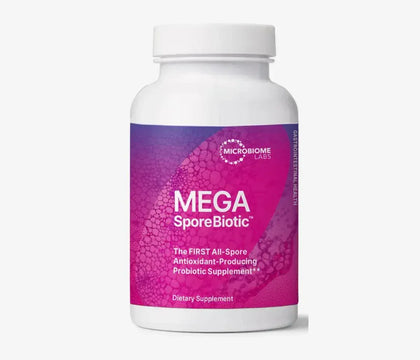
Price: £59.99 (reduced from £65.00) · Reviews: 114 · Stock: In stock · Where to buy: Available from Welzo
Why it's the best: This is the product family the endotoxaemia trial was built on, which puts it ahead of everything else in the category on evidence. The listing shows a 152mg proprietary blend delivering 5 billion spore cells from B. subtilis HU58™, B. coagulans SC-208, B. clausii SC-109 and B. licheniformis SL-307.
It is also the cleanest formulation here — a plain cellulose capsule with the spore blend and nothing else. No refrigeration, a shelf life stated at up to five years, and suitable for adults and children over six. That makes it a sensible travel probiotic too: see travel probiotics.
Two caveats worth knowing. The trial formulation included a fifth strain, B. indicus HU36, which this listing doesn't show — check the current pack if that matters to you. And at £59.99 for a month it is a premium purchase; the evidence behind it is mechanistic rather than symptom-based, so go in with realistic expectations.
| Pros | Cons |
|---|---|
| The product family behind the main human trial Highest spore count here (5 billion) Four named Bacillus strains Cellulose capsule, no other excipients Up to five-year shelf life, no refrigeration Suitable from age six Currently reduced from £65.00 |
Expensive at £59.99 a month Listing shows four strains, trial used five Proprietary blend hides per-strain amounts Evidence is biomarker-based, not symptom-based |
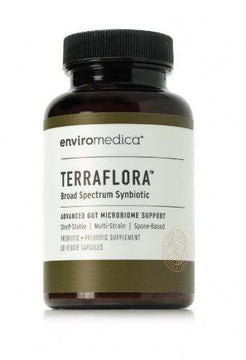
Price: £53.84 · Reviews: 192 · Stock: In stock · Where to buy: Available from Welzo
Why we like it: A broad-spectrum soil-based (SBO) synbiotic — meaning it pairs the spore organisms with prebiotic fibre in the same capsule, so the bacteria have a substrate waiting when they germinate. That's a more coherent design than spores alone, and it's the only product here that does it. Our prebiotic vs probiotic guide explains why the pairing matters.
It also carries 192 reviews — comfortably the most of any spore product on the site, and more than any product in our other probiotic guides. It undercuts MegaSporeBiotic by £6 for the same capsule count.
The honest limitation is evidence. "Soil-based" describes where the organisms came from, not what they've been shown to do, and this specific blend does not have its own published human trial. If you want the formulation tied to the research, that's number one. If you want a well-reviewed daily synbiotic at a slightly lower price, this is a reasonable choice.
| Pros | Cons |
|---|---|
| Synbiotic — spores plus prebiotic in one capsule Most reviewed spore product here (192) £6 cheaper than MegaSporeBiotic Broad-spectrum formulation Shelf stable In stock |
No published human trial on this blend "Soil-based" is an origin story, not evidence Added prebiotic may aggravate sensitive guts Still a premium price at £53.84 |
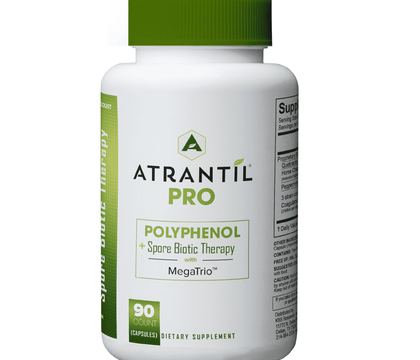
Price: £75.05 · Reviews: 120 · Stock: In stock · Where to buy: Available from Welzo
Why we like it: A different proposition from the others — it combines spore biotics with polyphenols, and Atrantil's original formulation was developed specifically around bloating and abdominal discomfort rather than general gut maintenance. If bloating is your actual complaint rather than a vague wish to "support the microbiome", this is the most targeted product in the category.
The 90-capsule pack is also the largest here, and polyphenols are independently associated with beneficial shifts in gut bacteria — see polyphenols and gut health.
It is the most expensive option at £75.05, and while Atrantil's non-PRO formulation has been studied for bloating, that evidence does not automatically transfer to this spore-containing version. Anyone whose bloating is persistent, or who suspects SIBO, should be assessed rather than self-treating — see supplements for bloating and SIBO.
| Pros | Cons |
|---|---|
| Targeted at bloating rather than general support Combines polyphenols with spore biotics Largest pack here at 90 capsules Well reviewed (120) In stock |
Most expensive option (£75.05) Evidence for the original formula doesn't transfer automatically Not a simple daily maintenance probiotic Persistent bloating needs assessment, not self-treatment |
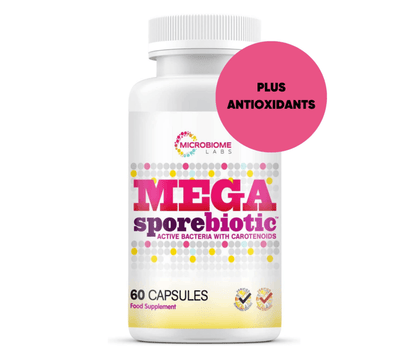
Price: £59.99 · Reviews: 122 · Stock: In stock · Where to buy: Available from Welzo
Why we like it: The same four-strain Microbiome Labs blend as our top pick, with beta carotene, astaxanthin, lutein and lycopene added at 1mg each. If you want carotenoids and a spore probiotic in one capsule, this consolidates them, and it is slightly better reviewed than the standard version.
Why it ranks last, plainly. Both products cost exactly £59.99. For that identical price, this one gives you a 100mg blend at 4 billion spore cells rather than 152mg at 5 billion — around 20% fewer spores — and adds modified starch and sucrose to the excipient list. You are paying the same money for less probiotic plus 4mg of carotenoids you could get from a portion of vegetables.
Unless the single-capsule convenience genuinely matters, buy the standard MegaSporeBiotic at number one instead.
| Pros | Cons |
|---|---|
| Same four-strain blend as our top pick Adds four carotenoid antioxidants Convenient all-in-one capsule Best reviewed of the two MegaSpore products (122) In stock |
Same £59.99 price for ~20% fewer spores Contains modified starch and sucrose Carotenoid doses are small (1mg each) Standard MegaSporeBiotic is the better buy |
These are spore-based products we have not ranked, because we could not verify current pricing and availability at the time of writing. Strain details are taken from the product listings. Check each page for current price and stock.
| Product | What's in it |
|---|---|
| Microbiome Labs RestorFlora PD, 21 caps | HU58, SC-109, SC-208 HC plus S. boulardii CNCM-I-1079; enteric coated. The best rationale for use during antibiotics, since the yeast isn't killed by them. |
| Microbiome Labs HU58 High Potency, 60 caps | B. subtilis HU58 alone at 10 billion CFU — the only single-strain spore option, for anyone who wants one organism rather than a blend. |
| Biocidin Proflora 4R, 30 caps | Three spore strains at 3 billion cells plus quercetin, marshmallow root and aloe vera gel — aimed at gut barrier protocols. |
| Cura Sporebiotics, 30 caps | Three spore strains with carotenoids, suitable from age three — the lowest age threshold available. See children's probiotics. |
Most spore products are one to two capsules daily. The endotoxaemia trial used four capsules a day for 30 days, which is higher than typical label dosing — worth knowing if you're trying to mirror the study.
Start low, and expect a settling-in period. Spore probiotics have a reputation for causing more noticeable adjustment symptoms than conventional ones — wind, bloating, looser or firmer stools during the first week or two. Many practitioners suggest starting with one capsule every other day, or half a capsule, and building up over two to three weeks. This is the single most common reason people abandon them unnecessarily.
Take with food. Bile salts released with a meal help trigger germination, so this is one probiotic where taking it with food has a mechanistic reason rather than being a convention. See when to take probiotics.
Give it time. The main trial ran 30 days and other work has used 90. Allow at least four weeks before judging — see how long probiotics take to work. No refrigeration is needed for any product here: do probiotics need refrigeration.
Bacillus probiotics have a good safety record in healthy adults. The usual experience is a temporary increase in wind, bloating or stool changes over the first week or two, which typically settles — see probiotic side effects.
Speak to a doctor before taking spore probiotics if you
Products containing Saccharomyces boulardii carry an additional caution: yeast-based probiotics should be avoided by people with central venous catheters, in whom fungaemia has been reported. Further detail in probiotics safety.
On labelling: probiotics carry no authorised health claim in GB or the EU, so they are sold as food supplements and cannot legally be marketed as treating any condition.
See your GP — or seek urgent care — if you have:
Persistent bloating in particular should be assessed rather than self-treated — in women it is one of the symptoms associated with ovarian cancer. Read more on when to see a GP about stomach symptoms and bowel cancer screening in the UK.
Microbiome Labs MegaSporeBiotic at £59.99 — it is the product family used in the main human trial and delivers the highest spore count here at 5 billion from four named strains. Enviromedica Terraflora Daily Care at £53.84 is the best-reviewed alternative and adds a prebiotic.
Better at surviving the stomach, yes. Better overall, not established. Conventional strains such as L. rhamnosus GG have hundreds of human trials and appear in clinical guidelines; spore probiotics have a much smaller literature. Delivery is only one part of the picture.
Because far more of it survives. Spore products are typically dosed at 1 to 5 billion rather than the 10 to 50 billion common in conventional probiotics, since the spores pass through gastric acid intact. The two numbers are not comparable.
No. They are stable at room temperature and some carry a shelf life of up to five years, which makes them the most practical probiotics for travel or for keeping in a desk drawer.
The main trial found a 42% reduction in post-meal blood endotoxin and a 24% reduction in triglycerides over 30 days, in healthy adults pre-screened as high responders. Those are biomarkers rather than symptoms, so it demonstrates a plausible mechanism rather than proving the products treat anything.
An increase in wind, bloating or stool changes in the first week or two is common with spore probiotics and usually settles. Starting with one capsule every other day and building up over two to three weeks makes the transition much easier. If symptoms are severe or persist, stop and speak to a pharmacist or GP.
For healthy adults, generally yes — they are Bacillus species, the same organisms as other sporebiotics, and the "soil-based" name refers to where they were originally isolated. People who are immunocompromised or have indwelling lines should avoid all live probiotics without medical advice.
Some are formulated for them — Cura Sporebiotics states suitability from age three, and MegaSporeBiotic from age six. Always check the specific product and speak to your GP or health visitor before giving a supplement to a child.
Spores are hardy but still bacteria, so antibiotics can affect them. For cover during a course, a product containing Saccharomyces boulardii — a yeast, unaffected by antibacterials — has better rationale. RestorFlora PD combines both.
No product should be sold on that basis. The endotoxaemia trial is often cited as proof, but the researchers could not directly measure gut permeability and said so explicitly. It is a mechanistic signal, not a treatment claim.
Medical disclaimer: This article is for general information and education only and does not constitute medical advice, diagnosis or treatment. Food supplements are not a substitute for a varied and balanced diet, and are not intended to diagnose, treat, cure or prevent any disease. Probiotics should be discussed with a doctor before use if you are immunocompromised, critically unwell, have an indwelling venous line, have inflammatory bowel disease, or are pregnant or breastfeeding, and supplements for children should be discussed with a GP or health visitor. Persistent bloating or a change in bowel habit should be medically assessed. Product specifications, prices, review counts and availability are correct at the time of writing and may change. Always seek advice from your GP or pharmacist before starting a new supplement, particularly if you have an existing condition or take prescription medication.
About the author
Dr Zeeshan Afzal (MBBS) is a practising medical doctor and Welzo's Medical Content Lead. He writes and reviews Welzo's health content to ensure it is accurate, evidence-based and aligned with current UK clinical guidance, translating complex research into practical advice patients can trust.
 Évalué Excellent par 28,951+ avis
 Garantie de remboursement à 100%
Notre garantie de rétroaction garantit que vous recevez vos articles ou obtenez un remboursement complet.


