




Best Saccharomyces boulardii Supplements UK
Posted on:
Aug 05, 2026
Authored by


Written and medically reviewed by Dr Zeeshan Afzal (MBBS) — Medical Doctor & Medical Content Lead, Welzo
Part of our digestive health guides · Shop gut health supplements
Evidence-based · Honest about what's proven and what isn't · UK-focused
Last updated: July 2026 · Reading time: ~15 minutes
Saccharomyces boulardii is the odd one out in the probiotics aisle — it isn't a bacterium at all, but a beneficial yeast. Antibiotics can't kill it, which is why it has been through roughly 100 clinical trials and why it lives in the luggage of seasoned travellers.
The evidence is genuinely strong for one thing in particular. A meta-analysis of 21 randomised controlled trials covering 4,780 people found S. boulardii cut the risk of antibiotic-associated diarrhoea from 18.7% to 8.5% — a relative risk of 0.47, with only 10 people needing treatment to prevent one case (Szajewska & Kołodziej, 2015).
We compared every S. boulardii supplement currently in stock at Welzo on strain transparency, dose, formulation quality and — the number most buying guides ignore — cost per clinically relevant dose.
Table of contents
S. boulardii is a non-pathogenic yeast isolated in 1920 by French microbiologist Henri Boulard, who noticed people in Indochina chewing lychee and mangosteen skins to settle cholera-related diarrhoea. He cultured the yeast from those fruit skins, and it has been used as a medicinal probiotic in Europe ever since.
Genetically it sits within Saccharomyces cerevisiae — the same species as baker's yeast — but behaves very differently, growing best at body temperature and tolerating stomach acid. Unlike your resident gut bacteria it doesn't colonise: it reaches steady state within about three days and clears within three to five days of stopping. That makes it a tool for a defined window, not a permanent daily supplement.
Nearly every other probiotic is a bacterium, and antibiotics are designed to kill bacteria. Taking a bacterial probiotic mid-course is a race between the dose you swallow and the drug in your bloodstream. Antibacterial drugs have no mechanism of action against a fungal cell, so S. boulardii passes through unaffected — the main reason clinicians reach for it during a course of antibiotics.
The flagship use, and the evidence is strong. In the 2015 meta-analysis, risk fell from 20.9% to 8.8% in children and from 17.4% to 8.2% in adults. The World Gastroenterology Organisation lists the CNCM I-745 strain for this indication at evidence level 1.
Eradication therapy works but is poorly tolerated, and people who stop early don't clear the infection. A meta-analysis of 18 trials in 3,592 patients found adding S. boulardii modestly improved eradication rates (RR 1.09) and cut total side effects by more than half (RR 0.47), with discontinuation falling from 4.9% to 1.6% (Zhou et al., 2019). Relevant if you're being treated for H. pylori.
A systematic review found S. boulardii CNCM I-745 significantly reduced incidence (RR 0.79), while L. rhamnosus GG showed only a trend and L. acidophilus no significant effect. See our guide to probiotics for traveller's diarrhoea.
S. boulardii is marketed heavily for candida, SIBO and IBS. The rationale is plausible and small trials exist, but these are fewer and less consistent than the diarrhoea data. For C. difficile, the 2015 meta-analysis found a significant effect in children but not adults — see probiotics and C. difficile.
For general guidance see how to choose a probiotic.
Best Value: Now Foods Saccharomyces Boulardii 5 Billion CFU, 60 Veg Capsules — £19.14
Best Vegetarian: Seeking Health Saccharomyces Boulardii, 60 Vegetarian Capsules — £26.63
Best Shelf-Stable: Metagenics Saccharomyces Boulardii, 90 Capsules — £28.06
Best Hypoallergenic: Pure Encapsulations Saccharomyces Boulardii, 30 Capsules — £33.50
Best Practitioner-Grade: Klaire Labs Ther-Biotic Saccharomyces Boulardii, 60 Capsules — £36.59
Best Synbiotic: Jarrow Formulas Saccharomyces Boulardii + MOS, 180 Capsules — £60.49
Best for Children: Klaire Labs Saccharomyces boulardii Powder, 127g — £151.68
Trial doses are 250–500 mg twice daily, roughly 5–10 billion CFU per day. Headline price tells you very little; what matters is what it costs to reach a researched dose. This table normalises everything to the cost of one 5-billion-CFU serving.
| Product | Price | Size | Approx. cost per 5bn CFU |
|---|---|---|---|
| Now Foods | £19.14 | 60 caps @ 5bn | £0.32 |
| Jarrow + MOS (180s) | £60.49 | 180 caps @ 5bn | £0.34 |
| Seeking Health | £26.63 | 60 caps @ 5bn | £0.44 |
| Klaire Labs Ther-Biotic | £36.59 | 60 caps | £0.61 |
| Metagenics | £28.06 | 90 caps @ 1.5bn | £1.04 |
| Pure Encapsulations | £33.50 | 30 caps @ 5bn | £1.12 |
Prices correct at time of writing. CFU per capsule as stated by each manufacturer; where a product states potency at time of manufacture rather than to expiry, real-world delivered dose may be lower.
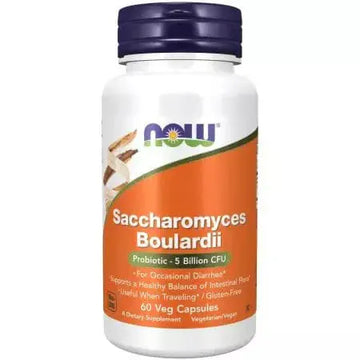
Price: £19.14 · Reviews: 146 · Where to buy: Available from Welzo
Why we like it: The lowest headline price of any in-stock option, and it still delivers a full 5 billion CFU per vegetarian capsule — so you're not compromising dose to save money. Now Foods is a large, long-established manufacturer with its own testing laboratories. At £0.32 per clinical dose it's the strongest choice if you want a short course for a single antibiotic prescription rather than an ongoing supply.
| Pros | Cons |
|---|---|
| Lowest headline price in stock Full 5 billion CFU per capsule Vegetarian capsule In-house quality testing |
60 capsules — 30 days at twice daily Strain not specified Less premium positioning than practitioner brands |
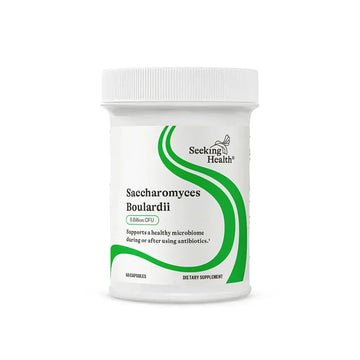
Price: £26.63 · Reviews: 160 · Where to buy: Available from Welzo
Why we like it: 5+ billion CFU in a vegetarian capsule from a brand built around clean formulation, and the most-reviewed S. boulardii product Welzo stocks. Seeking Health uses the identified Lynside® PRO SCB material, which is manufactured to pharmaceutical standards — a meaningful step up from products that name no strain source at all, even if it carries fewer published trials than CNCM I-745.
| Pros | Cons |
|---|---|
| Identified strain material (Lynside® PRO SCB) 5+ billion CFU per capsule Vegetarian, clean formulation Most-reviewed option here (160) |
Mid-range cost per dose (£0.44) 60 capsules only Fewer trials on this strain than CNCM I-745 |
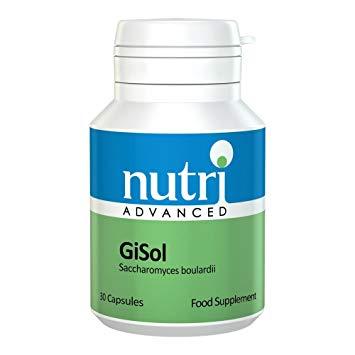
Price: £28.06 · Reviews: 130 · Where to buy: Available from Welzo
Why we like it: Formerly sold as Gisol, this guarantees 1.5 billion S. boulardii per capsule up to the expiry date rather than at manufacture — rarer than it should be, and it means the label number is what you actually swallow on the last day of the pot. No refrigeration needed, making it the most travel-practical option here. The trade-off is blunt: at 1.5 billion per capsule you need three to four capsules to reach a trial-level dose, which pushes the real cost to around £1.04 per clinical serving. See shelf-stable probiotics.
| Pros | Cons |
|---|---|
| Potency guaranteed to expiry date No refrigeration needed — ideal for travel 90 capsules Long-established practitioner brand |
1.5 billion CFU per capsule — lowest here Needs 3–4 capsules for a clinical dose Expensive per researched serving (£1.04) |

Price: £33.50 · Reviews: 106 · Where to buy: Available from Welzo
Why we like it: Pure Encapsulations built its reputation on hypoallergenic formulation and label accuracy — S. boulardii with rice maltodextrin in a vegetarian capsule, GMP manufactured with testing for identity and contaminants. This is the pick if you have multiple sensitivities or react to excipients; the ingredient list is about as short as it gets, and practitioners use the brand precisely because they trust what's on the label. The honest caveat is cost: at 30 capsules and £1.12 per clinical dose, a full antibiotic course gets expensive fast.
| Pros | Cons |
|---|---|
| Hypoallergenic, minimal excipients Strong clinician reputation for label accuracy GMP manufactured and contaminant tested |
Most expensive per dose here (£1.12) Only 30 capsules — a fortnight at twice daily Contains rice maltodextrin carrier |
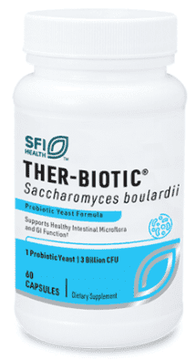
Price: £36.59 · Reviews: 122 · Where to buy: Available from Welzo
Why we like it: Klaire Labs (SFI Health) is one of the most widely used practitioner brands in UK integrative clinics, with lactose-free, gluten-free, hypoallergenic formulation and routine potency verification. If you're following a protocol prescribed by a nutritional therapist or functional medicine practitioner, this is likely the brand they'll name. At £0.61 per dose it sits mid-table on value — you're paying for the quality systems rather than the yeast.
| Pros | Cons |
|---|---|
| Widely used practitioner brand Lactose free, gluten free, hypoallergenic Routine potency verification 60 capsules |
Mid-to-high cost per dose (£0.61) No advantage over cheaper options on dose alone Premium pricing reflects brand systems |
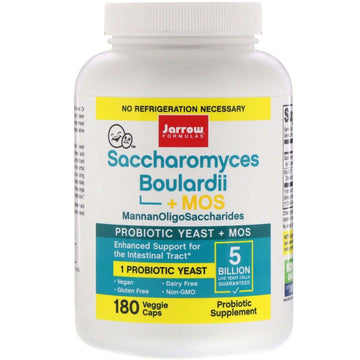
Price: £60.49 · Reviews: 122 · Where to buy: Available from Welzo (also in a smaller 90-capsule size)
Why we like it: Jarrow pairs 5 billion CFU of S. boulardii with MOS (mannan-oligosaccharides), a prebiotic that feeds resident bacteria — making this a synbiotic rather than a straight probiotic. There's a neat logic to the pairing: S. boulardii is transient and leaves within days of stopping, so it does nothing to rebuild your resident population, while MOS feeds the bacteria that stay. If your goal is post-antibiotic recovery rather than symptom prevention during the course, that addresses both halves. At 180 capsules it's also the largest supply here. See synbiotic supplements.
| Pros | Cons |
|---|---|
| Prebiotic MOS included 5 billion CFU per capsule 180 capsules — 90 days at twice daily Good cost per dose (£0.34) |
Highest upfront cost Prebiotics can worsen bloating in some people Less suitable during a low-FODMAP phase |
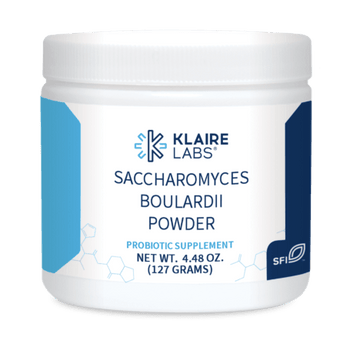
Price: £151.68 · Reviews: 128 · Where to buy: Available from Welzo
Why we like it: A 127g powder delivering 3–5 billion CFU per serving, lactose free, gluten free and hypoallergenic. Powder is the practical answer for anyone who can't swallow capsules — children in particular, where paediatric trials used 250 mg twice daily — and it lets you titrate the dose precisely in a way capsules don't.
Be clear-eyed about the price. At £151.68 this is by a wide margin the most expensive product here, and it is a bulk professional size rather than a consumer pot. Unless you specifically need powder or are dosing several people over months, a capsule product opened into food may serve you better. One handling note: mix into cool or room-temperature liquid only — heat above roughly 40°C kills the yeast. Always speak to a pharmacist or GP before giving probiotics to an unwell child; see children's probiotics.
| Pros | Cons |
|---|---|
| Powder — no capsules to swallow Precise dose titration possible Lactose free, gluten free, hypoallergenic Large 127g professional size |
By far the most expensive option (£151.68) Needs scales or an accurate scoop Must not be added to hot liquid Impractical for travel |
Also stocked, currently out of stock: OptiBac Saccharomyces Boulardii 40 capsules (£20.01), Kirkman Laboratories 100 capsules (£66.76) and Swanson 30 vcaps (£8.18). OptiBac in particular is the best-known UK consumer brand in this category and worth checking back for.
| Situation | Typical trial dose | Duration |
|---|---|---|
| Adults, antibiotic course | 500 mg twice daily | Day 1 of antibiotics until a few days after finishing |
| Children, antibiotic course | 250 mg twice daily | Duration of antibiotics |
| Travel | 250–1000 mg daily | From ~5 days before travel, throughout the trip |
| H. pylori eradication | 500 mg twice daily | Alongside the eradication regimen |
You do not need to space it away from antibiotics — that's the advantage of a yeast. Steady-state gut levels are reached in about three days, so for preventing antibiotic-associated diarrhoea, start on day one rather than waiting for symptoms.
In trials S. boulardii was well tolerated. The most commonly reported effects are transient: mild bloating, wind, increased thirst and occasional constipation, usually settling within a few days — see probiotic side effects. The one meaningful interaction is with antifungal medication: fluconazole or oral nystatin will kill the yeast. Antibacterial antibiotics are not a problem.
Important: do not take S. boulardii if you
Very rare cases of fungaemia (yeast entering the bloodstream) have been reported. In 2017 the European Medicines Agency concluded that in critically ill or immunocompromised patients the risks outweigh the benefits, and required product information to be updated (EMA, 2017). Around half of fatal cases occurred in patients with a central line. For everyone else, the safety record across thousands of trial participants is reassuring.
There is limited safety data in pregnancy and breastfeeding, so discuss it with your midwife or GP first. On labelling: probiotics are sold in the UK as food supplements, and no probiotic health claims are currently authorised on the GB register — a regulatory position on claim wording, not a verdict on the science.
See your GP — or seek urgent care — if you have:
Read more on when to see a GP about stomach symptoms, and see NHS — Diarrhoea and vomiting.
For most adults the Now Foods Saccharomyces Boulardii offers the best combination of dose and value at £19.14 for 60 vegetarian capsules, working out at roughly £0.32 per 5-billion-CFU serving — the lowest cost per clinically relevant dose of any option we compared. If you need a powder rather than capsules, or are buying for a child, choose differently: the Klaire Labs powder is the practical option there.
Clinical trials used 250–500 mg of freeze-dried yeast twice daily, roughly 5–10 billion CFU per day. Check the per-capsule count rather than the headline number: a 90-capsule pot at 1.5 billion CFU needs three to four capsules to match what one 5-billion capsule delivers, which changes the real cost considerably.
Yes, and this is its main advantage. Because it's a yeast, antibacterial antibiotics don't kill it, so it can be taken at the same time rather than spaced apart. Trials generally started it on the first day of the course and continued for a few days afterwards.
It reaches steady-state levels in the gut within about three days. For preventing antibiotic-associated diarrhoea the benefit comes from starting early rather than waiting for symptoms. For general digestive symptoms, allow one to two weeks.
Not directly. It's a beneficial yeast unrelated to Candida albicans and doesn't cause or worsen thrush. Laboratory and animal work suggests it may reduce candida colonisation by competing for adhesion sites, but human evidence is preliminary and it shouldn't be considered an antifungal treatment.
It's well tolerated in trials, but because it doesn't colonise the gut, continuous long-term use isn't really the point — most people use it as a defined course around antibiotics, travel or a period of gut disruption. For ongoing daily support, a multi-strain bacterial probiotic plus dietary fibre is a better fit.
People who are critically ill, significantly immunocompromised, have a central venous catheter, or are receiving parenteral nutrition should avoid it because of the rare risk of fungaemia. The European Medicines Agency concluded in 2017 that the risk outweighs the benefit in these groups.
Generally no — the yeast cell wall resists heat and humidity, so most products are shelf-stable. Some manufacturers refrigerate as an extra precaution. Check the individual label, and never add powders to hot drinks.
Yes. A yeast and bacterial strains occupy different ecological niches and don't compete, so they can be taken together. Browse the best probiotics UK guide for multi-strain options.
Genetically it belongs to the same species, Saccharomyces cerevisiae, but it's a distinct strain that thrives at body temperature, tolerates stomach acid, and has a clinical evidence base ordinary brewer's or baker's yeast does not. Eating brewer's yeast is not a substitute.
Medical disclaimer: This article is for general information and education only and does not constitute medical advice, diagnosis or treatment. Food supplements are not a substitute for a varied and balanced diet or a healthy lifestyle, and are not intended to diagnose, treat, cure or prevent any disease. Product specifications, prices and availability are correct at the time of writing and may change — always check the product page and label. Always seek advice from your GP, pharmacist or another suitably qualified clinician before starting a new supplement, particularly if you are pregnant, breastfeeding, immunocompromised, taking prescription medication or have an existing health condition.
About the author
Dr Zeeshan Afzal (MBBS) is a practising medical doctor and Welzo's Medical Content Lead. He writes and reviews Welzo's health content to ensure it is accurate, evidence-based and aligned with current UK clinical guidance, translating complex research into practical advice patients can trust.

 Beoordeeld uitstekend door 28,951+ beoordelingen
 100% geld -terug -garantie
Onze geld -terug -garantie zorgt ervoor dat u uw artikelen ontvangt of een volledige terugbetaling krijgt.


