





Best Zinc Carnosine Supplements UK


Související produkty
Written and medically reviewed by Dr Zeeshan Afzal (MBBS) — Medical Doctor & Medical Content Lead, Welzo
Part of our digestive health guides · Shop gut health supplements
Evidence-based · Honest about what's proven and what isn't · UK-focused
Last updated: July 2026 · Reading time: ~14 minutes
Zinc carnosine is unusual among gut health supplements: it started life as a prescription medicine. Licensed in Japan since 1994 for gastric ulcers under the name polaprezinc, it has a genuine pharmaceutical history rather than a wellness one.
The landmark trial is worth knowing before you buy. In a randomised crossover study, indomethacin tripled gut permeability in healthy volunteers — the lactulose:rhamnose ratio rose from 0.35 to 0.88. When zinc carnosine was taken alongside it, that rise did not happen at all (Mahmood et al., Gut, 2007).
Two things trip buyers up: it is very easy to buy plain L-carnosine by mistake, and a full clinical dose delivers more zinc than UK guidance suggests taking long term. We've ranked every zinc carnosine product currently in stock at Welzo and explained both.

Table of contents
- What is zinc carnosine?
- The mistake most buyers make
- What the evidence shows
- The zinc ceiling — why this is a course, not a habit
- How we chose
- Our top picks
- Cost per clinical dose compared
- 1. Doctor's Best PepZin GI — Best Overall
- 2. Revive Zinc Carnosine — Best Value
- 3. Swanson PepZin GI — Best for Trying It
- 4. Seeking Health — Best Vegetarian
- Dosage and how to take it
- Side effects and who should avoid it
- When to see a doctor
- Frequently asked questions
What is zinc carnosine?
Zinc carnosine — also called polaprezinc or zinc-L-carnosine — is a chelated compound in which one zinc ion is bound to one molecule of the dipeptide L-carnosine in a 1:1 ratio. That chelation is the whole point. The bound complex behaves completely differently from either component taken alone.
Why the chelation matters
Ordinary zinc supplements dissolve in the stomach and are absorbed. Zinc carnosine instead dissolves slowly and adheres to areas of damaged or ulcerated mucosa, where it releases zinc gradually and directly at the site that needs repair. It stays in the gut lumen rather than being rapidly absorbed — which is precisely why it works locally on the gut lining rather than acting as a systemic mineral supplement.
In laboratory work it stimulated cell migration and proliferation roughly three-fold, the two processes involved in re-lining damaged epithelium. This is why it appears so often in protocols aimed at gut barrier function rather than digestion or bloating.
PepZin GI — the branded form
Most quality products use PepZin GI, the branded zinc-L-carnosine ingredient used in the published human trials. A capsule typically contains 37.5mg of the complex, which supplies around 8mg of elemental zinc and 29.5mg of L-carnosine. If a label names PepZin GI, you know which material you're getting.
The mistake most buyers make
Zinc carnosine is not the same as L-carnosine
Search "carnosine" on any UK supplement site and you will get two entirely different products side by side. L-carnosine (or "Super Carnosine") is a free dipeptide sold for muscle buffering, antioxidant and cognitive purposes. Zinc carnosine is the zinc-chelated complex studied for gut mucosal repair.
They are not interchangeable. Plain L-carnosine has no meaningful evidence for gut lining repair, because the gut effects come from the chelated complex adhering to the mucosa and releasing zinc locally. If the label says only "L-Carnosine 500mg" with no zinc, it is the wrong product for this purpose — and it is often more expensive.
How to check in five seconds: look at the supplement facts panel for zinc. A genuine zinc carnosine product lists elemental zinc (usually around 8mg per capsule) alongside L-carnosine. If there's no zinc on the panel, put it back.
What the evidence shows
NSAID-induced gut injury — the strongest evidence
The 2007 Gut study remains the reference point. Ten healthy volunteers took indomethacin 50mg three times daily for five days, with either placebo or zinc carnosine 37.5mg twice daily, in a double-blind crossover design. Indomethacin roughly tripled intestinal permeability in the placebo arm. In the zinc carnosine arm there was no significant increase at all.
The same paper reported a 75% reduction in gastric injury and a 50% reduction in villus shortening in animal models. If you take regular anti-inflammatories, this is the most directly relevant evidence available — see ibuprofen and stomach damage.
Exercise-induced permeability — good supporting evidence
A 2016 randomised trial in the American Journal of Clinical Nutrition found zinc carnosine worked alongside bovine colostrum to truncate the rise in gut permeability caused by heavy exercise, with effects on tight junctions, apoptosis and heat shock protein 70. Notably, the two were studied together — so if you're combining them, that combination has actually been tested. See our guide to colostrum supplements.
Gastric ulcers and H. pylori — established clinical use
Polaprezinc has been prescribed in Japan for gastric ulcer treatment since 1994, and has been studied as an adjunct to H. pylori eradication therapy. That's a three-decade regulatory track record, which is unusual for something sold in the UK as a food supplement. Relevant reading: stomach ulcers and H. pylori.
Where the evidence is thinner
Zinc carnosine is widely recommended for IBS, general "leaky gut" and reflux. The mechanistic case is reasonable and it is plausibly helpful, but the trials are small, often Japanese, and rarely placebo-controlled for those specific indications. The 2007 study itself concluded that further studies are warranted — a caution worth keeping. See is leaky gut real for context.
| Use | Evidence | Key finding |
|---|---|---|
| NSAID-induced permeability | Good | 3-fold rise fully prevented (L:R 0.35 → 0.88 in controls) |
| Gastric ulcer | Good | Licensed prescription use in Japan since 1994 |
| Exercise-induced permeability | Moderate | RCT; effective combined with colostrum |
| H. pylori adjunct | Moderate | Studied as add-on to eradication therapy |
| IBS, reflux, general gut | Preliminary | Small trials, plausible mechanism |
The zinc ceiling — why this is a course, not a habit
Here is the practical point that changes how you should buy and use it.
This isn't a reason to avoid zinc carnosine. It is a reason to treat it as a defined course rather than an indefinite daily supplement — typically four to eight weeks, which is also the window over which the research measured effects. It also means you should check your other supplements: a multivitamin, a separate zinc tablet or an immune formula can quietly push you well past the ceiling.
If you need something for ongoing daily use rather than a course, a lower dose (one or two capsules) or a different mucosal-support option makes more sense. Compare against zinc carnosine vs slippery elm and supplements for leaky gut.
How we chose
- Genuine zinc carnosine, not plain L-carnosine. This alone excluded most of the category.
- PepZin GI or a stated zinc content — the branded ingredient used in the trials.
- Cost per clinical dose — four capsules a day changes the maths considerably.
- Pack size versus course length — can one bottle cover a meaningful course?
- Capsule suitability — vegetarian, allergen profile, excipients.
All four products below are available to buy now.
Our top picks
Best Overall: Doctor's Best PepZin GI Zinc-L-Carnosine Complex, 120 Capsules — £41.08
Best Value: Revive Zinc Carnosine, 120 vcaps — £27.71
Best for Trying It: Swanson Zinc Carnosine featuring PepZin GI, 60 Capsules — £21.10
Best Vegetarian: Seeking Health Zinc Carnosine, 60 Vegetarian Capsules — £45.35
Cost per clinical dose compared
At the researched dose of four 37.5mg capsules daily, pack size matters far more than shelf price. This table shows cost per capsule and how long each pack lasts at a full clinical dose.
| Product | Price | Capsules | Cost per capsule | Days at 4/day |
|---|---|---|---|---|
| Revive | £27.71 | 120 | £0.23 | 30 |
| Doctor's Best PepZin GI | £41.08 | 120 | £0.34 | 30 |
| Swanson PepZin GI | £21.10 | 60 | £0.35 | 15 |
| Seeking Health | £45.35 | 60 | £0.76 | 15 |
Prices correct at time of writing. "Days at 4/day" assumes 37.5mg per capsule, the standard PepZin GI strength — always confirm the per-capsule strength on the product page, as it varies between brands. Many people use one to two capsules daily rather than four; see the dosage section.
1. Doctor's Best PepZin GI Zinc-L-Carnosine Complex, 120 Capsules — Best Overall
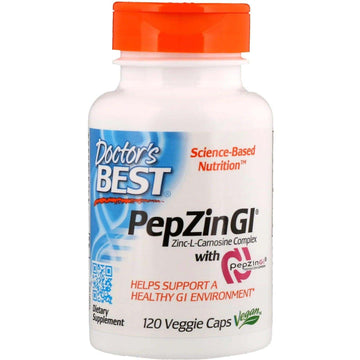
Price: £41.08 · Reviews: 128 · Where to buy: Available from Welzo
120 capsules of the branded PepZin GI zinc-L-carnosine complex — the same material used in the published human trials.
Why it's the best: Two things settle it. First, it names PepZin GI explicitly, so you're getting the exact ingredient the research was conducted on rather than a generic zinc-carnosine blend. Second, and more practically, 120 capsules is the only pack here that covers a full 30-day course at the clinical dose of four capsules daily. The 60-capsule bottles run out in a fortnight, which means reordering mid-course — an easy way to lose the thread of a protocol that's supposed to run four to eight weeks.
It also has the most reviews in the category at 128, and at £0.34 per capsule it's within pennies of the cheapest per-capsule option while carrying the branded ingredient. It isn't the lowest headline price, but on cost per completed course it's the sensible choice.
| Pros | Cons |
|---|---|
| Branded PepZin GI — the researched ingredient 120 capsules covers a full 30-day course Most reviewed in the category (128) £0.34 per capsule |
Higher upfront price than 60-capsule packs Four capsules daily at clinical dose Exceeds NHS zinc guidance at full dose — course use only |
2. Revive Zinc Carnosine, 120 vcaps — Best Value
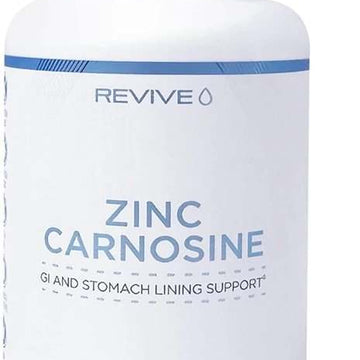
Price: £27.71 (reduced from £43.04 — save £15.33) · Reviews: 66 · Where to buy: Available from Welzo
Why we like it: The cheapest per capsule here by a clear margin at £0.23, in a 120-capsule vegetarian format that also covers a full month at clinical dosing. At the current reduced price it undercuts the Doctor's Best equivalent by more than £13 for the same capsule count — a meaningful saving on a course-based supplement.
The reason it isn't our overall pick is transparency: the listing doesn't confirm PepZin GI branding or per-capsule strength, so verify both on the product page before assuming the dosing maths above applies. It also has the fewest reviews in the category. If the label checks out, it's the best-value way to complete a course.
| Pros | Cons |
|---|---|
| Cheapest per capsule (£0.23) 120 vegetarian capsules — full month Currently reduced by £15.33 Best value for a complete course |
PepZin GI branding not confirmed on listing Per-capsule strength needs checking Fewest reviews here (66) |
3. Swanson Zinc Carnosine featuring PepZin GI, 60 Capsules — Best for Trying It
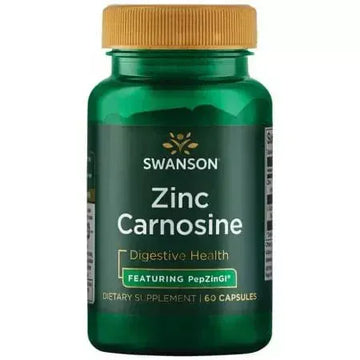
Price: £21.10 · Reviews: 106 · Where to buy: Available from Welzo
Why we like it: The lowest entry price in the category, with branded PepZin GI and a clearly stated label — 8mg zinc and 29.5mg L-carnosine per capsule, which is the textbook 37.5mg complex. That label clarity is genuinely useful: you can calculate your zinc intake precisely, which matters given the ceiling discussed above.
At 60 capsules it's a fortnight at clinical dosing, so treat it as a way to test tolerance before committing to a 120-capsule bottle — or as a month's supply at the lower two-capsule daily dose that many people use for maintenance.
| Pros | Cons |
|---|---|
| Lowest entry price (£21.10) Branded PepZin GI Clear label: 8mg zinc, 29.5mg carnosine per capsule Low-risk way to test tolerance |
Only 15 days at clinical dose Needs reordering mid-course Higher per capsule than the 120-count packs |
4. Seeking Health Zinc Carnosine, 60 Vegetarian Capsules — Best Vegetarian
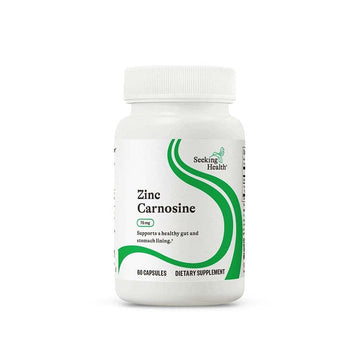
Price: £45.35 · Reviews: 110 · Where to buy: Available from Welzo
Why we like it: Seeking Health is a practitioner-facing brand built around clean formulation and plant-based capsules, and this is the option most likely to be named in a nutritional therapist's protocol. The vegetarian capsule and minimal excipient approach suits people with multiple sensitivities.
Be aware of the cost. At £45.35 for 60 capsules it is £0.76 per capsule — more than triple the Revive price and the most expensive in the category by a wide margin. At clinical dosing that's roughly £3 a day, or £90 to complete a 30-day course. Unless you specifically need the vegetarian capsule or the brand, the value case is difficult.
| Pros | Cons |
|---|---|
| Vegetarian capsules Practitioner-trusted brand Clean, minimal-excipient formulation 110 reviews |
By far the most expensive (£0.76 per capsule) ~£90 to complete a 30-day course Only 60 capsules |
Dosage and how to take it
| Approach | Dose | Elemental zinc | Duration |
|---|---|---|---|
| Full clinical dose | 75mg twice daily (4 capsules) | ~32mg — above NHS guidance | 4–8 weeks, then stop |
| Moderate / maintenance | 37.5–75mg daily (1–2 capsules) | ~8–16mg — within guidance | Longer periods possible |
Take it with food. Splitting the dose morning and evening keeps a more constant presence in the gut lumen, which is the point of a compound that works by adhering to the mucosa rather than being absorbed. Effects in the research were measured over days to weeks — most protocols run four to eight weeks, and there is no benefit to indefinite high-dose use.
Zinc can reduce absorption of certain antibiotics (tetracyclines, quinolones) and of iron, so separate those by at least two hours. If you're on long-term acid suppression, read omeprazole long-term effects, as low stomach acid affects mineral absorption generally.
Side effects and who should avoid it
Zinc carnosine has an excellent safety record, reflecting three decades of prescription use in Japan. The most common effects are mild and transient: nausea, a metallic taste, or mild stomach upset if taken without food. Taking it with a meal usually resolves this.
Take medical advice first if you
- Already take zinc from a multivitamin, immune formula or standalone supplement — add up your total
- Are pregnant or breastfeeding — not recommended without medical supervision
- Take tetracycline or quinolone antibiotics, or iron supplements — separate doses by two hours
- Have Wilson's disease or any condition affecting copper metabolism
- Plan to use it beyond eight weeks at full dose
The main long-term concern is copper depletion. Sustained zinc intake above roughly 25mg daily interferes with copper absorption, and copper deficiency can cause anaemia and neurological symptoms. This is entirely avoidable by using zinc carnosine as a defined course rather than an open-ended daily supplement.
On labelling: zinc carnosine is sold in the UK as a food supplement, not a medicine, and no health claims are authorised on the GB register — a regulatory position on claim wording, not a verdict on the underlying science.
When to see a doctor
See your GP — or seek urgent care — if you have:
- Blood in your stool, or black tarry stools — this can indicate a bleeding ulcer
- Vomiting blood, or vomit that looks like coffee grounds — seek urgent care
- Unexplained weight loss
- Persistent upper abdominal pain, especially if it wakes you at night
- Difficulty swallowing, or persistent vomiting
- Indigestion that doesn't settle, particularly if you are over 55
Zinc carnosine is not a treatment for a diagnosed ulcer in the UK — see your GP, who can test for H. pylori and prescribe appropriately. Read more on when to see a GP about stomach symptoms and gastritis.
Frequently asked questions
What is the best zinc carnosine supplement in the UK?
Doctor's Best PepZin GI Zinc-L-Carnosine Complex at £41.08 is the strongest overall choice: it uses the branded PepZin GI ingredient from the published trials, and its 120 capsules cover a full 30-day course at the clinical dose. Revive is better value per capsule at £0.23 if the label checks out, and Swanson is the cheapest way to try it.
Is zinc carnosine the same as L-carnosine?
No, and this is the most common purchasing mistake. L-carnosine is a free dipeptide sold for muscle and cognitive purposes. Zinc carnosine is a zinc-chelated complex that adheres to the gut lining and releases zinc locally. Only the chelated form has evidence for gut mucosal repair. Check the supplement facts panel lists zinc.
How much zinc carnosine should I take?
The clinical dose used in research is 75mg twice daily — 150mg a day, or four 37.5mg capsules. Many people use one to two capsules daily for maintenance instead, which keeps zinc intake within NHS guidance.
Can I take zinc carnosine long term?
Not at the full clinical dose. 150mg a day supplies roughly 32mg of elemental zinc, above the NHS's 25mg daily guidance for supplemental zinc, and sustained high zinc intake interferes with copper absorption. Use it as a four to eight week course, or take a lower daily dose if you want ongoing use.
What is PepZin GI?
PepZin GI is the branded zinc-L-carnosine ingredient used in most published human trials, typically supplied as 37.5mg per capsule delivering around 8mg of elemental zinc and 29.5mg of L-carnosine. If a label names it, you know exactly which material you're taking.
Does zinc carnosine help with leaky gut?
It has the most direct evidence of any supplement in this space for NSAID-induced intestinal permeability, where it fully prevented a three-fold rise in the 2007 Gut study. Evidence for general "leaky gut" without a clear trigger is weaker, though the mechanism is plausible.
Can I take zinc carnosine with probiotics?
Yes. They act through completely different mechanisms — zinc carnosine on the mucosal lining, probiotics on the microbial community — and there is no interaction. Browse the best probiotics UK guide for options.
Should I take zinc carnosine with or without food?
With food. Taking it on an empty stomach is the most common cause of nausea or a metallic taste. Splitting the dose across morning and evening meals maintains a more constant presence in the gut.
How long does zinc carnosine take to work?
The permeability effects in the research were measured over five days, but symptomatic improvement in real-world use typically takes two to four weeks. Most protocols run four to eight weeks in total.
Can zinc carnosine treat a stomach ulcer?
In Japan, polaprezinc is a licensed prescription treatment for gastric ulcers. In the UK it is sold only as a food supplement and is not a treatment for a diagnosed ulcer. If you have ulcer symptoms, see your GP — ulcers are usually caused by H. pylori or NSAIDs and need proper diagnosis and treatment.
Medical disclaimer: This article is for general information and education only and does not constitute medical advice, diagnosis or treatment. Food supplements are not a substitute for a varied and balanced diet or a healthy lifestyle, and are not intended to diagnose, treat, cure or prevent any disease. Zinc carnosine supplies elemental zinc — check your total intake across all supplements and do not exceed 25mg of supplemental zinc daily unless advised by a doctor. Product specifications, prices and availability are correct at the time of writing and may change. Always seek advice from your GP, pharmacist or another suitably qualified clinician before starting a new supplement, particularly if you are pregnant, breastfeeding, taking prescription medication or have an existing health condition.
About the author
Dr Zeeshan Afzal (MBBS) is a practising medical doctor and Welzo's Medical Content Lead. He writes and reviews Welzo's health content to ensure it is accurate, evidence-based and aligned with current UK clinical guidance, translating complex research into practical advice patients can trust.
References
- Mahmood A, FitzGerald AJ, Marchbank T, et al. Zinc carnosine, a health food supplement that stabilises small bowel integrity and stimulates gut repair processes. Gut. 2007;56(2):168–175. Link
- Davison G, Marchbank T, March DS, Thatcher R, Playford RJ. Zinc carnosine works with bovine colostrum in truncating heavy exercise-induced increase in gut permeability in healthy volunteers. Am J Clin Nutr. 2016;104(2):526–536. Link
- Hewlings S, Kalman D. A review of zinc-L-carnosine and its positive effects on oral mucositis, taste disorders, and gastrointestinal disorders. Nutrients. 2020;12(3):665. Link
- The role of zinc L-carnosine in the prevention and treatment of gastrointestinal mucosal disease in humans: a review. Clin Res Hepatol Gastroenterol. 2022. Link
- NHS — Vitamins and minerals: Others (zinc). Link




 Hodnoceno výborně o 28,951+ recenzí
 100% záruka vrácení peněz