




Die Hautalterung von innen unterstützen


Related products


Medizinisch geprüft von Dr. Zeeshan Afzal (MBBS, Allgemeinmediziner) – Medizinischer Gutachter bei Welzo.
Verfasst von: Der Welzo-Redaktionsteam für Langlebigkeit | Zuletzt aktualisiert: Juli 2026
Evidenzstandard: Jede unten aufgeführte Dosierung, Aussage und Statistik wird auf eine namentlich genannte klinische Studie, eine systematische Übersichtsarbeit oder eine britische Gesundheitsbehörde verwiesen, wobei die vollständigen Quellenangaben am Ende aufgeführt sind. Wo die Evidenz umstritten ist – und bei diesem Thema ist dies teilweise der Fall –, weisen wir darauf hin. Wie wir unsere Inhalte recherchieren und auf ihre Richtigkeit überprüfen, erfahren Sie in den redaktionellen Richtlinien von Welzo.
Die Kategorie der „Beauty-Nahrungsergänzungsmittel zum Einnehmen“ ist eine der am schnellsten wachsenden im Markt für Nahrungsergänzungsmittel – und eine der am wenigsten ehrlich berichteten. Dieser Leitfaden wendet die Evidenzhierarchie aus unserem Leitfaden zu Langlebigkeitspräparaten auf Nahrungsergänzungsmittel gegen Hautalterung an – einschließlich Kollagen, dem Verkaufsschlager dieser Kategorie und zugleich dem umstrittensten Produkt.
Kurze Antwort: Täglicher Breitband-Lichtschutzfaktor (SPF) ist hier jedem Nahrungsergänzungsmittel überlegen, gestützt durch Erkenntnisse aus randomisierten Studien. Kollagen ist einen 90-tägigen Test mit realistischen Erwartungen wert – siehe unseren Leitfaden zu Rinderkollagen und „Pure Bovine Collagen Peptides Powder“. Für die breitere Kategorie: NMN-Vorteile, Nebenwirkungen und Dosierung, das NMN-Nahrungsergänzungssortiment, NMN Pro 1000 sowie Anti-Aging- und Langlebigkeitspräparate.
Produkte dieser Kategorie werden routinemäßig im Rahmen von Testphasen verkauft, die von den Herstellern finanziert werden, wobei die Effektstärken in Prozentangaben beeindruckend klingen, im Spiegel jedoch bescheiden wirken. Das bedeutet nicht, dass nichts wirkt. Es bedeutet, dass die ehrliche Version dieses Artikels anders aussieht als das meiste, was Sie sonst lesen werden.
Für einige Inhaltsstoffe liegen echte Daten aus randomisierten Studien vor. Eine Maßnahme – bei der es sich nicht um ein Nahrungsergänzungsmittel handelt – übertrifft alle anderen und kostet nur ein paar Pfund im Monat. Und der mit Abstand wichtigste Faktor dafür, wie Ihr Gesicht altert, hängt hauptsächlich davon ab, wie viel ungeschützter Sonneneinstrahlung Sie ausgesetzt waren – und nicht davon, was in Ihrem Schrank steht. Im Folgenden: Was die wissenschaftlichen Erkenntnisse belegen, was die umstrittenen Ergebnisse tatsächlich aussagen und wofür Sie Ihr Geld am besten ausgeben.

Inhaltsverzeichnis
- Was tatsächlich sichtbare Hautalterung verursacht
- Kollagenpeptide: eine ehrliche Betrachtung der wissenschaftlichen Erkenntnisse
- Die anderen Inhaltsstoffe mit Daten aus Studien am Menschen
- Wovor man skeptisch sein sollte
- NAD⁺, Spermidin und der Crossover zur Langlebigkeit
- Die inneren Faktoren, die wichtiger sind als jede Kapsel
- Testen statt raten: Was es sich lohnt zu messen
- Ein realistisches Protokoll und ein realistischer Zeitplan
- Qualität und Sicherheit
- Wann Sie einen Arzt oder Dermatologen aufsuchen sollten
- Häufig gestellte Fragen
- Literatur
Was verursacht eigentlich sichtbare Hautalterung?
Intrinsische versus extrinsische Hautalterung
Die Haut altert durch zwei unterschiedliche Prozesse. Die intrinsische Hautalterung ist chronologisch bedingt und genetisch vorprogrammiert: Die Kollagensynthese verlangsamt sich, die Dermis wird dünner, Elastin wird abgebaut und der Zellumsatz nimmt ab. Die extrinsische Hautalterung ist umweltbedingt und wird vor allem durch UV-Strahlung beeinflusst – ein Prozess, den Dermatologen als „Photoalterung“ bezeichnen und der zu tiefen Falten, ungleichmäßiger Pigmentierung, geplatzten Kapillaren und einer ledrigen Hautstruktur führt, die die meisten Menschen eigentlich bekämpfen möchten.
Sie können den Unterschied an sich selbst erkennen. Vergleichen Sie die Haut an der Innenseite Ihres Oberarms – die selten der Sonne ausgesetzt ist – mit dem Handrücken oder Ihrem Gesicht. Beide Bereiche haben genau das gleiche chronologische Alter. Der sichtbare Unterschied zwischen ihnen ist fast schon ein anschauliches Beispiel dafür, wie viel des „Alterns“ tatsächlich auf die kumulierte Sonneneinstrahlung zurückzuführen ist.
Diese Unterscheidung ist aus kommerzieller Sicht von Bedeutung, da Nahrungsergänzungsmittel auf die intrinsische Seite nur am Rande einwirken, während die extrinsische Seite den größten, veränderbare Effekt bietet.
Warum darüber zu wenig berichtet wird
Die lichtbedingte Hautalterung ist für die Industrie der einnehmbaren Schönheitsprodukte unbequem, da die Maßnahme, die dagegen hilft, günstig, langweilig und kein Nahrungsergänzungsmittel ist. Eine Kapsel mit einer firmeneigenen Mischung und einer prozentualen Verbesserung auf einem Feuchtigkeitsmesser ergibt eine bessere Produktseite als „Tragen Sie in den nächsten zwanzig Jahren täglich Sonnenschutz auf“. Das macht die Kapsel nicht nutzlos. Es bedeutet jedoch, dass die Rangfolge der Maßnahmen, die Sie online sehen, eher davon geprägt ist, was sich verkaufen lässt, als von der Effektstärke.
Die wirksamste Maßnahme ist kein Nahrungsergänzungsmittel
Dies ist die Erkenntnis, die die gesamte Kategorie neu definiert, und sie stammt aus einer ungewöhnlich guten Studie.
Im Rahmen der Nambour-Studie in Queensland, Australien, wurden 903 Erwachsene unter 55 Jahren randomisiert vier Gruppen zugeordnet: tägliche Anwendung von Breitspektrum-Sonnenschutz mit 30 mg Beta-Carotin, tägliche Anwendung von Sonnenschutz mit Placebo, nach eigenem Ermessen erfolgte Anwendung von Sonnenschutz mit Beta-Carotin und nach eigenem Ermessen erfolgte Anwendung von Sonnenschutz mit Placebo. Nach 4,5 Jahren wiesen die Gruppen mit täglicher Sonnencreme bei mikro-topografischen Messungen eine um 24 % geringere Hautalterung auf als die Gruppen mit gelegentlicher Anwendung (relative Odds 0,76, 95 % KI 0,59–0,98). Eine Beta-Carotin-Supplementierung zeigte keinerlei Wirkung auf die Hautalterung [1].
Lesen Sie diese Studie sorgfältig durch. In derselben Studie, über denselben Zeitraum und bei denselben Personen führte die tägliche Sonnencreme zu einer messbaren Verringerung der Hautalterung um 24 %, während das Antioxidans-Präparat keinerlei Wirkung zeigte. Wenn Sie Ihr Budget für die Hautpflege planen und noch keine tägliche Breitband-Sonnencreme mit Lichtschutzfaktor verwenden, sollten Sie Ihr Geld in erster Linie dafür ausgeben. Schauen Sie sich Sonnenschutzmittel an, bevor Sie sich mit Kapseln beschäftigen.
Was das für Ihr Budget bedeutet
Eine sinnvolle Reihenfolge der Ausgaben sieht so aus: zuerst täglicher Breitband-Sonnenschutz, dann ein Retinoid oder ein anderes evidenzbasiertes topisches Mittel, dann Nichtrauchen, dann Schlaf und Ernährung und erst dann Nahrungsergänzungsmittel. Nahrungsergänzungsmittel machen die letzten paar Prozent aus, sie sind nicht die Grundlage. Jede Marke, die Ihnen etwas anderes erzählt, will eher verkaufen als informieren.
Das Wichtigste auf einen Blick: Lichtalterung ist der entscheidende Faktor für das Aussehen Ihres Gesichts, und es spricht auf Sonnenschutz an – was durch randomisierte Studien belegt ist. Orale Nahrungsergänzungsmittel können die Haut von innen unterstützen, wirken jedoch nur am Rande eines viel größeren Gesamtwirkungsspektrums.
Kollagenpeptide: eine ehrliche Betrachtung der wissenschaftlichen Erkenntnisse

Was die positiven Studien zeigen
Hier liegen echte randomisierte Daten vor. In einer doppelblinden, placebokontrollierten Studie wurden 64 Teilnehmer randomisiert entweder der Placebo-Gruppe oder der Gruppe mit 1.000 mg niedermolekularen Kollagenpeptiden täglich über 12 Wochen zugeordnet. Die Hautfeuchtigkeit war in der Kollagengruppe sowohl nach 6 als auch nach 12 Wochen signifikant höher, und nach 12 Wochen hatten sich der visuelle Bewertungswert sowie drei Parameter der Hautfaltenbildung im Vergleich zum Placebo signifikant verbessert [2].
Eine systematische Übersichtsarbeit und Metaanalyse von 19 randomisierten, doppelblinden, kontrollierten Studien mit 1.125 Teilnehmern im Alter von 20 bis 70 Jahren (95 % Frauen) ergab positive Ergebnisse für hydrolysiertes Kollagen im Vergleich zu Placebo hinsichtlich Hautfeuchtigkeit, Elastizität und Falten, wobei sich die Verbesserung der Feuchtigkeitsversorgung und Elastizität in einer Subgruppenanalyse bestätigte. Die Autoren kamen zu dem Schluss, dass eine 90-tägige Einnahme von hydrolysiertem Kollagen wirksam zur Verringerung von Markern der Hautalterung beiträgt [3].
Auf dieser Grundlage scheint die Wirksamkeit von Kollagen gut belegt zu sein. Eine neuere Analyse hat das Bild jedoch erheblich verkompliziert.
Das Problem der Finanzierungsquellen
Eine im Jahr 2025 im „American Journal of Medicine“ veröffentlichte systematische Übersichtsarbeit und Metaanalyse fasste 23 randomisierte kontrollierte Studien mit 1.474 Teilnehmern zusammen. Über alle 23 Studien hinweg verbesserten Kollagenpräparate die Hautfeuchtigkeit, Elastizität und das Erscheinungsbild von Falten signifikant – was mit den früheren Übersichtsarbeiten übereinstimmt.
Die Autoren unterteilten die Studien jedoch anschließend nach Finanzierungsquelle und Qualität. Studien, die keine Finanzierung durch die Pharmaindustrie oder die Industrie erhielten, zeigten keine Wirkung auf den Feuchtigkeitsgehalt, die Elastizität oder die Falten. Hochwertige Studien zeigten ebenfalls in keiner Kategorie eine signifikante Wirkung, während Studien von geringer Qualität eine signifikante Verbesserung der Elastizität zeigten. Die Autoren kamen zu dem Schluss, dass es derzeit keine klinischen Belege gibt, die die Verwendung von Kollagenpräparaten zur Vorbeugung oder Behandlung von Hautalterung stützen [4].
Wie man dies ehrlich interpretiert
Wir verkaufen Kollagen, daher wäre es bequem, diesen letzten Absatz wegzulassen. Hier ist unsere tatsächliche Interpretation:
- Der Wirkmechanismus ist plausibel. Kollagenpeptide werden als Dipeptide resorbiert, die in der Dermis auftreten und die Aktivität der Fibroblasten anregen können. Das ist keine Homöopathie.
- Die Wirkung, sofern sie real ist, ist bescheiden. Niemand in diesen Studien wurde um ein Jahrzehnt verjüngt. Bei den gemessenen Unterschieden handelt es sich um instrumentell festgestellte Veränderungen der Feuchtigkeitsversorgung und der Faltentiefe über einen Zeitraum von 8 bis 12 Wochen.
- Die Art der Finanzierung ist ein echtes Warnsignal. Wenn der Nutzen in unabhängig finanzierten und qualitativ hochwertigeren Studien verschwindet, ist die ehrliche Haltung Unsicherheit, nicht Zuversicht.
- Das Risiko ist gering. Kollagenpeptide sind eine Proteinquelle mit einem guten Sicherheitsprofil. Es 90 Tage lang auszuprobieren und sich selbst ein Urteil zu bilden, ist durchaus sinnvoll.
Unsere Position: Kollagen ist eine sinnvolle optionale Anschaffung bei realistischen Erwartungen, jedoch kein Produkt erster Wahl und kein Ersatz für Sonnenschutz. Wenn Ihr Budget begrenzt ist, geben Sie es zuerst für Sonnenschutzmittel (SPF) und eine ausreichende Proteinzufuhr über die Ernährung aus.
Wenn Sie es ausprobieren
In Studien werden typischerweise täglich 2,5–10 g hydrolysierte Kollagenpeptide verwendet, wobei in der oben genannten Studie mit niedermolekularem Kollagen 1.000 mg eines spezifischen, tripeptidreichen Präparats zum Einsatz kamen [2]. Probieren Sie es volle 90 Tage lang aus, da dies die Dauer ist, bei der die Metaanalyse Wirkungen festgestellt hat [3]. Pulver ist bei diesen Dosierungen kostengünstiger als Kapseln. Sehen Sie sich die Welzo-Kollagen-Kollektion an, unseren Vergleich zwischen Astaxanthin und Kollagen sowie den Vergleich zwischen Glutamin und Kollagen für die Darmgesundheit, falls dies ebenfalls ein Ziel ist.
Hinweis für Veganer: Jegliches Kollagen stammt von Rindern, Schweinen oder Meeresorganismen. Es gibt kein veganes Kollagen – in unserem Leitfaden zu veganen Nahrungsergänzungsmitteln für ein langes Leben erfahren Sie, welche pflanzlichen Alternativen es tatsächlich gibt.
Die weiteren Inhaltsstoffe mit Daten aus Studien am Menschen
Astaxanthin – der UV-Schutz-Aspekt

Astaxanthin ist ein von Mikroalgen produziertes Carotinoid, und es ist hier gerade deshalb interessant, weil es eher auf die lichtbedingte Hautalterung als auf das Kollagen einwirkt.
In einer randomisierten, doppelblinden, placebokontrollierten Studie erhielten 23 gesunde japanische Teilnehmer über einen Zeitraum von 10 Wochen entweder 4 mg Astaxanthin oder ein Placebo. Die Astaxanthin-Gruppe zeigte im Vergleich zur Placebo-Gruppe eine erhöhte minimale Erythem-Dosis – was bedeutet, dass eine stärkere UV-Belastung erforderlich war, um sichtbare Rötungen hervorzurufen – sowie einen geringeren Feuchtigkeitsverlust der Haut im bestrahlten Bereich [5].
Es handelt sich zwar um eine kleine Studie, und die Erhöhung der Schwelle für UV-bedingte Rötungen ist keinesfalls ein Grund, weniger Sonnenschutz zu verwenden. Aber es ist ein mechanistisch schlüssiger Befund, der in die richtige Richtung weist. Siehe die Welzo-Astaxanthin-Kollektion.
Hyaluronsäure – oral, nicht nur topisch
Eine placebokontrollierte, randomisierte Doppelblindstudie mit 120 mg oralem Hyaluronsäure täglich über 12 Wochen bei 40 gesunden Erwachsenen im Alter von 35–64 Jahren ergab im Vergleich zum Placebo signifikante Verbesserungen bei der Faltenbewertung, dem Feuchtigkeitsgehalt der Hornschicht, dem transepidermalen Wasserverlust und der Elastizität, wobei sich die Werte für Falten, Feuchtigkeitsversorgung und Elastizität sowohl nach 8 als auch nach 12 Wochen im Vergleich zum Ausgangswert signifikant verbessert hatten [6].
Nochmals: kleine Studie, instrumentell gemessene Endpunkte, mäßiger Effekt. Siehe das Hyaluronsäure-Sortiment.
Vitamin C – das Cofaktor-Argument
Vitamin C ist ein notwendiger Cofaktor für die Enzyme Prolyl- und Lysylhydroxylase, die die Kollagen-Dreifachhelix stabilisieren. Ohne ausreichendes Vitamin C ist die Kollagensynthese messbar beeinträchtigt – das ist Biochemie wie aus dem Lehrbuch, am eindrucksvollsten demonstriert durch Skorbut.
Die ehrliche Einschränkung: Dies belegt, dass Vitamin C notwendig ist, nicht aber, dass zusätzliches Vitamin C bei einer Person, die bereits ausreichend versorgt ist, zu besserer Haut führt. Wenn Sie regelmäßig Obst und Gemüse essen, sind Sie mit ziemlicher Sicherheit ausreichend versorgt. Wenn Ihre Ernährung wirklich mangelhaft ist, ist eine Umstellung wichtig. Siehe die Vitamin-C-Sammlung.
Omega-3
Langkettige Omega-3-Fettsäuren sind strukturelle Bestandteile von Zellmembranen, auch in der Haut, und besitzen eine entzündungshemmende Wirkung, die bei entzündlichen Hauterkrankungen von Bedeutung ist. Die Europäische Behörde für Lebensmittelsicherheit hält eine tägliche Gesamtzufuhr von 250 mg EPA und DHA für Erwachsene für ausreichend, wobei eine zusätzliche Zufuhr von bis zu 5 g/Tag keine Sicherheitsbedenken aufwirft [7]; eine Übersichtsarbeit in „Nutrition Research Reviews“ ergab, dass 250 mg/Tag international die am häufigsten empfohlene Zufuhrmenge für Erwachsene ist [8]. Sollte eher als allgemeine gesundheitliche Grundversorgung denn als gezielte Hautmaßnahme betrachtet werden. Siehe die Omega-3-Reihe.
Vitamin D und eine ausreichende Versorgung mit Mikronährstoffen
Die NHS-Leitlinien empfehlen allen Menschen im Vereinigten Königreich ab vier Jahren, im Herbst und Winter täglich 10 Mikrogramm (400 IE) Vitamin D einzunehmen, bei Personen mit geringer Sonnenexposition sogar das ganze Jahr über [9]; die British Heart Foundation gibt dieselbe Empfehlung ab [10]. Für die Haut ergibt sich daraus ein offensichtlicher Konflikt: Die Sonnenexposition, die Vitamin D bildet, ist dieselbe, die die lichtbedingte Hautalterung vorantreibt – ein gutes Argument für die Einnahme von Nahrungsergänzungsmitteln anstelle von Sonnenbädern.
Auch eine umfassendere ausreichende Versorgung ist wichtig. Eine Analyse der Daten der britischen National Diet and Nutrition Survey unter 3.238 Erwachsenen mittleren Alters ergab, dass 19 % der Personen in ihren Zwanzigern unter der unteren Referenzzufuhr (LRNI) für Magnesium lagen, und 50,3 % der Frauen unter dem LRNI für Selen lagen [11] – ein Hinweis darauf, dass die Haut eines der ersten Gewebe ist, an denen sich eine allgemein schlechte Ernährung bemerkbar macht. Insbesondere Zink ist für die Hautregeneration erforderlich; siehe die Zink-Kollektion und das Sortiment für Haare, Haut und Nägel.
Orale versus topische Anwendung: Was bewirkt was?
Eine Frage, die es zu klären gilt, bevor Sie Geld ausgeben. Topische Mittel wirken lokal und in hoher Konzentration auf das zu behandelnde Gewebe ein, weshalb Retinoide und Sonnenschutzmittel nachweislich so wirksam sind. Orale Nahrungsergänzungsmittel verteilen sich im gesamten Körper und erreichen die Haut nur in dem Anteil, der die Verdauung und den First-Pass-Metabolismus übersteht.
Das ist kein Argument gegen orale Nahrungsergänzungsmittel – Kollagenpeptide tauchen tatsächlich als Dipeptide in der Dermis auf, und Astaxanthin erreicht das Hautgewebe. Es ist vielmehr ein Argument dafür, von oraler Einnahme geringere Wirkungen zu erwarten und ein einnehmbares Präparat nicht als Ersatz für ein topisches Mittel mit besserer wissenschaftlicher Belegung zu betrachten. Beide ergänzen sich, und wenn man sich nur für eine Variante entscheiden kann, spricht mehr für die topische Anwendung. Stöbern Sie in unserem Sortiment an Anti-Aging-Cremes, Feuchtigkeitscremes und weiteren Hautpflegeprodukten.
Vergleich der Inhaltsstoffe
| Inhaltsstoff | Beste Evidenz | Typische Dosierung | Ehrliches Fazit |
|---|---|---|---|
| Täglicher Breitband-Lichtschutzfaktor | RCT, 903 Erwachsene, 4,5 Jahre, 24 % weniger Hautalterung [1] | Täglich auf unbedeckte Haut auftragen | Stärkste Evidenz aller hier genannten Punkte |
| Kollagenpeptide | Positive Metaanalysen [2,3]; keine Wirkung in nicht von der Industrie finanzierten oder qualitativ hochwertigen Studien [4] | 2,5–10 g täglich, 90 Tage | Umstritten; geringes Risiko; ein Versuch ist sinnvoll |
| Astaxanthin | Kleine randomisierte kontrollierte Studie (RCT): erhöhte Schwelle für UV-Erytheme, geringerer Feuchtigkeitsverlust [5] | 4–6 mg täglich | Vielversprechender Wirkmechanismus, geringe Evidenzbasis |
| Hyaluronsäure (oral) | RCT, 40 Erwachsene, 12 Wochen [6] | 120 mg täglich | Bescheidene Wirkung, kleine Studie |
| Vitamin C | Etablierter Cofaktor für die Kollagensynthese | Ausreichende Zufuhr über die Ernährung | Notwendig, keine zusätzliche Wirkung bei ausreichender Versorgung |
| Omega-3 | Zellmembranstruktur; allgemeine Gesundheit [7,8] | 250–1.000 mg EPA+DHA | Grundlegende Gesundheit, kein Zielwert |
| Vitamin D | NHS-Empfehlungen für die Bevölkerung [9,10] | 10–25 µg (400–1.000 IE) | Einnahme empfohlen; relevant bei Vermeidung von Sonneneinstrahlung |
| Beta-Carotin | Keine Auswirkung auf die Hautalterung in der Nambour-RCT [1] | — | Für diesen Zweck nicht empfohlen |
Wovor man skeptisch sein sollte
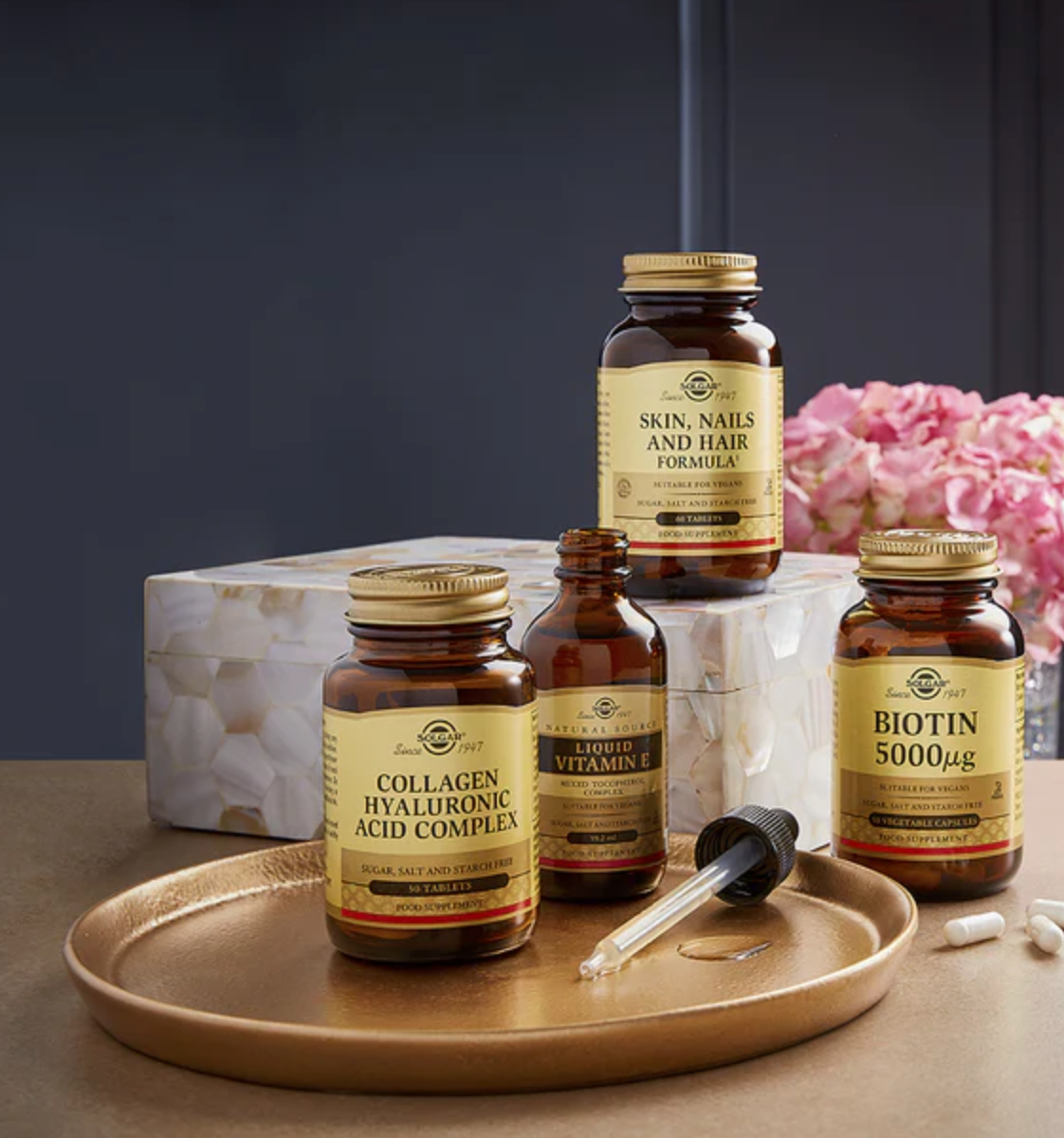
- Biotin für Haut und Nägel. Biotin behebt Probleme bei Menschen mit einem Mangel, was jedoch selten vorkommt. Bei Menschen ohne Mangel sind die Belege für einen kosmetischen Nutzen schwach. Es beeinträchtigt zudem einige Laboruntersuchungen, darunter bestimmte Schilddrüsen- und Troponin-Tests – informieren Sie Ihren Arzt, wenn Sie es einnehmen, bevor Sie sich einer Blutuntersuchung unterziehen. Weitere Informationen finden Sie in der Biotin-Übersicht.
- Behauptungen, dass „meeresbasiertes Kollagen überlegen“ sei. Die Herkunft beeinflusst das Aminosäureprofil und das Molekulargewicht, doch gibt es kaum direkte Belege dafür, dass meeresbasiertes Kollagen bei Hautergebnissen besser abschneidet als Rinderkollagen. Entscheiden Sie sich anhand von Preis, Reinheit und Prüfverfahren.
- „Veganes Kollagen“. Das gibt es nicht. Bei diesen Produkten handelt es sich um Mischungen aus Vitamin C und Aminosäuren, die Ihre körpereigene Synthese unterstützen sollen. Das ist eine legitime Produktkategorie, doch die Kennzeichnung verwischt häufig die Unterscheidung.
- Beauty-Gummibärchen. Oft sind sie im Vergleich zu Studienprotokollen unterdosiert und enthalten häufig mehrere Gramm Zucker pro Portion – was angesichts des unten genannten Glykationspunkts kontraproduktiv ist.
- Geschützte „Beauty-Mischungen“. Wenn die Dosierungen der einzelnen Inhaltsstoffe nicht angegeben sind, können Sie nicht wissen, ob ein Wirkstoff in der in Studien untersuchten Menge enthalten ist. Siehe Erläuterungen zu Füllstoffen in Nahrungsergänzungsmitteln und zu Langlebigkeitspräparaten, die nicht wirken.
NAD⁺, Spermidin und der Crossover zur Langlebigkeit

Langlebigkeitswirkstoffe werden zunehmend mit Hautversprechen vermarktet, daher lohnt es sich, genau zu unterscheiden, was nachgewiesen wurde und was nicht.
Bei NMN beziehen sich die Erkenntnisse aus Humanstudien eher auf körperliche Funktionen und den Schlaf als auf die Haut. Eine randomisierte, doppelblinde, placebokontrollierte Studie mit 108 älteren japanischen Erwachsenen, die 12 Wochen lang täglich 250 mg einnahmen, ergab, dass die Einnahme am Nachmittag mit einer fünfmal besseren Leistung beim Aufstehen aus dem Sitzen und einer verringerten Schläfrigkeit verbunden war [12]. Eine Studie von GeroScience ergab, dass 250 mg/Tag den NAD-Spiegel im Blut erhöhten, zur Aufrechterhaltung der Gehgeschwindigkeit beitrugen und die Schlafqualität bei älteren Erwachsenen verbesserten [13]. Eine Metaanalyse von acht randomisierten kontrollierten Studien (RCTs) ergab keinen signifikanten Nutzen hinsichtlich der Glukose- oder Lipidwerte [14]. In keiner dieser Studien wurden hautbezogene Endpunkte gemessen.

Spermidin und Resveratrol sind aus mechanistischer Sicht ähnlich interessant – Spermidin durch Autophagie, Resveratrol durch Sirtuin-Signalwege –, allerdings liegen keine spezifischen Studienergebnisse zur Hautalterung beim Menschen in für Verbraucher üblichen Dosierungen vor. Lesen Sie unsere ehrlichen Bewertungen in den Artikeln „Wirkt Resveratrol?“, „Spermidin vs. NMN“, „Resveratrol vs. Pterostilben“, „Fisetin vs. Quercetin“ sowie unseren Leitfaden zu Ergothionein.
Die vernünftige Haltung: Nehmen Sie diese Substanzen aus den Gründen ein, für die tatsächlich Belege vorliegen, und betrachten Sie etwaige Vorteile für die Haut eher als unbewiesenen Bonus denn als Kaufargument. Siehe den Leitfaden zu NAD-Nahrungsergänzungsmitteln und die Sammlung von Nahrungsergänzungsmitteln für ein langes Leben.
Die inneren Faktoren, die wichtiger sind als jede Kapsel
Rauchen
Rauchen ist nach UV-Strahlung der zweitgrößte äußere Faktor für die Gesichtsalterung. Es baut Kollagen und Elastin ab, beeinträchtigt die Durchblutung der Haut und führt zu einem charakteristischen Muster vorzeitiger Faltenbildung. Kein Nahrungsergänzungsmittel kann dies ausgleichen.
Schlaf
Die Hautregeneration und der Zellumsatz konzentrieren sich auf die Schlafphase. Chronischer Schlafmangel macht sich im Gesicht schneller bemerkbar als fast alles andere. Wenn der Schlaf das Problem ist, sollten Sie sich um den Schlaf kümmern – siehe Apigenin vs. Magnesium für den Schlaf, das Sortiment für Schlaf und Entspannung sowie, falls Sie nachts arbeiten, Nahrungsergänzungsmittel für Schichtarbeiter.
Proteinzufuhr
Kollagen ist ein Protein, und Ihr Körper kann es nicht aus dem Nichts synthetisieren. Eine ausreichende Gesamtproteinaufnahme über die Nahrung ist wichtiger als jedes Kollagenpräparat und wird bei Menschen, die dann Kollagenpulver kaufen, am häufigsten vernachlässigt. Siehe das Welzo-Proteinsortiment.
Glykation und Blutzucker
Chronisch erhöhter Blutzucker fördert die Bildung von fortgeschrittenen Glykationsendprodukten (AGEs), die Kollagen- und Elastinfasern vernetzen und deren Flexibilität verringern. Dies ist ein echter Mechanismus, der die Ernährungsgewohnheiten mit der Hautqualität verknüpft, und ein Argument für dieselben Ernährungsempfehlungen, die auch bei allen anderen Problemen helfen.
Alkohol
Alkohol wirkt dehydrierend, stört die Schlafarchitektur und erweitert die Gesichtsgefäße. Eine Reduzierung ist kostenlos und sichtbar.
Hormonelle Veränderungen
Die Kollagendichte der Haut nimmt in den Jahren um die Menopause herum deutlich ab, weshalb viele Frauen eher eine sprunghafte Veränderung als eine allmähliche Verschlechterung bemerken. Dies ist eher ein medizinisches Thema als eine Frage der Nahrungsergänzung – siehe Nahrungsergänzungsmittel für die Langlebigkeit von Frauen über 40, NMN und Menopause, das Nahrungsergänzungsmittel „Ultra Purity Menopause Support“ sowie, zur Beurteilung, einen Bluttest zur Menopause.
Testen statt raten: Was es sich lohnt zu messen
Veränderungen an Haut und Haaren sind häufig das sichtbare Symptom eines systemischen Problems, weshalb Tests manchmal eine Ursache aufdecken, die kein Kosmetikprodukt hätte beheben können.
- Ferritin (Eisen)-Bluttest – ein niedriger Eisenspiegel ist eine häufige und behebbare Ursache für Haarausfall und schlechte Hautqualität, insbesondere bei menstruierenden Frauen.
- Bluttest zur Schilddrüsenfunktion – sowohl eine Unter- als auch eine Überfunktion der Schilddrüse führen zu charakteristischen Veränderungen an Haut und Haaren.
- Vitamin-D-Bluttest – besonders relevant, wenn Sie sich konsequent vor Sonneneinstrahlung schützen.
- Bluttest auf weibliche Hormone – für diejenigen, die in der Perimenopause eine deutliche Veränderung ihrer Haut feststellen.
- Bluttest zu Ernährung und Vitaminen oder „Full Body MOT“-Gesundheitscheck – umfassendere Ausgangswerte in einer einzigen Blutentnahme.
Siehe auch „Biologisches Alter“ und „So senken Sie Ihr biologisches Alter“, um zu erfahren, was tatsächlich messbar ist und was nur Marketing ist.
Ein realistisches Protokoll und ein realistischer Zeitplan
| Priorität | Maßnahme | Voraussichtlicher Zeitplan |
|---|---|---|
| 1 | Täglicher Breitband-Lichtschutzfaktor (SPF) für Gesicht, Hals und Hände | Prävention; messbarer Unterschied über Jahre hinweg [1] |
| 2 | Ausreichende Zufuhr von Eiweiß und Vitamin C über die Nahrung | Grundlegend; kein sichtbarer „Vorher-Nachher“-Effekt |
| 3 | Vitamin D 10–25 µg täglich, ganzjährig bei Personen, die die Sonne meiden | 8–12 Wochen, bis sich die Blutwerte ändern [9] |
| 4 | Schlaf, Raucherentwöhnung, Reduzierung des Alkoholkonsums | Wochen bis Monate, und kostenlos |
| 5 | Kollagenpeptide 2,5–10 g täglich, falls Sie eine Testphase durchführen möchten | Beurteilen Sie den Erfolg nach 90 Tagen, nicht früher [3] |
| 6 | Astaxanthin 4–6 mg oder oral eingenommene Hyaluronsäure 120 mg | 8–12 Wochen [5,6] |
Erwartungen richtig setzen
Nichts in diesem Artikel führt innerhalb von zwei Wochen zu einer sichtbaren Veränderung. Die Studien, die Wirkungen nachweisen konnten, haben diese nach 8 bis 12 Wochen mit Laborgeräten gemessen, nicht im Badezimmerspiegel. Wenn Sie sich nicht auf 90 Tage festlegen können, fangen Sie gar nicht erst an – Sie werden so oder so zu keinem Ergebnis kommen. Unser Leitfaden dazu, wie lange es dauert, bis Nahrungsergänzungsmittel wirken, behandelt realistische Zeiträume für verschiedene Kategorien.
Machen Sie zu Beginn ein gut ausgeleuchtetes Foto bei gleichbleibender Beleuchtung. Ohne dieses Foto werden Sie eine echte Veränderung nicht von einer Wunschvorstellung unterscheiden können.
Um zu erfahren, wie sich dies in eine umfassendere Routine einfügt, lesen Sie den Leitfaden zum „Minimal Supplement Stack“, zum „Cheap Longevity Stack“ und zu unserem „Longevity Stack“, sowie die Tabelle zum Einnahmezeitpunkt von Nahrungsergänzungsmitteln und den Artikel „Kann man Nahrungsergänzungsmittel zusammen einnehmen?“.
Qualität und Sicherheit

In Großbritannien werden Nahrungsergänzungsmittel als Lebensmittel und nicht als Arzneimittel reguliert und vor dem Verkauf nicht auf ihre Wirksamkeit geprüft. Achten Sie auf unabhängige Tests durch Dritte, ein veröffentlichtes chargenspezifisches Analysezertifikat und offen gelegte Dosierungen in namentlich genannten Formen statt in proprietären Mischungen. Siehe von Dritten getestete Nahrungsergänzungsmittel, wie man ein Analysezertifikat liest und die Zertifizierungen von Welzo zur Qualität und Reinheit der Inhaltsstoffe. Die Welzo Ultra Purity-Reihe verwendet Formulierungen mit nur einem Inhaltsstoff und offen gelegten Dosierungen.
Wer sollte besonders vorsichtig sein
- Personen mit einer Fisch- oder Schalentierallergie – Meereskollagen und einige Astaxanthin-Trägerstoffe werden aus diesen Quellen gewonnen.
- Personen, die verschreibungspflichtige Medikamente einnehmen, insbesondere Antikoagulanzien, da Omega-3 die Thrombozytenfunktion beeinflusst.
- Personen, bei denen eine Blutuntersuchung ansteht – geben Sie die Einnahme von Biotin-Präparaten an, da diese mehrere gängige Testverfahren beeinträchtigen können.
- Schwangere oder stillende Frauen – lassen Sie sich beraten, bevor Sie etwas Neues einnehmen, und beachten Sie, dass Vitamin-A-Derivate zur Hautpflege in der Schwangerschaft kontraindiziert sind.
Wann Sie einen Arzt oder Dermatologen aufsuchen sollten
Suchen Sie umgehend einen Hausarzt auf, anstatt zu einem Nahrungsergänzungsmittel zu greifen, wenn Sie Folgendes bemerken: ein neues oder sich veränderndes Muttermal oder eine Läsion, die blutet, juckt, ihre Farbe verändert oder nicht innerhalb weniger Wochen abheilt; plötzlichen oder fleckigen Haarausfall; einen neuen, anhaltenden Hautausschlag; oder erhebliche, unerklärliche Veränderungen der Hautstruktur oder -pigmentierung.
Sonnenbedingte Hautveränderungen und das Hautkrebsrisiko sind die ernsten Aspekte dieses Themas, und ein ergänzender Artikel ist nicht der richtige Ort, um diese zu bewerten. Wenn Sie sich intensiv der Sonne ausgesetzt haben oder Solarien nutzen, besprechen Sie Hautuntersuchungen mit Ihrem Hausarzt. Anhaltende Haut- oder Haarveränderungen, die mit Müdigkeit, Gewichtsveränderungen oder Veränderungen des Menstruationszyklus einhergehen, erfordern Blutuntersuchungen statt der Verwendung kosmetischer Produkte.
Häufig gestellte Fragen
Helfen Kollagenpräparate tatsächlich gegen Hautalterung?
Die Beweislage ist tatsächlich umstritten. Metaanalysen, die 19 bzw. 23 randomisierte Studien umfassten, ergaben insgesamt Verbesserungen hinsichtlich Feuchtigkeitsgehalt, Elastizität und Falten [3,4]. Die Analyse aus dem Jahr 2025 im „American Journal of Medicine“ ergab jedoch: Bei einer Aufschlüsselung der Studien nach Finanzierungsquelle und Qualität zeigten nicht von der Industrie finanzierte Studien sowie Studien höherer Qualität keine signifikante Wirkung, und die Autoren kamen zu dem Schluss, dass es derzeit keine klinischen Belege gibt, die für die Wirksamkeit von Kollagen bei der Hautalterung sprechen [4]. Unsere Einschätzung: plausibler Wirkmechanismus, bestenfalls mäßige Wirkung, geringes Risiko; einen 90-tägigen Versuch wert, wenn Sie zuvor bereits für Sonnenschutz und Proteinzufuhr über die Ernährung gesorgt haben.
Was ist das wirksamste Mittel gegen Hautalterung?
Tägliche Anwendung eines Breitspektrum-Sonnenschutzmittels. In einer randomisierten Studie mit 903 Erwachsenen über einen Zeitraum von 4,5 Jahren führte die tägliche Verwendung von Sonnenschutzmitteln zu einer um 24 % geringeren Hautalterung als die gelegentliche Anwendung, während die Einnahme von Beta-Carotin-Präparaten in derselben Studie keine Wirkung zeigte [1]. Das ist der stärkste Beleg in diesem gesamten Bereich, und es kostet weniger als die meisten Nahrungsergänzungsmittel.
Wie lange dauert es, bis Hautpräparate wirken?
Studien, die eine Wirkung feststellten, maßen diese nach 8 bis 12 Wochen, wobei Messgeräte anstelle einer visuellen Beurteilung zum Einsatz kamen [2,5,6], und die Metaanalyse zu Kollagen kam zu dem Ergebnis, dass eine Wirkung nach etwa 90 Tagen der Einnahme eintritt [3]. Nichts davon wirkt innerhalb von zwei Wochen. Machen Sie ein Ausgangsfoto bei gleichbleibender Beleuchtung und beurteilen Sie das Ergebnis erst nach drei Monaten.
Ist Meereskollagen besser als Rinderkollagen?
Es gibt keine eindeutigen Vergleichsdaten, die dies belegen. Die Herkunft beeinflusst das Aminosäureprofil und das typische Molekulargewicht, und marines Kollagen ist in der Regel teurer. Entscheiden Sie sich anhand des Preises pro Gramm, der Reinheit, der Prüfungen durch unabhängige Dritte und der Frage, ob Sie eine Fischallergie haben. Keines der beiden ist für Veganer geeignet. Unser Leitfaden zu Rinderkollagen behandelt die Frage der Herkunft ausführlicher.
Wie viel Kollagen sollte ich für die Haut einnehmen?
In Studien werden in der Regel täglich 2,5–10 g hydrolysierte Kollagenpeptide verwendet, obwohl in einer Studie mit positivem Ergebnis über 12 Wochen hinweg 1.000 mg eines spezifischen, tripeptidreichen Präparats mit niedrigem Molekulargewicht eingesetzt wurden [2]. Pulver ist bei diesen Mengen kostengünstiger als Kapseln. Siehe „Reines Rinderkollagen-Peptidpulver“.
Hilft Astaxanthin der Haut?
Es gibt eine kleine, aber aus mechanistischer Sicht interessante Evidenzbasis. Eine randomisierte, doppelblinde, placebokontrollierte Studie mit 23 Teilnehmern ergab, dass 4 mg Astaxanthin über einen Zeitraum von 10 Wochen die minimale Erythem-Dosis – die UV-Exposition, die erforderlich ist, um sichtbare Rötungen hervorzurufen – erhöhte und den Feuchtigkeitsverlust in bestrahlter Haut im Vergleich zum Placebo verringerte [5]. Es handelt sich um eine kleine Studie, und Astaxanthin ist kein Ersatz für Sonnenschutzmittel.
Sollte ich Biotin für Haut, Haare und Nägel einnehmen?
Nur, wenn bei Ihnen ein Mangel vorliegt, was jedoch selten ist. Bei Menschen mit ausreichendem Biotin-Status sind die Belege für einen kosmetischen Nutzen schwach. Wichtig ist, dass Biotin verschiedene Labortests beeinträchtigen kann, darunter einige Schilddrüsen- und Herzuntersuchungen. Informieren Sie daher Ihren Arzt, wenn Sie Biotin einnehmen, bevor Sie sich einer Blutuntersuchung unterziehen.
Können Nahrungsergänzungsmittel bereits vorhandene Falten rückgängig machen?
Nein. Die Studienergebnisse beschreiben moderate, instrumentell gemessene Veränderungen hinsichtlich Feuchtigkeitsgehalt, Elastizität und Faltentiefe über einen Zeitraum von 8 bis 12 Wochen – keine Rückbildung bereits bestehender lichtbedingter Hautalterung. Selbst die Studie zur Sonnencreme, die die stärksten Ergebnisse lieferte, zeigte eher eine verlangsamte Alterung als eine Rückbildung bestehender Schäden [1]. Etablierte tiefe Falten sind ein Thema für die Dermatologie, nicht für Nahrungsergänzungsmittel.
Gibt es so etwas wie veganes Kollagen?
Nein. Alle Kollagenpeptide stammen aus Rindern, Schweinen oder Meeresorganismen. Produkte, die als „veganes Kollagen“ vermarktet werden, sind Mischungen aus Vitamin C, Aminosäuren und anderen Cofaktoren, die Ihre eigene Kollagensynthese unterstützen sollen. Das kann ein sinnvolles Produkt sein, aber es ist kein Kollagen – siehe unseren Leitfaden zu veganen Nahrungsergänzungsmitteln für ein langes Leben.
Hilft NMN bei der Hautalterung?
Es gibt keine Belege aus Humanstudien, die speziell die Auswirkungen von NMN auf die Haut belegen. Die randomisierten Studien bei älteren Erwachsenen untersuchten die körperliche Funktionsfähigkeit, Schläfrigkeit, NAD-Spiegel im Blut und die Schlafqualität [12,13], und eine Metaanalyse von acht randomisierten kontrollierten Studien (RCTs) ergab keine signifikante Wirkung auf Glukose- oder Lipidmarker [14]. Nehmen Sie NMN aus den Gründen ein, für die tatsächlich Belege vorliegen, und betrachten Sie etwaige positive Auswirkungen auf die Haut als unbewiesen. Siehe den Leitfaden zur NMN-Säule.
Literaturhinweise
- Hughes MCB, Williams GM, Baker P, Green AC. Sonnenschutz und Prävention der Hautalterung: eine randomisierte Studie. Annals of Internal Medicine. 2013;158(11):781–790. https://www.acpjournals.org/doi/10.7326/0003-4819-158-11-201306040-00002
- Kim DU, Chung HC, Choi J, Sakai Y, Lee BY. Die orale Einnahme von niedermolekularen Kollagenpeptiden verbessert die Feuchtigkeitsversorgung, Elastizität und Faltenbildung der menschlichen Haut: Eine randomisierte, doppelblinde, placebokontrollierte Studie. Nutrients. 2018;10(7):826. https://www.ncbi.nlm.nih.gov/pmc/articles/PMC6073484/
- de Miranda RB, Weimer P, Rossi RC. Auswirkungen einer Supplementierung mit hydrolysiertem Kollagen auf die Hautalterung: eine systematische Übersichtsarbeit und Metaanalyse. International Journal of Dermatology. 2021;60(12):1449–1461. https://pubmed.ncbi.nlm.nih.gov/33742704/
- Myung SK, Park Y. Auswirkungen von Kollagenpräparaten auf die Hautalterung: Eine systematische Übersicht und Metaanalyse randomisierter kontrollierter Studien. The American Journal of Medicine. 2025. https://www.amjmed.com/article/S0002-9343(25)00283-9/abstract
- Die schützende Wirkung von Astaxanthin bei UV-bedingter Hautalterung bei gesunden Menschen – Eine randomisierte, doppelblinde, placebokontrollierte Studie. Nutrients. 2018;10(7):817. https://www.ncbi.nlm.nih.gov/pmc/articles/PMC6073124/
- Oral eingenommenes Hyaluronsäure lindert Falten und verbessert trockene Haut: Eine 12-wöchige doppelblinde, placebokontrollierte Studie. Nutrients. 2021;13(7):2438. https://www.ncbi.nlm.nih.gov/pmc/articles/PMC8308347/
- EFSA-Gremium für diätetische Produkte, Ernährung und Allergien. Wissenschaftliches Gutachten zur tolerierbaren Obergrenze der Aufnahme von EPA, DHA und DPA. EFSA Journal. 2012;10(7):2815. https://efsa.onlinelibrary.wiley.com/doi/abs/10.2903/j.efsa.2012.2815
- Ein Überblick über nationale und internationale Empfehlungen zur Zufuhr langkettiger mehrfach ungesättigter Omega-3-Fettsäuren für gesunde Bevölkerungsgruppen. Nutrition Research Reviews, Cambridge University Press. Weiterlesen auf Cambridge Core
- NHS. Vitamin D – Vitamine und Mineralstoffe. https://www.nhs.uk/conditions/vitamins-and-minerals/vitamin-d/
- British Heart Foundation. Vitamin D: Mangel, Nahrungsergänzungsmittel, Sonnenlicht und Ernährung. https://www.bhf.org.uk/informationsupport/heart-matters-magazine/nutrition/ask-the-expert/vitamin-d
- Derbyshire E. Mikronährstoffaufnahme britischer Erwachsener im mittleren Lebensalter: Eine Sekundäranalyse der britischen Nationalen Ernährungs- und Diätumfrage. Frontiers in Nutrition. 2018;5:55. https://www.frontiersin.org/journals/nutrition/articles/10.3389/fnut.2018.00055/full
- Kim M, Seol J, Sato T, et al. Wirkung einer 12-wöchigen Einnahme von Nicotinamid-Mononukleotid auf Schlafqualität, Müdigkeit und körperliche Leistungsfähigkeit bei älteren japanischen Erwachsenen. Nutrients. 2022;14(4):755. https://www.ncbi.nlm.nih.gov/pmc/articles/PMC8877443/
- Morifuji M, Higashi S, Ebihara S, Nagata M. Die Einnahme von β-Nicotinamid-Mononukleotid erhöhte den NAD-Spiegel im Blut, erhielt die Gehgeschwindigkeit aufrecht und verbesserte die Schlafqualität bei älteren Erwachsenen. GeroScience. 2024;46(5):4671–4688. https://pmc.ncbi.nlm.nih.gov/articles/PMC11336149/
- Auswirkungen von Nicotinamid-Mononukleotid auf den Glukose- und Fettstoffwechsel bei Erwachsenen: Eine systematische Übersicht und Metaanalyse randomisierter kontrollierter Studien. Current Diabetes Reports. 2024. https://www.ncbi.nlm.nih.gov/pmc/articles/PMC11557618/
- Anti-Aging- und feuchtigkeitsspendende Wirkungen einer Supplementierung mit niedermolekularen Kollagenpeptiden bei gesunden Erwachsenen: Eine randomisierte, doppelblinde, placebokontrollierte klinische Studie. https://www.ncbi.nlm.nih.gov/pmc/articles/PMC12438954/
Medizinischer Haftungsausschluss
Dieser Artikel dient der allgemeinen Information und stellt keine medizinische Beratung, Diagnose oder Behandlung dar. Nahrungsergänzungsmittel sind kein Ersatz für eine abwechslungsreiche, ausgewogene Ernährung und einen gesunden Lebensstil und sollten nicht zur Behandlung oder Vorbeugung von Krankheiten verwendet werden. Kein Nahrungsergänzungsmittel beugt Hautkrebs vor oder behandelt ihn. Jedes neue oder sich verändernde Muttermal sowie jede Hautveränderung, die blutet, juckt, ihre Farbe verändert oder nicht abheilt, sollte umgehend von einem Arzt untersucht werden. Konsultieren Sie immer einen qualifizierten Arzt, bevor Sie mit der Einnahme eines neuen Nahrungsergänzungsmittels beginnen, insbesondere wenn Sie verschreibungspflichtige Medikamente einnehmen, an einer Vorerkrankung oder Allergie leiden oder schwanger sind bzw. stillen. Auf medizinische Richtigkeit geprüft von Dr. Zeeshan Afzal. Siehe den vollständigen medizinischen Haftungsausschluss von Welzo.
Alle Produktfotos in diesem Artikel sind Eigentum von Welzo und stammen aus der Welzo-Medienbibliothek. Die Preise sind zum Zeitpunkt der Veröffentlichung gültig und können sich ändern.




 Ocenione doskonałe przez 28,951+ recenzji
 Gwarancja 100% zwrotu pieniędzy