




ecoNugenics PectaSol vs Welzo Modified Citrus Pectin


Související produkty


Written and medically reviewed by Dr Zeeshan Afzal (MBBS) — Medical Doctor & Medical Content Lead, Welzo
Evidence-based · Honest about what's proven and what isn't · UK-focused
Last updated: July 2026 · Reading time: ~14 minutes
Related: probiotics · Modified Citrus Pectin · Akkermansia · Berberine · TUDCA
Citrus pectin is one of the most misunderstood supplements sold in the UK. Two products dominate the market — ecoNugenics PectaSol-C at £134.18, and Welzo Ultra Purity Modified Citrus Pectin at £26.99 — and the five-fold price gap makes people assume one must be a compromise. Having read both products' full published specifications, including the batch Certificate of Analysis, I don't think that's the right way to see it. This comparison sits within our wider digestive health hub and gut health range.
For the great majority of people buying citrus pectin in Britain — for soluble fibre, digestive comfort and daily gut support — Welzo Ultra Purity is the better purchase, and it isn't close. It is the only one of the two that publishes a full batch Certificate of Analysis, the only one that is a genuine single ingredient with no undeclared mineral load, and it costs roughly one-fifth as much per gram. There is one specific scenario where I recommend PectaSol-C instead, and I set it out plainly below rather than burying it.
Winner — best overall
Welzo Ultra Purity Modified Citrus Pectin
£26.99 (RRP £39.99) · 455g · 91 servings · £0.30 per serving · 100 reviews
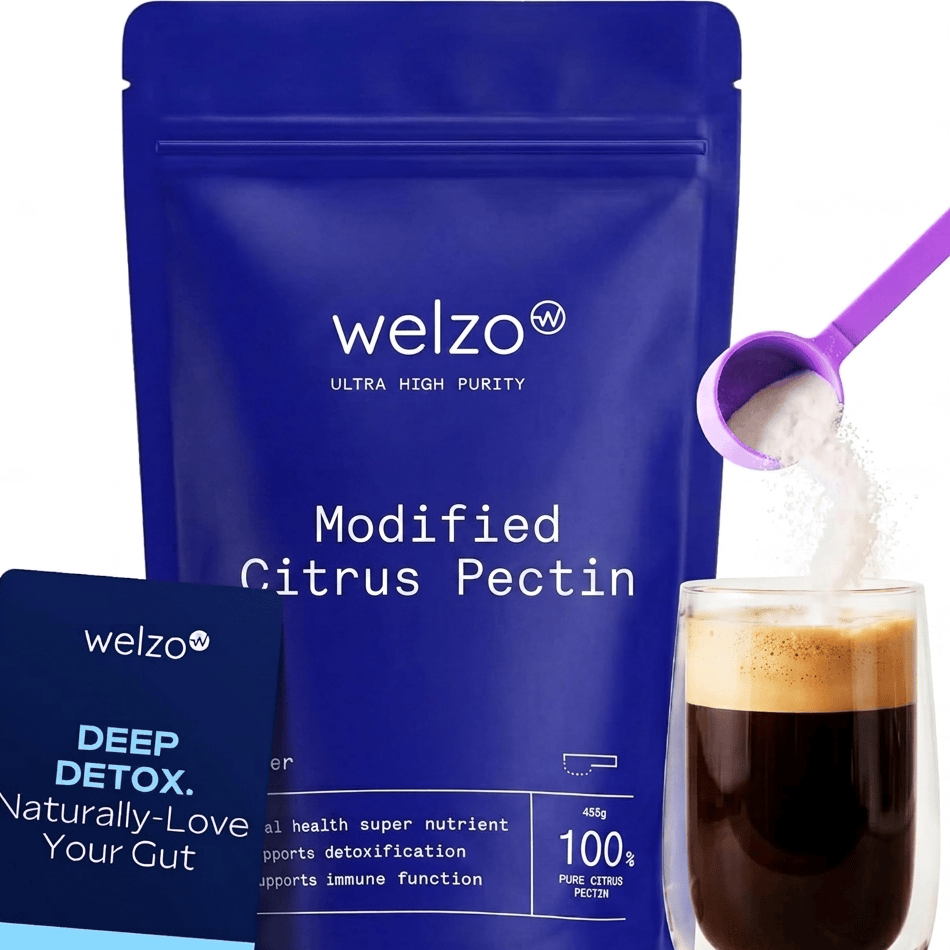
Why it wins: it is the only product in this comparison with a published, batch-specific Certificate of Analysis — lead at 0.06 mg/kg against a 0.3 limit, mercury at 0.003 against 0.02, pesticides and salmonella absent. It is 100% modified citrus pectin with nothing else in the tub: no sweeteners, no flow agents, and critically no added sodium or potassium. And at £0.30 per 5g serving it is the only one of the two most people can realistically afford to take for the six months that any fibre intervention needs.
Available from Welzo — Welzo's own brand; disclosed in full below.
Runner-up — best for clinical protocol
ecoNugenics PectaSol-C
£134.18 · 454g · 90 servings · £1.49 per serving · 108 reviews
The one reason to pay five times more: PectaSol is the specific material used in every published human trial of modified citrus pectin, and its molecular weight and degree of esterification are documented in the peer-reviewed literature. If your aim is to reproduce a published protocol under specialist supervision, specification-matching is the whole point and this is the product to buy.
Table of contents
- PectaSol vs Welzo at a glance
- How we judged these two products
- What modified citrus pectin actually is
- Winner: Welzo Ultra Purity Modified Citrus Pectin
- Runner-up: ecoNugenics PectaSol-C
- Head-to-head scorecard
- The one case where PectaSol wins
- Cost per serving and cost per course
- Which one should you buy?
- How to take modified citrus pectin
- Safety, interactions and who should avoid it
- Where the marketing outruns the evidence
- When to see a doctor
- Frequently asked questions
PectaSol vs Welzo Modified Citrus Pectin at a glance
| Feature | Welzo Ultra Purity | ecoNugenics PectaSol-C |
|---|---|---|
| Price | £26.99 (RRP £39.99) | £134.18 |
| Tub size | 455g | 454g |
| Servings | 91 × 5g | 90 × 5g |
| Cost per serving | £0.30 | £1.49 |
| Published batch COA | Yes — full panel | Not on UK listing |
| Heavy metal results | Published, 3–6× under limits | Not published |
| Ingredients | 100% pectin, nothing else | Pectin plus sodium and potassium |
| Sodium / potassium per serving | None declared | 180mg / 420mg |
| Degree of esterification | 62% (per COA) | 3.8% (published) |
| Used in human trials | No | Yes |
| Reviews | 100 | 108 |
| Best for | Almost everyone | Replicating the trial protocol |
How we judged these two products
A verdict is only useful if you can see the criteria behind it. Here are mine, in priority order, along with which product takes each one. I have made no attempt to hide the criterion that goes against the winner.
| Criterion | Why it matters | Winner |
|---|---|---|
| 1. Verified batch purity | Peel-derived botanicals concentrate heavy metals. You should be able to see the numbers. | Welzo |
| 2. Label transparency | Undeclared minerals matter clinically. Single ingredient means no surprises. | Welzo |
| 3. Cost per serving and course affordability | A supplement you stop after a month because of price does nothing. | Welzo |
| 4. Fitness for the common use case (soluble fibre) | This is what most UK buyers actually want from citrus pectin. | Welzo |
| 5. Match to the published trial specification | Only relevant if you are reproducing a research protocol. | PectaSol |
Welzo Ultra Purity takes four of the five criteria, including the three I weight most heavily. That is why it is the overall winner. Criterion 5 is the exception, it is a real one, and section 7 explains exactly who it applies to.
What modified citrus pectin actually is
Pectin is a structural carbohydrate in the peel and pith of citrus fruit. As dietary fibre it is genuinely valuable — a soluble, gel-forming fibre with a long evidence base in cholesterol management, and a fermentable substrate that gut bacteria convert into short-chain fatty acids, the compounds that nourish the colonic lining and support gut barrier function. For that job it sits alongside psyllium and inulin as a well-tolerated soluble fibre — and unlike inulin, pectin is generally gentler on people who react badly to fermentable carbohydrates.
Why "modified" is the load-bearing word
Native pectin molecules are large, branched and heavily methyl-esterified. Modification means breaking those chains down and stripping the methyl ester groups, producing short, low-molecular-weight galacturonic acid chains that can be absorbed in small amounts and that expose the structures binding galectin-3 — a carbohydrate-binding protein implicated in cell adhesion and fibrosis. That binding is the proposed mechanism behind MCP's systemic effects, reviewed by Eliaz and Raz in Nutrients (2019).
The two numbers that describe how far modification has gone are molecular weight and degree of esterification (DE). The material used in the human research was characterised in Phytotherapy Research at ~15,400 Da with a DE of 3.8% (Eliaz et al., 2006). Keep those two figures in mind — they are the only honest way to compare MCP products, and we go deeper in our guide to modified citrus pectin vs ordinary pectin.
Winner: Welzo Ultra Purity Modified Citrus Pectin
Price: £26.99 (RRP £39.99) · Reviews: 100 · Size: 455g, 91 servings · Cost per serving: £0.30 · GTIN: 5070004247515 · Where to buy: Available from Welzo — Welzo's own brand; disclosed in full below.
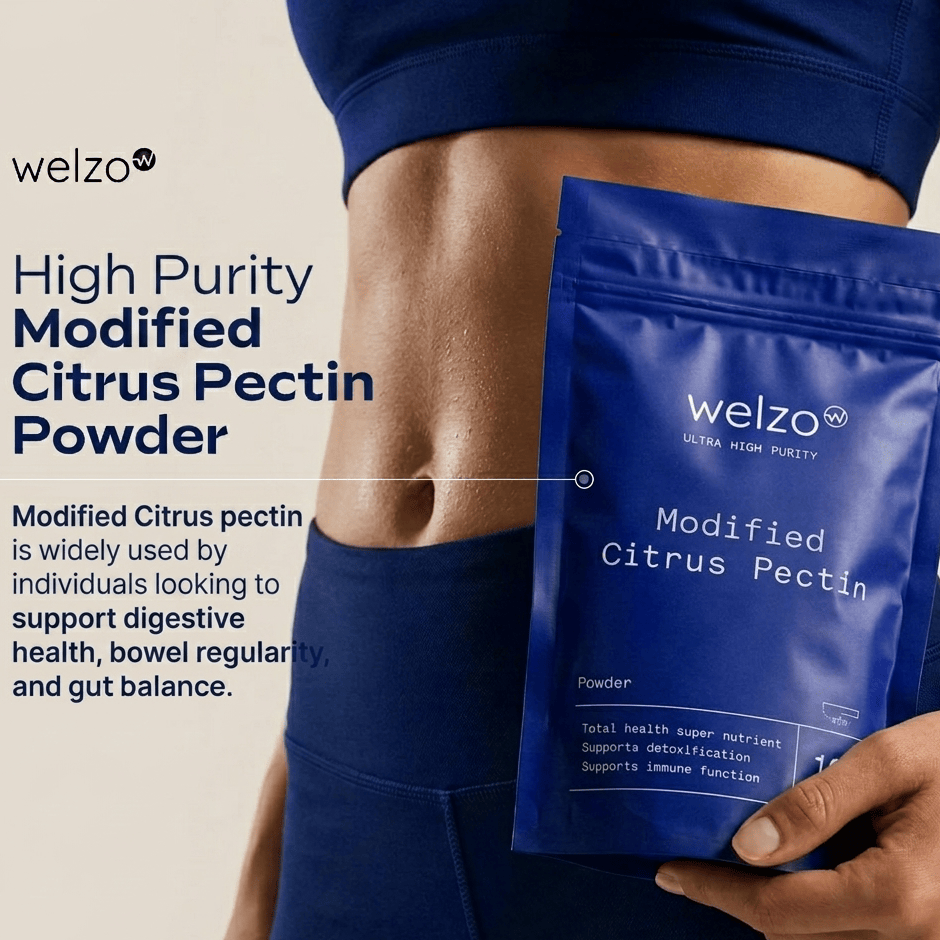
Why we like it
Very few supplement brands publish a batch-specific Certificate of Analysis, and in a category built on peel-derived botanicals that omission matters more than most people realise — citrus peel is exactly the plant tissue that concentrates cadmium and lead from soil. Welzo publishes the whole panel, openly, with the lot number on it. That single decision tells you more about a product than any amount of heritage marketing, and it is the main reason this wins.
The formulation is equally clean. It is 100% modified citrus pectin — no sweeteners, no flavourings, no silicon dioxide, no bulking agents. It also carries no added sodium or potassium, which sounds like a small thing until you are a patient with reduced kidney function or on an ACE inhibitor, at which point it becomes the deciding factor. And at £0.30 per 5g serving, a six-month course costs about £162 rather than £805. Adherence is not a footnote in fibre research; it is the whole ballgame.
What the Certificate of Analysis shows
Batch CIT20251129001, manufactured November 2025 from Spanish orange peel, tested against GB 1886.334 and USP 45:
| Test | Specification | Result |
|---|---|---|
| Pectin content per serving | ≥5g | 5.05g |
| Purity (galacturonic acid) | ≥70.0% | 72.5% |
| Lead | ≤0.3 mg/kg | 0.06 mg/kg |
| Cadmium | ≤0.1 mg/kg | 0.02 mg/kg |
| Mercury | ≤0.02 mg/kg | 0.003 mg/kg |
| Arsenic | ≤0.5 mg/kg | 0.12 mg/kg |
| Pesticide residues | None detected | None detected |
| Aflatoxin B1 | ≤5.0 µg/kg | 1.5 µg/kg |
| Salmonella / S. aureus | Absent | Absent |
| Degree of esterification | 55–70% | 62% |
Welzo Ultra Purity: pros and cons
| Pros | Cons |
|---|---|
| Full batch Certificate of Analysis published openly — rare in this category Heavy metals 3–6× below limits; pesticides, salmonella and S. aureus absent True single ingredient — no fillers, sweeteners or flow agents No added sodium or potassium declared £0.30 per serving — a full six-month course is affordable 91 servings, vegan, mixes easily, 72.5% galacturonic acid purity |
Degree of esterification 62% — high-methoxyl, not the trial specification No molecular weight stated on the COA Not the material used in any published human trial Not the right choice if you are reproducing a research protocol Earlier batches were labelled "Citrus Pectin Powder" without the word "Modified" |
Runner-up: ecoNugenics PectaSol-C

Price: £134.18 · Reviews: 108 · Size: 454g, 90 servings · Cost per serving: £1.49 · GTIN: 892985000102 · Where to buy: Available from Welzo
Why we like it
PectaSol has one advantage nothing else in the UK market can claim: it is the actual material used in the published human research, with its molecular weight and degree of esterification documented in peer-reviewed literature rather than asserted in marketing copy. Each 5g scoop matches the trial dosing unit exactly, so reproducing a protocol requires no arithmetic. It has been made by the same company since 1995 and was well tolerated across the studies with no dose-limiting toxicity reported.
Against that: no batch COA on the UK listing, 420mg of potassium and 180mg of sodium per scoop that many buyers never notice, and a price that makes a full protocol cost roughly £805 over six months.
The evidence behind PectaSol specifically
Prostate cancer and PSA doubling time
A 2003 pilot in Prostate Cancer and Prostatic Diseases gave 13 men with biochemical PSA failure 14.4g/day for 12 months; in 7 of the 10 evaluable men (70%), PSA doubling time lengthened significantly (Guess et al., 2003). A later prospective phase II study across five Israeli centres enrolled 60 patients, 59 of whom completed six months on 4.8g three times daily; 75% showed improved PSA doubling time (Keizman et al., 2021), with 46 continuing a further 12 months (Keizman et al., 2023).
Heavy-metal excretion
Eight healthy volunteers took 15g/day for five days and 20g on day six. Urinary arsenic rose significantly in the first 24 hours (130%, p<0.05) and cadmium by day six (150%, p<0.05), without depleting essential minerals (Eliaz et al., 2006). This single study underpins most "detox" marketing in the category. It had eight participants, no placebo group and no control for dietary metal exposure during collection — limitations set out in a published critique in Alternative Medicine Review (2008;13(4):283).
PectaSol-C: pros and cons
| Pros | Cons |
|---|---|
| The literal material used in every major human MCP trial Molecular weight (~15,400 Da) and DE (3.8%) published in peer-reviewed literature Scoop size matches the trial dosing unit exactly Non-GMO citrus; brand established since 1995 Well tolerated with no dose-limiting toxicity reported |
Roughly 5× the cost per gram — about £805 for a six-month course No batch Certificate of Analysis published on the UK listing Adds 1,260mg potassium and 540mg sodium daily at trial dose At the trial dose a tub lasts only 30 days Key evidence is single-arm and manufacturer-funded, with no phase III |
Head-to-head scorecard
| Category | Welzo Ultra Purity | PectaSol-C | Winner |
|---|---|---|---|
| Published batch COA | Yes, full panel | No | Welzo |
| Contaminant results | 3–6× under limits | Not disclosed | Welzo |
| Ingredient simplicity | One ingredient | Pectin plus sodium and potassium | Welzo |
| Suitability in kidney disease | No potassium load declared | 1,260mg potassium daily | Welzo |
| Cost per gram | £0.059 | £0.30 | Welzo |
| Soluble fibre performance | Excellent | Excellent | Draw |
| Match to trial specification | DE 62%, MW not stated | DE 3.8%, ~15,400 Da | PectaSol |
| Overall | Six categories | One category | Welzo |
The one case where PectaSol wins
Welzo Ultra Purity is the better buy for almost everyone. There is one group for whom it isn't, and I would rather be direct about it than let someone find out the expensive way.
If you have come to modified citrus pectin because of the prostate research, the galectin-3 mechanism or the heavy-metal excretion study, then the specification is the product. Those findings belong to a material with a degree of esterification of 3.8% and a molecular weight around 15,400 Da. Welzo's COA reports 62% DE and states no molecular weight — chemically a different starting point, and I have no data showing the two behave alike. In that scenario the £107 price difference is not the relevant number; matching the studied material is. Buy PectaSol-C, and discuss it with your consultant first.
If you are here for fibre, regularity, digestive comfort or general gut support — which is most people — none of that applies, and Welzo Ultra Purity is comfortably the better product at a fifth of the price.
Cost per serving and cost per course
| Scenario | Welzo Ultra Purity | PectaSol-C |
|---|---|---|
| 5g per day (fibre dose) | £0.30/day · ~£9/month | £1.49/day · ~£45/month |
| 15g per day (trial dose) | £0.89/day · ~£27/month | £4.47/day · £134.18/month |
| Tub duration at 5g/day | 91 days | 90 days |
| Six-month course at 15g/day | ~£162 | ~£805 |
Prices verified on Welzo at the time of writing and subject to change.
Which one should you buy?
| Your goal | Recommendation |
|---|---|
| A clean soluble fibre for digestive comfort and regularity | Welzo Ultra Purity |
| Raising daily fibre intake cost-effectively | Welzo, alongside high-fibre foods |
| You want to see batch test results before buying | Welzo — the only one with a published COA |
| You need to avoid added potassium or sodium | Welzo — declares neither |
| Long-term daily use on a realistic budget | Welzo — around £9/month at 5g |
| Reproducing a published protocol under specialist care | PectaSol-C |
If broad gut support is the real goal, pectin is one lever among several. Diversity of plant intake matters more than any single powder — see 30 plants a week and increasing microbiome diversity. Many people get more from a well-chosen probiotic, a prebiotic, or Akkermansia muciniphila than from pectin alone.
How to take modified citrus pectin
| Use | Dose | Timing | Time to assess |
|---|---|---|---|
| General fibre and digestive support | 5g once daily | Any time, with plenty of water | 2–4 weeks |
| Published trial protocol | 4.8g × 3 daily (14.4g) | Divided doses, empty stomach | 6 months minimum |
| Starting out | 2.5g, build up over 2 weeks | With food initially | Reduces wind and bloating |
Increase fluid intake alongside any soluble fibre and build the dose gradually. Sudden large increases are a common cause of trapped wind and bloating — our guide to increasing fibre safely explains the titration.
Safety, interactions and who should avoid it
The most common side effects of either product are the ordinary consequences of adding soluble fibre: wind, mild distension and looser stools in the first fortnight. These usually settle. If they don't, reduce the dose and rebuild slowly.
Important safety information — please read before buying
- The potassium load in PectaSol-C is easy to miss. At 420mg per scoop, the trial dose delivers roughly 1,260mg potassium and 540mg sodium daily. If you have chronic kidney disease, or take an ACE inhibitor, an angiotensin receptor blocker, spironolactone or another potassium-sparing diuretic, speak to your GP, pharmacist or renal team first. The Welzo product declares neither mineral.
- Soluble fibre can reduce absorption of medicines taken at the same time. Separate any pectin powder from prescription medication — including thyroid hormone, antibiotics and iron — by at least two hours.
- Not recommended in pregnancy or breastfeeding, or for children, in the absence of safety data.
- Avoid if you have a known citrus allergy.
- Caution with swallowing difficulties or a history of bowel obstruction or strictures. Gel-forming fibres require adequate fluid; anyone with a stricturing pattern of Crohn's disease should take advice first.
- Modified citrus pectin is not a treatment for cancer or any other disease, and must never replace or delay treatment recommended by your oncology team.
On labelling: modified citrus pectin carries no authorised health claim in GB or the EU. It is sold as a food supplement and cannot legally be marketed as treating, preventing or managing any condition.
Where the marketing outruns the evidence
This category carries some of the most overheated marketing in supplements, and I would rather you heard the corrections here.
"Clinically proven." Cancer Research UK's position is blunt and, in my view, correct: modified citrus pectin is an alternative therapy, and there is no scientific evidence that it can cure or prevent cancer. The phase II data are worth following. They are not proof.
"Detox." Not an authorised claim under the GB nutrition and health claims register, and the human data amount to a single-arm pilot in eight people plus a small case series. Genuine chelation for confirmed heavy-metal poisoning is a supervised medical treatment, not a powder bought online.
"Supports healthy galectin-3 levels." Galectin-3 is a legitimate research target, but this is not an authorised health claim in Great Britain, and for any product that has not demonstrated the required molecular specification it isn't supportable on the science either. Judge every MCP product — ours included — on its published degree of esterification and molecular weight, not its front label. That is precisely why we publish our COA.
We take the same approach in is leaky gut real?, do probiotics work? and our standalone PectaSol review.
When to see a doctor
Speak to your GP promptly if you have:
- A rising PSA, or urinary symptoms such as hesitancy, a weak stream, nocturia or blood in urine or semen — see NHS guidance on prostate cancer symptoms
- Blood in your stool, or a persistent change in bowel habit lasting more than three weeks
- Unexplained weight loss, persistent abdominal pain, or a new abdominal lump
- Difficulty swallowing, or vomiting that will not settle
- Any diagnosed cancer, kidney disease or liver disease before starting any supplement
If you are under an oncology or renal team, tell them about any supplement you are considering — including this one. For urgent advice contact your GP surgery or call NHS 111. See also when to see a GP about stomach symptoms and UK bowel cancer screening.
Frequently asked questions
Which modified citrus pectin is best in the UK?
For most buyers, Welzo Ultra Purity Modified Citrus Pectin at £26.99 is the best choice. It is the only product in this comparison with a published batch Certificate of Analysis, it is a true single ingredient with no added sodium or potassium, and it costs £0.30 per serving against £1.49. Choose ecoNugenics PectaSol-C only if you are reproducing a published clinical protocol.
Is Welzo Modified Citrus Pectin the same as PectaSol?
No. Both deliver 5g of citrus pectin per serving, but their specifications differ. Welzo publishes a degree of esterification of 62%; PectaSol's published characterisation is 3.8% with a molecular weight around 15,400 Da. Welzo is the better everyday soluble fibre; PectaSol is the material used in the trials.
Why is PectaSol-C so much more expensive?
At £134.18 for 454g it costs roughly five times as much per gram. The premium reflects controlled enzymatic depolymerisation, batch-to-batch molecular weight consistency and the cost of the research programme. Whether that is worth paying depends entirely on whether you need the trial specification — most people don't.
What dose was used in the studies?
4.8g three times daily — 14.4g per day — in both the 2003 pilot and the 2021 phase II study, taken on an empty stomach in divided doses. That means a 454g tub lasts about one month.
Does modified citrus pectin treat cancer?
No. Cancer Research UK states there is no scientific evidence that it can cure or prevent cancer. The phase II data concern a blood marker in one specific setting, are uncontrolled, and are not evidence of an effect on survival. It must never replace or delay conventional treatment.
How long does modified citrus pectin take to work?
For digestive effects as a soluble fibre, most people notice changes in regularity within two to four weeks. The clinical trials assessed their endpoints at six and eighteen months. This is not a short-course supplement.
Can I take citrus pectin with a probiotic?
Yes. Pectin is a fermentable soluble fibre, so it acts as a prebiotic substrate and pairs well with live cultures. See prebiotic vs probiotic and our synbiotic guide.
Does modified citrus pectin remove heavy metals?
A 2006 pilot in eight healthy volunteers found significant increases in urinary arsenic and cadmium excretion using PectaSol at 15–20g/day. It had no placebo group and did not control for dietary exposure, and a published critique highlighted these limitations. Suspected heavy-metal toxicity needs medical assessment, not a supplement.
Is citrus pectin safe if I have kidney problems?
Pectin itself has a long food-safety record, but PectaSol-C supplies 420mg potassium per scoop — around 1,260mg daily at full dose. Welzo Ultra Purity declares no added potassium, which makes it the more appropriate option here. Either way, discuss it with your clinician first.
What are the side effects of modified citrus pectin?
Mainly gastrointestinal: wind, bloating, mild cramping and looser stools, particularly in the first two weeks or if the dose rises too quickly. No dose-limiting toxicity was reported in the phase II prostate studies. Build up gradually and drink plenty of water.
Medical disclaimer: This article is for general information and education only and does not constitute medical advice, diagnosis or treatment. Food supplements are not a substitute for a varied and balanced diet, and are not intended to diagnose, treat, cure or prevent any disease. Modified citrus pectin is not a treatment for cancer. If you have a cancer diagnosis, discuss any supplement with your oncology team before use. No authorised health claim exists for modified citrus pectin in GB or the EU. PectaSol-C supplies added potassium and sodium — relevant in chronic kidney disease and alongside ACE inhibitors, angiotensin receptor blockers and potassium-sparing diuretics. Soluble fibre can reduce the absorption of medication — separate doses by at least two hours and check with a pharmacist. Any new lump, unexplained weight loss, or change in bowel habit lasting three weeks or more requires medical assessment; do not delay this to try a supplement. Prices, review counts and availability are correct at the time of writing.
About the author
Dr Zeeshan Afzal (MBBS) is a practising medical doctor and Welzo's Medical Content Lead. He writes on gastroenterology, nutrition and evidence appraisal, with a focus on translating primary clinical literature into practical guidance for UK patients. All Welzo health content is produced under our published editorial policy and reviewed by our medical team, led by Chief Medical Officer Dr Sameer Nakedar (MBBS, MRCGP, PGCert).
Transparency note
Welzo sells both products compared here, and Welzo Ultra Purity Modified Citrus Pectin is Welzo's own brand. Welzo therefore has a commercial interest in this comparison. The verdict was reached against the stated criteria in section 2, using each product's published specification, Certificate of Analysis and peer-reviewed characterisation data. Where the evidence favoured the competitor — on match to the published trial specification — we have said so plainly rather than omitting it. Prices verified at the time of writing and subject to change.
References
- Welzo. Modified Citrus Pectin Powder — Certificate of Analysis, batch CIT20251129001. View COA
- Keizman D, Frenkel M, Peer A, et al. Modified Citrus Pectin Treatment in Non-Metastatic Biochemically Relapsed Prostate Cancer: Results of a Prospective Phase II Study. Nutrients. 2021;13(12):4295. Link
- Keizman D, Frenkel M, Peer A, et al. Modified Citrus Pectin Treatment in Non-Metastatic Biochemically Relapsed Prostate Cancer: Long-Term Results. Nutrients. 2023;15(16):3533. Link
- Guess BW, Scholz MC, Strum SB, et al. Modified citrus pectin (MCP) increases the prostate-specific antigen doubling time in men with prostate cancer: a phase II pilot study. Prostate Cancer Prostatic Dis. 2003;6(4):301–304. Link
- Eliaz I, Hotchkiss AT, Fishman ML, Rode D. The effect of modified citrus pectin on urinary excretion of toxic elements. Phytother Res. 2006;20(10):859–864. Link
- Eliaz I, Raz A. Pleiotropic Effects of Modified Citrus Pectin. Nutrients. 2019;11(11):2619. Link
- Cancer Research UK. Modified citrus pectin (MCP). Link
- Is Modified Citrus Pectin an Effective Mobilizer of Heavy Metals? Alternative Medicine Review. 2008;13(4):283. Link
- NHS. Prostate cancer — symptoms. Link
- NHS inform. Chronic kidney disease. Link



 Hodnoceno výborně o 28,951+ recenzí
 100% záruka vrácení peněz