

Best Bifidobacterium longum Supplements UK
Posted on:
Aug 05, 2026
Authored by


Written and medically reviewed by Dr Zeeshan Afzal (MBBS) — Medical Doctor & Medical Content Lead, Welzo
Part of our digestive health guides · Shop gut health supplements
Evidence-based · Honest about what's proven and what isn't · UK-focused
Last updated: July 2026 · Reading time: ~13 minutes
Bifidobacterium longum is one of the first bacteria to colonise the human gut and one of the most abundant in a healthy infant. It is also, for buyers, the most confusingly labelled probiotic on the market — because the same organism has been sold under at least three different names.
There are two layers of confusion. First, B. longum splits into subspecies — longum and infantis — which behave differently. Second, the clinical evidence attaches to individual strains, and the two best-researched ones (BB536 and 35624) have almost nothing in common beyond the species name.
Get the strain wrong and you are buying a different product from the one in the trials. This guide explains the distinction, ranks every B. longum supplement at Welzo, and states openly which are in stock. For the wider range, start with gut health supplements.

Table of contents
Almost every mistake buyers make in this category comes from treating these three levels as interchangeable. They are not.
A broad group of bacteria naturally present in the human colon, and among the most abundant organisms in a breastfed infant's gut. Useful as a category. Meaningless as a purchasing specification.
B. longum subsp. longum is the adult-associated form. B. longum subsp. infantis is specialised for infancy — it carries the genetic machinery to digest human milk oligosaccharides, the complex sugars in breast milk that the baby itself cannot break down. They are close relatives doing quite different jobs.
A strain is one specific, catalogued isolate. Clinical trials test strains, not species — and the results do not transfer sideways. This is worth stressing because the labelling history here is genuinely messy: the strain marketed for IBS has appeared on packaging as B. infantis 35624, then B. longum subsp. infantis 35624, and now B. longum 35624. Same organism, three names, one body of evidence. Published commentary in the field has described the persisting taxonomic confusion in almost exactly those terms.
The practical consequence: a tub labelled only "Bifidobacterium longum" tells you the genus and species and nothing that predicts an effect. See how to choose a probiotic for the wider principles, and Lactobacillus rhamnosus GG for the same problem in another category.
| Strain | Studied mainly for |
|---|---|
| B. longum 35624 (formerly B. infantis 35624) | IBS symptoms — the best-evidenced strain in this species |
| B. longum BB536 | Immune and respiratory outcomes; general gut balance |
| B. longum subsp. infantis (e.g. M-63, EVC001) | Infant gut development and human milk oligosaccharide digestion |
| B. longum 1714 | Stress and cognition — preliminary human data only |
| Unnamed "B. longum" | No transferable evidence |
| What it says | What it means |
|---|---|
| B. longum BB536 | Good — a named, clinically studied strain |
| B. longum 35624 | Good — the IBS strain, whatever name is printed |
| subsp. infantis | Infant-associated subspecies — check it suits your purpose |
| "Bifidobacterium longum", no code | Species only — the strain evidence does not apply |
| Very high CFU, no strain named | Potency without identity — see the dose note below |
Storage matters more here than with most probiotics. Bifidobacteria are strict anaerobes and comparatively fragile, so several quality products require refrigeration. See do probiotics need refrigeration and shelf-stable probiotics.
The landmark study is Whorwell and colleagues, published in the American Journal of Gastroenterology in 2006. It randomised 362 women in primary care with IBS to the strain then called B. infantis 35624 at one of three doses, or placebo, for four weeks.
The result is the most useful thing in this entire article. At 1×10⁸ CFU the strain significantly improved abdominal pain, bloating, bowel dysfunction, flatulence, straining and incomplete evacuation versus placebo. At 1×10⁶ and 1×10¹⁰ CFU it did not. The highest dose performed no better than placebo.
Later work has been broadly supportive: an observational study of 278 patients diagnosed by Rome IV criteria reported reduced severity and improved quality of life after 30 days, with the largest gains in those with the most severe symptoms. Several clinical guidelines now mention the strain by name. If IBS is your reason for reading, also see supplements for IBS and confirm your IBS subtype first.
BB536 is the other well-characterised strain and the one stocked here. In a randomised trial, children aged two to six taking BB536 for ten months had a 46% shorter duration of sore throat than placebo (p=0.018). Reductions in runny nose and cough were smaller and did not reach statistical significance. Gut microbiota analysis showed an increase in Faecalibacterium in the BB536 group that was not seen with placebo. Related reading: gut health and the immune system.
B. longum subsp. infantis is the dominant organism in a healthy breastfed infant's gut, where it metabolises human milk oligosaccharides and produces short-chain fatty acids. This is a genuinely distinct area from adult supplementation, and infant probiotics should be discussed with a health visitor or GP — see baby probiotics.
The strain B. longum 1714 has been studied for stress and cognitive measures, and the gut-brain connection is a legitimate research field. But human trials remain small and preliminary. Treat mood claims on a B. longum label as ahead of the evidence — see probiotics for anxiety.
| Use | Evidence |
|---|---|
| IBS symptoms (strain 35624) | Strongest — RCT plus supportive follow-up; dose-specific |
| Immune / respiratory (BB536) | Moderate — one long paediatric RCT, mixed endpoints |
| Infant gut development (infantis) | Good mechanistic basis; distinct clinical area |
| General digestion (unnamed strains) | Plausible but not demonstrated for that product |
| Mood, stress, weight | Preliminary — avoid products leading with these claims |
Welzo lists four B. longum products. Two are currently in stock, and availability is stated openly on each entry rather than filtered out. Prices and review counts were correct at the time of writing — always check the live listing.
Best Overall: Life Extension Bifido GI Balance, 60 vcaps — £15.67
Best In Stock: Kirkman Bifido Complex Advanced Formula, 60 caps — £62.25
Best High-Potency: Custom Probiotics B. Longum Powder, 50g — £103.25
Best Value Powder: Metabolics Bifidobacterium Longum Powder, 100g — £48.55
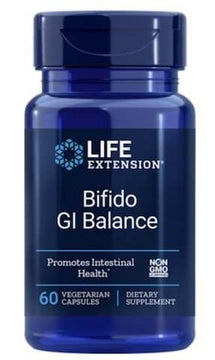
Price: £15.67 (reduced from £20.51) · Reviews: 86 · Stock: Currently sold out — check listing · Where to buy: Available from Welzo
Why it's the best: This is the only product in the range that names a clinically studied strain. Each vegetarian capsule supplies 2 billion CFU of Bifidobacterium longum BB536, standardised at 25mg. Everything else here gives you the species and asks you to trust it.
BB536 is the strain behind the paediatric respiratory trial described above, and it has the deepest research base of any B. longum you can readily buy in the UK outside the Alflorex 35624 strain. It is gluten-free, non-GMO and vegetarian, with a short excipient list. It is also, notably, the cheapest product in this guide by a wide margin.
Two things to know. The dose is modest at 2 billion CFU — deliberately so, and the Whorwell dose findings suggest that isn't the drawback it looks like, but it is much lower than the powders below. And it should be refrigerated after opening, so it's less convenient for travel.
| Pros | Cons |
|---|---|
| Names a clinically studied strain (BB536) Cheapest option here by a wide margin Gluten-free, non-GMO, vegetarian Short excipient list Simple once- or twice-daily capsule |
Lowest CFU (2 billion per capsule) Refrigerate after opening Single strain — no broader Bifido coverage Currently out of stock |
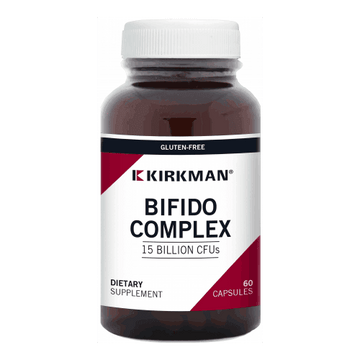
Price: £62.25 · Reviews: 152 · Stock: In stock · Where to buy: Available from Welzo
Why we like it: A Bifidobacterium-only formula delivering 15 billion CFU per capsule from four species — B. longum, B. lactis, B. bifidum/lactis and B. breve. No Lactobacillus, which is unusual and useful if you specifically want to support the bifidobacterial side of the microbiome.
The engineering is the standout. It is genuinely hypoallergenic — free from milk, eggs, fish, shellfish, tree nuts, peanuts, wheat, soy and sesame — with only microcrystalline cellulose, a vegetarian capsule and silicon dioxide alongside the cultures. It ships in an amber glass bottle with an oxygen absorber and desiccant, which is meaningful packaging for organisms this fragile rather than marketing dressing. It is the most reviewed product in this guide, and it is in stock.
The honest caveat: the label gives species, not strain codes. At £62.25 you are paying practitioner-grade prices for a formulation whose specific clinical evidence you cannot look up. It also requires refrigeration. See single vs multi-strain probiotics for whether the broader blend suits your goal.
| Pros | Cons |
|---|---|
| In stock 15 billion CFU from four Bifidobacterium species Genuinely hypoallergenic — nine major allergens excluded Amber glass, oxygen absorber, desiccant Minimal excipients Most reviewed here (152) |
Species listed, not strain codes Expensive at £62.25 Must be kept refrigerated Not a single-strain B. longum product |
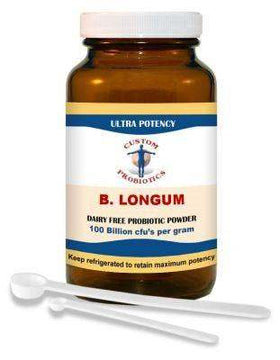
Price: £103.25 · Reviews: 80 · Stock: Currently sold out — check listing · Where to buy: Available from Welzo
Why we like it: A single-strain powder using B. longum BL-05 at 100 billion CFU per gram. It names its strain, which puts it ahead of the two products above on identity, and the powder format allows genuinely flexible dosing — you can start at a fraction of a gram and titrate up, which capsules do not permit.
It is dairy-free, sugar-free, gluten-free and non-GMO, which makes it workable for restricted diets. For anyone who reacts to fillers, a plain single-strain powder is about as stripped back as this category gets. See probiotic powders.
The price is the problem. At £103.25 for 50g this is by far the most expensive option here, and BL-05 — while named — does not carry the published clinical record that BB536 or 35624 do. You are paying a premium for potency and strain transparency rather than for trial evidence.
| Pros | Cons |
|---|---|
| Names its strain (BL-05) Very high potency — 100 billion CFU per gram Powder allows precise, flexible dosing Dairy-free, sugar-free, gluten-free, non-GMO Single strain, no fillers |
By far the most expensive (£103.25) BL-05 has a thinner published record than BB536 Requires scales or a scoop to dose accurately Currently out of stock |
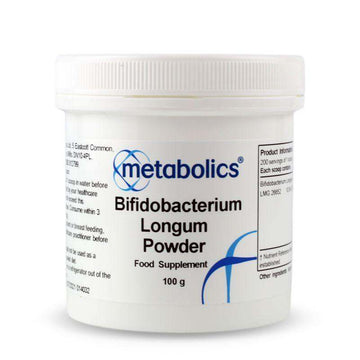
Price: £48.55 · Reviews: 98 · Stock: In stock — but see note below · Where to buy: Available from Welzo
Why we like it: On a per-gram basis this is much better value than the Custom Probiotics powder — 100g for £48.55 against 50g for £103.25, roughly a quarter of the cost per gram. It is a straightforward single-species powder from a UK manufacturer, and the format gives the same dosing flexibility.
If you have decided you want a B. longum powder for daily maintenance rather than to replicate a particular trial, this is the sensible economic choice.
Two caveats worth reading before you order. The listing does not declare a strain code, so the evidence discussed in this article does not attach to it. And the product page carries marketplace wording suggesting availability should be checked elsewhere, which sits oddly with the collection page showing it as in stock — worth confirming with customer service before ordering.
| Pros | Cons |
|---|---|
| Best value per gram of any powder here Large 100g pack Flexible powder dosing UK manufacturer Listed as in stock |
No strain code declared CFU per gram not stated on the listing Conflicting availability wording on the product page Not a match for any specific trial |
There is no single established dose for B. longum, because the right dose depends on the strain. BB536 products typically supply 2 to 6 billion CFU daily. The 35624 IBS evidence points to roughly 1×10⁸ CFU — considerably lower than most products on sale, and a reminder that bigger numbers are not the goal.
Practical guidance: follow the label for the specific product rather than a figure from an article, since a 2 billion CFU capsule and a 100 billion CFU per gram powder are not interchangeable by volume. Start at the lowest stated serving. See when to take probiotics and CFU vs AFU.
Timing and storage: bifidobacteria are anaerobes and less acid-tolerant than many lactobacilli, so taking them with or just after food can help. Keep refrigerated products refrigerated — potency claims assume it.
How long to give it: allow four weeks before judging general digestive comfort, and stop if symptoms worsen rather than pushing through. See how long probiotics take to work. Bifidobacteria are also fed by fermentable fibre, so pairing with dietary prebiotic foods is reasonable — though not if you are actively flaring on a low FODMAP diet.
Bifidobacteria have a strong safety record in healthy adults and children. Mild bloating, wind or a change in stool frequency during the first week or two is common and usually settles — see probiotic side effects. Some products are dairy-derived, so check the allergen statement if you are dairy-allergic.
Speak to a doctor before taking B. longum if you
Probiotic bacteraemia is rare and occurs almost exclusively in people with the risk factors above. Further detail in probiotics safety.
On labelling: probiotics carry no authorised health claim in GB or the EU, so they are sold as food supplements and cannot legally be marketed as treating any condition.
See your GP — or seek urgent care — if you have:
IBS should be diagnosed by a clinician, not assumed. A probiotic is not a substitute for assessment. Read more on when to see a GP about stomach symptoms and bowel cancer screening in the UK.
Life Extension Bifido GI Balance at £15.67 is the strongest choice on the evidence, because it is the only product in this range that names a clinically studied strain — B. longum BB536. If it's out of stock, Kirkman Bifido Complex is the best in-stock option, though it lists species rather than strain codes.
B. infantis is now classified as a subspecies of B. longum. The infantis subspecies is specialised for infancy and can digest human milk oligosaccharides; the longum subspecies is the adult-associated form. Confusingly, the IBS strain 35624 has been sold under both names over the years.
No, and this species provides the clearest evidence against that assumption. In the main IBS trial of strain 35624, a dose of 1×10⁸ CFU improved symptoms while 1×10¹⁰ did not outperform placebo. Strain identity matters far more than the size of the number on the label.
Strain 35624 has the strongest evidence of any B. longum for IBS symptoms, supported by a randomised trial and later observational data. That evidence does not transfer to other B. longum strains or to products that name only the species.
Often, yes. Bifidobacteria are strict anaerobes and comparatively fragile. Both the Life Extension and Kirkman products above should be kept refrigerated, and the Kirkman bottle includes an oxygen absorber and desiccant for the same reason.
Generally yes, and many multi-strain formulas combine bifidobacteria with lactobacilli. Whether you need both depends on your goal — a single well-chosen strain is more defensible if you're targeting a specific outcome.
Allow four weeks before judging general digestive comfort. In the IBS trials, symptom differences emerged over a four-week course. If symptoms worsen rather than settle, stop rather than pushing through.
B. longum subsp. infantis is the dominant organism in a healthy breastfed infant's gut, and infant-specific products exist. But infant supplementation should be discussed with your health visitor or GP first rather than started independently.
Mild bloating, wind or altered stool frequency in the first week or two are common and usually resolve. Serious adverse events are rare and essentially confined to people who are immunocompromised, critically unwell, or who have indwelling lines.
The evidence is preliminary. Strain 1714 has been studied for stress and cognitive measures, but human trials remain small. Treat mood claims on a B. longum label as running ahead of what has actually been demonstrated.
Medical disclaimer: This article is for general information and education only and does not constitute medical advice, diagnosis or treatment. Food supplements are not a substitute for a varied and balanced diet, and are not intended to diagnose, treat, cure or prevent any disease. Probiotics should be discussed with a doctor before use if you are immunocompromised, critically unwell, have an indwelling venous line, or are pregnant or breastfeeding, and infant supplementation should be discussed with a health visitor or GP. IBS should be diagnosed by a clinician. Product specifications, prices, review counts and availability are correct at the time of writing and may change. Always seek advice from your GP or pharmacist before starting a new supplement, particularly if you have an existing condition or take prescription medication.
About the author
Dr Zeeshan Afzal (MBBS) is a practising medical doctor and Welzo's Medical Content Lead. He writes and reviews Welzo's health content to ensure it is accurate, evidence-based and aligned with current UK clinical guidance, translating complex research into practical advice patients can trust.

 Βαθμολογημένη εξαιρετική από 28,951+ κριτικές
 100% εγγύηση επιστροφής χρημάτων
Η εγγύηση επιστροφής χρημάτων σας εξασφαλίζει ότι θα λάβετε τα στοιχεία σας ή θα λάβετε πλήρη επιστροφή χρημάτων.