

 Instagram







High-Fibre Foods UK: A Practical List


Related products


Medically reviewed and written by Dr Zeeshan Afzal, MBBS — Medical Officer at Welzo. Last updated: July 2026. This article is for general information and does not replace personalised medical advice from your GP or a registered dietitian.
If you have been told to eat more fibre and are not quite sure where to start, this is the practical list you have been looking for. UK government guidelines set the adult target at 30g of fibre a day, yet the latest national survey data show that roughly 96% of UK adults fall short of it. The gap is not usually caused by a lack of willpower — it is caused by not knowing which everyday supermarket foods actually deliver meaningful grams. Below you will find a genuinely usable list of high fibre foods in the UK, real numbers in grams, a worked example of what a 30g day looks like, and a gentle method for increasing fibre without triggering bloating. It sits alongside our wider work on gut health and our guides to gut health in the UK, how to increase fibre, prebiotic foods and the best foods for gut health. If you are also considering targeted support, our probiotics range, Akkermansia, Citrus Pectin Powder, Ultra Purity Berberine and Ultra Purity TUDCA are formulated to complement — not replace — a fibre-rich diet.

On this page
- How much fibre do you need in the UK?
- The main types of fibre (and why variety matters)
- High fibre foods UK: the practical list
- Fibre content table for common UK foods
- What 30g of fibre a day actually looks like
- Easy swaps that add fibre without extra effort
- What the evidence says about high-fibre diets
- How to increase fibre without bloating
- Who should be cautious with high-fibre foods
- Do fibre supplements have a place?
- When to see a GP
- Frequently asked questions
- References
How much fibre do you need in the UK?
The UK recommendation comes from the Scientific Advisory Committee on Nutrition (SACN), whose 2015 Carbohydrates and Health report set the adult population goal at 30g of dietary fibre per day. The NHS repeats this figure and notes that most adults currently manage only around 20g.
UK fibre recommendations by age
| Age group | Daily fibre target |
|---|---|
| 2 to 5 years | About 15g |
| 5 to 11 years | About 20g |
| 11 to 16 years | About 25g |
| 16 to 18 years | 30g |
| Adults (19+) | 30g |
Source: NHS and the British Dietetic Association. There is no specific recommendation for children under two, who should instead get fibre naturally from a varied diet once solids are established.
How much are we really eating?
This is where the UK picture gets uncomfortable. The National Diet and Nutrition Survey (NDNS) for 2019 to 2023, published by the Office for Health Improvement and Disparities in June 2025, found that 96% of adults and 96% of 11 to 18 year olds did not meet the fibre recommendation. Mean intakes for adults aged 19 to 64 sit at roughly 16 to 18g per day depending on the dataset — around half to two-thirds of the target.
The same survey found only 17% of adults met the 5 A Day fruit and vegetable target, and identified a clear socioeconomic gradient: households on higher incomes and in less deprived areas were consistently closer to meeting fibre recommendations. In other words, the fibre gap is a national issue rather than an individual failing.
What "high fibre" means on a UK food label
UK and retained EU nutrition labelling rules use two defined thresholds. Learning them turns supermarket shopping into a two-second decision:
- "High fibre" — the food contains 6g or more of fibre per 100g.
- "Source of fibre" — the food contains 3g or more of fibre per 100g.
When you are comparing two loaves, two cereals or two pasta sauces, flip to the back-of-pack nutrition panel and compare the "fibre" line per 100g. Aim for the upper threshold wherever it is realistic.
The main types of fibre (and why variety matters)
Fibre is not one substance. It is an umbrella term for plant carbohydrates that escape digestion in the small intestine and arrive in the colon largely intact. Different fibres behave very differently once they get there, which is why a varied intake beats a single "superfood".
Soluble fibre
Soluble fibres dissolve in water and form a gel. That gel slows gastric emptying, blunts the post-meal glucose rise and binds bile acids in the small intestine — the mechanism behind fibre's cholesterol-lowering effect. Sources include oats and barley (beta-glucan), apples and citrus (pectin), psyllium husk, chia, flaxseed and pulses. Our guide to fibre and cholesterol covers this mechanism in more depth.
Insoluble fibre
Insoluble fibres — cellulose, hemicellulose and lignin — do not dissolve. They add bulk, hold water and speed transit through the colon. Wheat bran, wholemeal bread, brown rice, vegetable skins, nuts and seeds are the main UK sources. If your issue is sluggish bowels rather than cholesterol, this is the category to prioritise. See our guide to constipation relief in the UK.
Resistant starch
Resistant starch is starch that resists digestion and behaves like fibre. It is found in slightly under-ripe bananas, cooked-and-cooled potatoes, pasta and rice, pulses, and wholegrains. It is highly fermentable and a strong driver of butyrate production. We cover it in detail in our article on resistant starch.
Prebiotic fibres
Prebiotics are fibres selectively used by beneficial gut bacteria. Inulin and fructo-oligosaccharides in onions, garlic, leeks, asparagus, chicory root and Jerusalem artichokes are the classic examples. When fermented, they yield short-chain fatty acids including butyrate, acetate and propionate, which fuel colonocytes and support gut barrier function. If you want to compare fibre types head to head, see psyllium vs inulin.
High fibre foods UK: the practical list
Everything below is available in mainstream UK supermarkets, including budget ranges. Frozen and tinned versions count in full.
Wholegrains and cereal staples
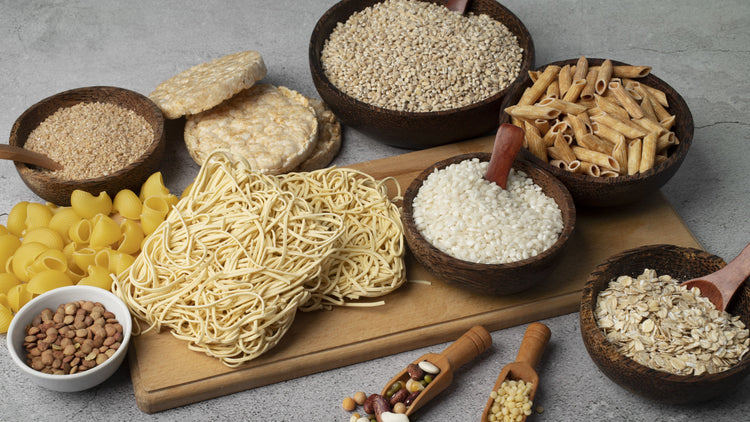
- Shredded wholewheat and bran-based cereals — the single highest-density everyday option at roughly 13–24.5g per 100g.
- Porridge oats — around 4g of fibre in a standard 50g dry portion, and a good source of soluble beta-glucan.
- Wholemeal bread — roughly 7g of fibre in two slices, compared with a fraction of that in standard white.
- Wholemeal pasta — about 4.2g per 100g cooked, roughly double white pasta.
- Brown rice, bulgur wheat, pearl barley, quinoa, rye bread and oatcakes.
- Potatoes with the skin on — a medium 180g baked potato provides around 5g. Peeling it throws most of that away.
Beans, peas, lentils and pulses
Pulses are the most underrated fibre lever in the UK diet, and among the cheapest food on the shelf. A tin of lentils, chickpeas or mixed beans stirred into a bolognese, chilli, curry or soup adds several grams without changing the meal.

- Baked beans in tomato sauce — about 4.9g per 100g; an 80g serving counts as roughly 3g and as one of your 5 A Day.
- Garden peas (boiled) — around 5.6g per 100g, and frozen peas are just as good as fresh.
- Green beans (boiled) — approximately 4.1g per 100g.
- Lentils, chickpeas, butter beans, kidney beans, cannellini beans and mixed bean salad.
- Hummus — chickpea-based, and a convenient vehicle for raw vegetable sticks.

Vegetables
- Parsnips (boiled) — around 4.7g per 100g, one of the highest-fibre common UK vegetables.
- Broccoli (boiled) — approximately 2.8g per 100g.
- Sweetcorn — an 80g tinned serving provides roughly 2g.
- Brussels sprouts, carrots, sweet potato with skin, leeks, cabbage, kale, spinach and beetroot.
- Onions, garlic and asparagus — modest in total fibre but rich in prebiotic inulin.
Fruit
- Dried figs — around 6.9g per 100g, comfortably in "high fibre" territory.
- Raspberries and blackberries — among the highest-fibre fresh fruits; frozen berries are equally good and cheaper.
- Strawberries — roughly 3.8g per 100g.
- Apples and pears with skin on, bananas, oranges, prunes and dried apricots.

Nuts and seeds
- Sesame seeds — approximately 7.9g per 100g.
- Peanuts — around 7.6g per 100g.
- Almonds — roughly 7.4g per 100g.
- Sunflower seeds — about 6.0g per 100g.
- Chia seeds and ground flaxseed (linseed) — concentrated soluble fibre; a tablespoon stirred into yoghurt or porridge is an easy daily habit.
A 30g handful of unsalted nuts is a sensible portion. Nuts are calorie-dense, so if you are managing your weight, keep to one portion rather than grazing.

Store-cupboard and convenience wins
- Tinned pulses (no soaking, no planning required).
- Frozen mixed vegetables and frozen berries.
- Oatcakes and rye crackers instead of standard crackers.
- Wholemeal or seeded wraps instead of white.
- Nut butter that is 100% nuts, with no added palm oil, sugar or salt.

Fibre content table for common UK foods
The values below are drawn from the British Dietetic Association's fibre resource, based on AOAC or non-starch polysaccharide analysis. Exact figures vary by brand, variety and cooking method — always check the label of the product you are actually buying.
| Food | Fibre per 100g | Category |
|---|---|---|
| Shredded wholewheat or bran cereals | 13–24.5g | High fibre |
| Sesame seeds | 7.9g | High fibre |
| Peanuts | 7.6g | High fibre |
| Almonds | 7.4g | High fibre |
| Wholemeal bread (two slices) | 7.0g | High fibre |
| Dried figs | 6.9g | High fibre |
| Sunflower seeds | 6.0g | High fibre |
| Peas (boiled) | 5.6g | Source of fibre |
| Baked beans in tomato sauce | 4.9g | Source of fibre |
| Parsnip (boiled) | 4.7g | Source of fibre |
| Wholemeal spaghetti (boiled) | 4.2g | Source of fibre |
| Green beans (boiled) | 4.1g | Source of fibre |
| Strawberries | 3.8g | Source of fibre |
| Broccoli (boiled) | 2.8g | Contributes fibre |
What 30g of fibre a day actually looks like
Thirty grams sounds intimidating until you see it laid out. The example below is adapted from the British Dietetic Association's worked menu and comes to roughly 38g — comfortably above target, with room to scale back.
A worked UK day
| Meal | What it contains | Approximate fibre |
|---|---|---|
| Breakfast | Overnight oats: 50g raw porridge oats, 50g frozen raspberries, yoghurt or milk, 40g walnuts or almonds | About 9g |
| Lunch | Medium baked potato with skin (180g), 80g baked beans, 80g tinned sweetcorn | About 10g |
| Dinner | 150g wholemeal spaghetti with pesto, plus 80g broccoli and cherry tomatoes | About 8g |
| Snacks | Two slices of wholemeal toast with a tablespoon of peanut butter, plus one medium banana or apple | About 10g |
| Total | Around 38g |
For comparison, the NHS gives three useful single-meal benchmarks: two slices of wholemeal toast with peanut butter followed by a medium orange delivers around 8.3g; wholemeal spaghetti with a lentil and tomato sauce delivers around 11g; and grilled chicken with a skin-on baked potato, carrots and green beans delivers around 11.2g. Three meals built along those lines will take you past 30g without any supplement or "superfood".
The variety angle
Total grams matter, but so does the number of different plants you eat. Diversity of plant foods is one of the strongest observed correlates of microbiome diversity. If you want a simple target that captures both quantity and variety, our guide to eating 30 plants a week is a good place to start, alongside our piece on how to increase gut bacteria diversity. Herbs, spices, nuts, seeds and wholegrains all count towards the tally.
Easy swaps that add fibre without extra effort
- Swap white bread, pasta and rice for wholemeal, wholewheat and brown versions.
- Keep the skins on potatoes, apples, pears, carrots and cucumbers.
- Add a tin of lentils or beans to any mince-based dish — bolognese, chilli, cottage pie, curry.
- Stir a tablespoon of ground flaxseed or chia into porridge, yoghurt or a smoothie.
- Replace crisps with a handful of unsalted nuts, oatcakes with hummus, or carrot sticks.
- Choose a higher-fibre breakfast cereal and top it with fruit and seeds.
- Use wholemeal flour in place of some of the white flour when baking.
- Add frozen peas, sweetcorn or spinach to whatever is already in the pan.
For a longer list of tactics, see our dedicated guide to how to increase fibre, and our roundup of polyphenols and gut health for the compounds that travel alongside fibre in the same foods.
What the evidence says about high-fibre diets
Cardiovascular disease and cholesterol
The most influential modern analysis is the 2019 series of systematic reviews and meta-analyses published in The Lancet by Reynolds and colleagues, commissioned by the World Health Organization. Pooling just under 135 million person-years of data from 185 prospective studies and 58 clinical trials, it reported a 15–30% reduction in all-cause and cardiovascular mortality, coronary heart disease, stroke, type 2 diabetes and colorectal cancer when comparing the highest fibre consumers with the lowest. Risk reduction was greatest at intakes of 25–29g per day, and dose-response curves suggested higher intakes may confer further benefit.
Clinical trials within the same analysis showed significantly lower body weight, systolic blood pressure and total cholesterol at higher fibre intakes. Separately, the European Food Safety Authority has concluded that a cause-and-effect relationship exists between oat beta-glucan and lowering blood LDL cholesterol, with the beneficial effect obtained at around 3g of oat beta-glucan per day — achievable with a generous bowl of porridge.
Bowel health and bowel cancer
The NHS states that eating plenty of fibre is associated with a lower risk of heart disease, stroke, type 2 diabetes and bowel cancer. Mechanistically, insoluble fibre increases faecal bulk and reduces transit time, while fermentable fibres generate butyrate — the preferred energy source for colonocytes. If you are unsure whether your bowel habit is within normal range, our guide to the Bristol stool chart is a useful starting point.
Blood sugar and appetite
Viscous soluble fibres slow gastric emptying and reduce the rate of glucose absorption, which flattens post-meal glucose peaks. Fibre also increases food volume and satiety without a proportional increase in calories. We explore these mechanisms further in our articles on gut health and blood sugar and gut health and weight loss.
The gut microbiome
Fibre is the primary substrate for the colonic microbiota. Different fibres feed different organisms, which is the practical argument for eating a wide range of plants rather than loading up on a single source. Fermentation produces short-chain fatty acids that lower colonic pH, support the mucosal barrier and modulate immune signalling. Our guides to prebiotic supplements in the UK and the best probiotics in the UK cover how supplementation fits alongside — never instead of — dietary fibre.
How to increase fibre without bloating
This is where most people come unstuck. Going from 16g to 30g overnight is the fastest route to wind, cramping and discomfort. The fermentation that makes fibre beneficial also produces gas, and your microbiota needs time to adapt.
- Increase gradually. Add roughly 3–5g per day and hold for a week before increasing again. Reaching 30g over six to eight weeks is a reasonable pace.
- Increase fluid at the same time. Fibre draws water into the bowel. Guts UK suggests around 8 to 10 cups (1.5 to 2 litres) of fluid daily for adults. Increasing fibre without fluid can make constipation worse, not better.
- Spread it across the day. Three moderate fibre hits are better tolerated than one enormous one.
- Start with gentler fibres. Oats, chia, cooked carrots and psyllium tend to be better tolerated than raw bran or large quantities of pulses.
- Go half-and-half. Mix white and wholemeal pasta or rice at first, then shift the ratio over time.
- Start pulses at two to three tablespoons rather than a whole tin.
- Move. Walking after meals genuinely helps with gas clearance.
If bloating persists despite a gradual approach, read our guides to foods that cause bloating and trapped wind relief.
Who should be cautious with high-fibre foods
Fibre is beneficial for most people, but "more is always better" is not universally true. Speak to your GP or a registered dietitian before making significant changes if any of the following apply:
- Irritable bowel syndrome. Highly fermentable fibres can worsen symptoms in some people. A structured, dietitian-supervised low FODMAP diet may be more appropriate than a blanket increase, followed by proper FODMAP reintroduction. See also our overview of supplements for IBS in the UK.
- Inflammatory bowel disease. Fibre requirements differ markedly between remission and active flare, and during strictures a low-residue approach may be advised. See our guides to Crohn's disease diets and ulcerative colitis diets.
- Diverticular disease. Advice differs between acute episodes and long-term management — see our diverticulitis diet guide.
- Recent bowel surgery, known strictures, or gastroparesis. Always follow your specialist team's instructions.
- Coeliac disease. Wheat, barley and rye are excluded, so fibre must come from naturally gluten-free sources such as oats certified gluten-free, pulses, fruit, vegetables, nuts and seeds. See coeliac vs gluten intolerance.
Do fibre supplements have a place?
Whole foods should always come first. Fibre-rich foods carry vitamins, minerals, polyphenols and a food matrix that isolated fibres do not replicate, and the national dietary shortfall is a food-pattern problem rather than a supplement problem.
That said, isolated fibres do have an evidence base in specific situations. Psyllium husk has been studied extensively for LDL cholesterol and for both constipation-predominant and diarrhoea-predominant bowel symptoms. Prebiotic fibres such as inulin are well characterised, though they cause wind at higher doses in many people. Modified citrus pectin, available as our Citrus Pectin Powder, is a soluble pectin-derived fibre; you can compare formats in our guide to modified citrus pectin vs pectin.
If you are considering supplementation, our comparison of prebiotic vs probiotic explains which category is likely to suit your goal, and our gut health collection brings the options together in one place. Check with your GP or pharmacist first if you take regular medication, since bulk-forming fibres can affect absorption and should be spaced apart from tablets.
When to see a GP
Increasing fibre is not the right first step for every digestive symptom. Book an appointment promptly if you have any of the following:
- Blood in your stool, or black, tarry stools
- A persistent change in bowel habit lasting three weeks or more
- Unexplained weight loss
- Persistent abdominal pain, or a lump in your abdomen
- Ongoing fatigue or symptoms suggestive of iron deficiency anaemia
- Difficulty swallowing or persistent vomiting
These are red-flag symptoms that need assessment rather than a dietary experiment. Our guide on when to see a GP about stomach symptoms covers this in more detail, and if you are aged 54 to 74 in England you should also take up the NHS bowel cancer screening programme when invited.
Frequently asked questions
What are the highest fibre foods in the UK?
Bran-based and shredded wholewheat breakfast cereals top the list at roughly 13–24.5g per 100g. After that come seeds and nuts (sesame 7.9g, peanuts 7.6g, almonds 7.4g, sunflower seeds 6.0g per 100g), dried figs at around 6.9g per 100g, wholemeal bread at around 7g per two slices, and pulses such as peas at 5.6g and baked beans at 4.9g per 100g.
How much fibre should I eat a day in the UK?
UK government guidance sets the adult target at 30g of fibre per day. Children need less: about 15g for ages 2–5, 20g for ages 5–11 and 25g for ages 11–16, rising to the full 30g from age 16.
What counts as a high fibre food on a UK label?
A food can be labelled "high fibre" if it contains 6g or more of fibre per 100g. It qualifies as a "source of fibre" at 3g or more per 100g. Check the fibre line on the back-of-pack nutrition panel and compare per 100g rather than per serving.
Are most UK adults getting enough fibre?
No. The National Diet and Nutrition Survey for 2019 to 2023 found that 96% of adults did not meet the 30g target. Average intakes for adults aged 19 to 64 sit at roughly 16 to 20g a day depending on the dataset — a shortfall of around 10 to 14g.
How can I get 30g of fibre a day without supplements?
A realistic day: porridge oats with berries and nuts at breakfast (around 9g), a skin-on baked potato with baked beans and sweetcorn at lunch (around 10g), wholemeal pasta with vegetables at dinner (around 8g), and wholemeal toast with nut butter plus a piece of fruit as snacks (around 10g). That totals roughly 38g using ordinary supermarket food.
Which is better for constipation, soluble or insoluble fibre?
Insoluble fibre from wholegrains, wheat bran, vegetable skins, nuts and seeds adds bulk and speeds transit, so it is often the more useful category for constipation. Soluble fibres such as psyllium also help by softening stool. Whichever you choose, increase fluid at the same time — fibre without water can make constipation worse.
Why does more fibre make me bloated?
Fermentable fibres produce gas as gut bacteria break them down, and a sudden large increase outpaces your microbiota's ability to adapt. Increase by around 3–5g per day per week, spread fibre across meals, start with gentler sources such as oats and chia, and begin pulses at two to three tablespoons rather than a whole tin. Most people settle within a few weeks.
Do fruit and vegetables count towards my fibre target?
Yes, and they are one of the main routes to it. Frozen, tinned and dried versions all count. Keep skins on where practical — most of the insoluble fibre in apples, pears, potatoes and carrots sits in or just under the skin.
Does fibre help lower cholesterol?
Soluble fibre does. The European Food Safety Authority has concluded that oat beta-glucan lowers blood LDL cholesterol, with the effect obtained at around 3g of oat beta-glucan per day. Clinical trials pooled in the 2019 Lancet analysis also showed lower total cholesterol, body weight and systolic blood pressure at higher fibre intakes.
Is it possible to eat too much fibre?
Very high intakes, especially if increased suddenly or without enough fluid, can cause bloating, wind, cramping and — paradoxically — constipation. People with IBS, inflammatory bowel disease, strictures, gastroparesis or recent bowel surgery may need a modified or restricted approach. If you are in one of those groups, get individual advice from your GP or a registered dietitian before increasing fibre substantially.
References and further reading
- NHS — How to get more fibre into your diet
- Office for Health Improvement and Disparities — National Diet and Nutrition Survey 2019 to 2023 (GOV.UK, published 11 June 2025)
- Scientific Advisory Committee on Nutrition — Carbohydrates and Health report (GOV.UK)
- McCance and Widdowson's Composition of Foods Integrated Dataset (CoFID), GOV.UK
- British Dietetic Association — Fibre Food Fact Sheet
- British Nutrition Foundation — Fibre
- Guts UK Charity — Fibre
- British Heart Foundation — High fibre foods: how much fibre should you eat per day?
- Reynolds A, Mann J, et al. Carbohydrate quality and human health: a series of systematic reviews and meta-analyses. The Lancet, 2019;393(10170):434–445
- Gill SK, Rossi M, Bajka B, Whelan K. Dietary fibre in gastrointestinal health and disease. Nature Reviews Gastroenterology & Hepatology, 2021;18:101–116
- European Food Safety Authority — Scientific Opinion on oat beta-glucan and lowering blood cholesterol (EFSA Journal, 2010)
- Veronese N, et al. Dietary fiber and health outcomes: an umbrella review of systematic reviews and meta-analyses. American Journal of Clinical Nutrition, 2018;107(3):436–444
- Jovanovski E, et al. Effect of psyllium fibre on LDL cholesterol and alternative lipid targets: a systematic review and meta-analysis. American Journal of Clinical Nutrition, 2018;108(5):922–932
- Hooper B, Spiro A, Stanner S. 30 g of fibre a day: an achievable recommendation? Nutrition Bulletin, 2015;40(2):118–129
- Linus Pauling Institute, Oregon State University — Fiber
- NHS — 5 A Day
About the author
Dr Zeeshan Afzal, MBBS is a qualified medical doctor and Medical Officer at Welzo. He writes and reviews Welzo's clinical content on digestive health, nutrition and preventive medicine, with a focus on translating UK guidance and peer-reviewed evidence into practical advice for patients.
Medical disclaimer
This article is intended for general information only and is not a substitute for individual medical advice, diagnosis or treatment. Dietary needs vary considerably between individuals, particularly for those with existing gastrointestinal conditions. Always consult your GP, pharmacist or a registered dietitian before making significant changes to your diet or starting a new supplement, especially if you take prescribed medication, are pregnant or breastfeeding, or have a diagnosed digestive condition. If you experience blood in your stool, unexplained weight loss or a persistent change in bowel habit, seek medical advice promptly.
Image credits
All photographs in this article are sourced from Wikimedia Commons under free or Creative Commons licences and are used with attribution. No copyrighted or licence-restricted stock imagery has been used.



 Évalué Excellent par 26,523+ avis
 Garantie de remboursement à 100%