





Best Peppermint Oil Capsules for IBS UK


Related products
Written and medically reviewed by Dr Zeeshan Afzal (MBBS) — Medical Doctor & Medical Content Lead, Welzo
Part of our digestive health guides · Shop gut health supplements
Evidence-based · Honest about what's proven and what isn't · UK-focused
Last updated: July 2026 · Reading time: ~14 minutes
Peppermint oil is the best-evidenced natural treatment for IBS — and unusually, it outperforms several conventional options. In a Lancet network meta-analysis comparing soluble fibre, antispasmodic drugs, peppermint oil and gut–brain neuromodulators, peppermint oil ranked first for overall IBS symptom improvement.
But there's a distinction that matters more than any brand comparison. In the UK, some peppermint oil capsules are licensed medicines with an official IBS indication. Others are food supplements that make no such claim — and at least one is explicitly designed to release fast, which is the opposite of what IBS needs.
This guide explains that difference, then ranks the peppermint oil capsules Welzo stocks.
Table of contents
- How peppermint oil works in IBS
- Why enteric coating decides everything
- Licensed medicine vs food supplement
- What the evidence shows
- How we chose
- Our top picks
- 1. Colpermin IBS Relief — Best Overall
- 2. BuscoMint Gastro-Resistant — Best Peanut-Free
- What about peppermint oil supplements?
- Dosage and how to take it
- Side effects and who should avoid it
- When to see a doctor
- Frequently asked questions
How peppermint oil works in IBS
Peppermint oil is an antispasmodic. Its active constituent, menthol, blocks calcium channels in intestinal smooth muscle, which stops the muscle contracting excessively. In IBS, that excessive contraction is what produces cramping pain, and it also traps pockets of gas that cause bloating and distension.
Relax the bowel wall and two things follow: the cramps ease, and trapped wind can move along and out. That's why peppermint oil helps pain and bloating more reliably than it helps bowel habit — see trapped wind relief and our guide to IBS types.
Menthol also acts on TRPM8 receptors, which appear to contribute to pain relief independently of the muscle-relaxing effect. It's a genuine pharmacological action, not a soothing folk remedy.
Why enteric coating decides everything
This is why heartburn is the most commonly reported side effect in the trials, and why a non-enteric-coated peppermint capsule can make reflux symptoms actively worse while doing little for IBS.
When you're comparing products, look for the words enteric-coated, gastro-resistant or sustained release. If a label instead advertises that it "disintegrates quickly" or offers "fast action", that's a signal it's designed for the stomach — fine for general digestive comfort, wrong for IBS. If reflux is your main issue rather than IBS, see acid reflux supplements instead.
Licensed medicine vs food supplement
This is the second distinction, and in the UK it's a meaningful one.
Colpermin and BuscoMint are licensed medicines. They hold marketing authorisations, carry an official indication for IBS, have been assessed by the regulator for efficacy and safety, and come with a patient information leaflet listing contraindications and interactions. They are permitted to say they treat IBS because they have demonstrated it.
Lamberts and Day Lewis peppermint capsules are food supplements. They contain peppermint oil, are perfectly legitimate products, and are considerably cheaper per capsule — but they carry no IBS indication, no regulatory assessment of efficacy, and are typically not enteric-coated.
Neither category is "better" in the abstract. But if you have diagnosed IBS and want the thing the research was actually done on, the licensed medicines are the closer match.
What the evidence shows
The headline finding
The most recent meta-analysis identified 10 randomised controlled trials covering 1,030 patients. Peppermint oil beat placebo for global IBS symptoms — relative risk of not improving 0.65 (95% CI 0.43–0.98), giving a number needed to treat of 4 — and for abdominal pain, RR 0.76 (0.62–0.93), NNT 7 (Ingrosso et al., 2022).
An NNT of 4 for global symptoms is a strong result for any IBS treatment. Earlier meta-analyses agreed: 12 trials in 835 patients found a risk ratio of 2.39 for global symptom improvement with no heterogeneity between studies, and a 2014 review of 9 trials in 726 patients found RR 2.23 for global improvement and 2.14 for abdominal pain.
How it compares to other IBS treatments
A network meta-analysis in The Lancet Gastroenterology & Hepatology compared soluble fibre, antispasmodic drugs, peppermint oil and gut–brain neuromodulators head to head. Peppermint oil ranked first for global IBS symptoms. Tricyclic antidepressants ranked first for abdominal pain specifically.
NICE guidance on IBS supports considering antispasmodics for abdominal pain and spasm, and peppermint oil is the antispasmodic most people can buy without a prescription.
The honest counterpoint
A 2020 randomised trial published in Gastroenterology tested both small-intestinal-release and ileocolonic-release peppermint oil, and neither met its prespecified primary endpoint for abdominal pain or global relief. The ileocolonic-release formulation actually increased reported abdominal cramps. The authors concluded the earlier meta-analyses may have overestimated the effect.
That doesn't overturn the evidence base, but it does mean expectations should be realistic — and it suggests release site matters, with the small intestine appearing more relevant than the colon. The authors of the 2022 meta-analysis noted the same uncertainty. Compare with other options in supplements for IBS.
| Outcome | Evidence | Key finding |
|---|---|---|
| Global IBS symptoms | Good | 10 RCTs, 1,030 patients; NNT = 4 |
| Abdominal pain | Good | RR 0.76 of not improving; NNT = 7 |
| Versus other IBS treatments | Moderate | Ranked 1st for global symptoms in network meta-analysis |
| Bloating and trapped wind | Moderate | Consistent with antispasmodic mechanism |
| Long-term use | Unknown | Most trials ran only 4–12 weeks |
How we chose
- Enteric or gastro-resistant coating — the feature that determines whether the oil reaches the bowel.
- Licensed for IBS — a marketing authorisation means regulatory assessment of efficacy and safety.
- Stated peppermint oil content per capsule, so you can match trial dosing.
- Pack size versus course length — three capsules daily adds up quickly.
- Allergen transparency — one leading product contains peanut oil, which matters enormously.
Our top picks
Best Overall: Colpermin IBS Relief Capsules, 20 — £8.32
Best Peanut-Free Option: BuscoMint Gastro-Resistant Soft Capsules, 24 — £9.48
Best for a Longer Course: Colpermin Capsules, 100 pack — same formulation, one month at standard dosing
1. Colpermin IBS Relief Capsules — Best Overall
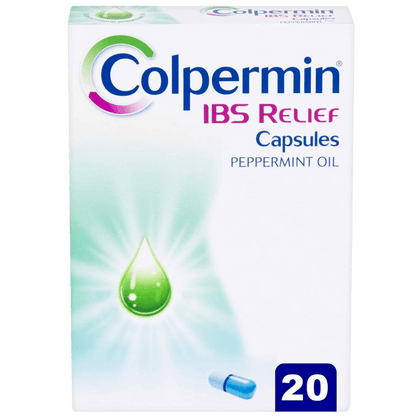
Price: £8.32 · Reviews: 80 · Where to buy: Available from Welzo
0.2ml of peppermint oil per capsule in a sustained-release, enteric-coated shell designed to release at the end of the small bowel. A licensed medicine indicated for IBS.
Why it's the best: Colpermin is the product most of the UK trial evidence was built on, and it gets the two things that matter right. The enteric coating means the oil bypasses the stomach and reaches the bowel rather than relaxing your oesophageal sphincter on the way past. And the 0.2ml dose per capsule matches the intake used in the research, so taking one capsule three times daily puts you on a researched regimen rather than guessing.
At £8.32 for 20 capsules it's also inexpensive for a licensed medicine — roughly a week at standard dosing, which is about how long the manufacturer expects symptoms to take to settle. If you're treating IBS properly rather than dipping in and out, the 100-capsule pack is the same formulation and covers a full month at one capsule three times daily, which better matches the four to twelve weeks used in trials.
Allergen warning: Colpermin contains arachis (peanut) oil. Do not take it if you are allergic to peanuts or soya. This is easy to miss on a product marketed as a natural peppermint remedy.
| Pros | Cons |
|---|---|
| Licensed medicine with an IBS indication Enteric-coated, releases in the small bowel 0.2ml per capsule matches trial dosing Cheapest entry point at £8.32 |
Contains peanut and soya Only ~7 days at standard dosing Not for under-15s Can still cause heartburn in some people |
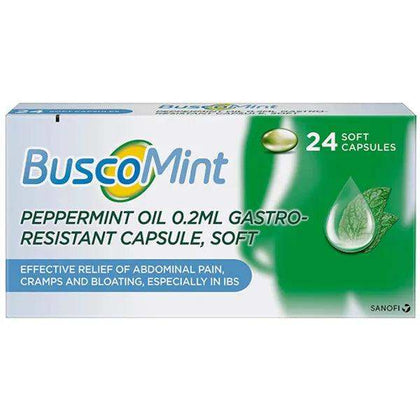
2. BuscoMint Gastro-Resistant Soft Capsules, 24 — Best Peanut-Free Option
Price: £9.48 · Reviews: 102 · Where to buy: Available from Welzo
Why we like it: Also a licensed medicine, also gastro-resistant, and crucially free of peanut and soya — which makes it the obvious choice if the Colpermin allergen warning rules that out for you. It has slightly more reviews than Colpermin's 20-pack, and the soft capsule is easier to swallow than a harder enteric shell.
The dosing instruction is more specific than Colpermin's: one capsule three times daily, taken 30 minutes before meals. Timing matters here — taken with food, the capsule can be carried through too quickly to release where it should.
Check the restrictions before buying. BuscoMint is not suitable if you are under 12, weigh less than 40kg, are pregnant or breastfeeding, or have liver problems, gallstones, bile duct infection or low stomach acid. It also uses a gelatin capsule, so it isn't suitable for vegetarians or vegans.
| Pros | Cons |
|---|---|
| Licensed medicine, gastro-resistant No peanut or soya Most reviewed here (102) Soft capsules, easier to swallow Clear timing instruction |
Only 24 capsules — 8 days at full dose Gelatin capsule — not vegetarian or vegan Not for under-12s or under 40kg Avoid with gallstones, bile duct or liver problems |
What about peppermint oil supplements?
Welzo also stocks peppermint oil food supplements — notably Lamberts Peppermint Oil 100mg (90 capsules) and Day Lewis Peppermint Oil (30 capsules). We haven't ranked them above, and it's worth explaining why rather than just leaving them out.
Both contain genuine peppermint oil and both are made by reputable British companies. Lamberts in particular has an unusually thorough allergen exclusion — no wheat, gluten, soya, eggs, milk, lactose or nuts — which makes it a sensible option for people with multiple allergies. Day Lewis is a simple four-ingredient formulation at a low price.
But neither is enteric-coated. Lamberts explicitly describes rapid disintegration for fast action, which for IBS is the wrong design: the oil is released in the stomach rather than the bowel, making heartburn more likely and the antispasmodic effect on the bowel less likely. Neither product carries an IBS indication, and neither has been assessed by the regulator for that use.
For general post-meal digestive comfort they're perfectly reasonable, and cheaper per capsule than the medicines. For diagnosed IBS, a licensed enteric-coated product is the better-matched choice — which is why the two above take the top spots.
Dosage and how to take it
| Situation | Dose | Duration |
|---|---|---|
| Standard IBS dosing | 1 capsule three times daily | Until symptoms settle, usually 1–2 weeks |
| Severe symptoms | 2 capsules three times daily | Short-term; review if not improving |
| Trial-length course | Standard dose | 4–12 weeks in most studies |
Three rules that matter. Swallow capsules whole — never chew, crush or open them, as that destroys the enteric coating and releases the oil straight into your stomach. Do not take them immediately after food; leave a gap, or the capsule can be carried through too quickly. And avoid taking them with indigestion remedies or antacids, which raise stomach pH and can cause the coating to dissolve early.
Peppermint oil works alongside dietary approaches rather than replacing them — see the low FODMAP diet and foods that cause bloating. Some people also combine it with probiotics, which act through an unrelated mechanism.
Side effects and who should avoid it
Peppermint oil is well tolerated but adverse events are measurably more common than with placebo. Heartburn is the most frequently reported, followed by perianal burning. Both are usually mild and settle on stopping.
Do not take peppermint oil capsules if you
- Are allergic to peanuts or soya — this rules out Colpermin specifically
- Are allergic to peppermint oil or menthol
- Are under 15 (Colpermin) or under 12 / under 40kg (BuscoMint)
- Have gallstones, bile duct obstruction, or liver problems
- Are pregnant or breastfeeding — seek advice first
Stop and seek medical help if you develop a rash, headache, slow pulse, loss of co-ordination or shaking — these are rare allergic reactions to peppermint oil or menthol. Also stop if symptoms persist beyond two weeks, worsen, or if you develop any red-flag symptom below.
If you already have reflux, be aware peppermint oil may aggravate it even in enteric-coated form. And if you're over 40 and your established IBS symptoms have changed character, that warrants review rather than self-treatment.
When to see a doctor
Peppermint oil treats IBS symptoms in people who already have an IBS diagnosis. It is not a substitute for getting one — and several conditions that mimic IBS need excluding first, including coeliac disease and inflammatory bowel disease.
See your GP — or seek urgent care — if you have:
- Blood in your stool, or black tarry stools
- Unexplained weight loss
- A change in bowel habit lasting three weeks or more
- Symptoms starting for the first time over the age of 50
- Anaemia, a lump in your abdomen, or a family history of bowel or ovarian cancer
- Persistent vomiting, fever, or symptoms after recent foreign travel
- Any first episode of these symptoms — get a diagnosis before self-treating
Read more on when to see a GP about stomach symptoms, and see NHS — Irritable bowel syndrome.
Frequently asked questions
What are the best peppermint oil capsules for IBS in the UK?
Colpermin IBS Relief Capsules at £8.32 are the strongest choice for most people. They're a licensed medicine with an official IBS indication, enteric-coated so the oil reaches the bowel rather than the stomach, and dosed at 0.2ml per capsule to match the research. If you have a peanut or soya allergy, choose BuscoMint instead — Colpermin contains arachis oil.
Does peppermint oil actually work for IBS?
Yes, and it's among the best-evidenced options. A meta-analysis of 10 randomised trials in 1,030 patients found a number needed to treat of 4 for global IBS symptoms. A Lancet network meta-analysis ranked peppermint oil first for global symptoms against soluble fibre, antispasmodics and gut–brain neuromodulators. One 2020 trial did fail to meet its primary endpoint, so expectations should stay realistic.
Why do peppermint oil capsules need to be enteric-coated?
Peppermint oil relaxes smooth muscle wherever it's released, including the valve that keeps stomach acid down. A capsule that dissolves in the stomach causes heartburn and never reaches the bowel. Enteric coating survives stomach acid so the oil is released further along, where it can relax the bowel wall and ease cramping.
Can peppermint oil cause heartburn?
Yes — it's the most commonly reported side effect in trials. Enteric coating reduces but doesn't eliminate the risk. Never chew or crush the capsules, don't take them immediately after food, and avoid taking them alongside antacids, which can cause the coating to dissolve too early.
How long does peppermint oil take to work for IBS?
Many people notice a difference within a few days, and manufacturers expect symptoms to settle within one to two weeks. Clinical trials generally ran four to twelve weeks, so give it a fair trial before concluding it isn't working.
Is Colpermin better than BuscoMint?
Both are licensed enteric-coated medicines for IBS. Colpermin has the larger body of trial evidence behind it; BuscoMint uses a higher peppermint concentration, comes in an easier-to-swallow soft capsule and — importantly — contains no peanut or soya. If you have a nut allergy, BuscoMint is the clear choice.
Are peppermint oil supplements as good as Colpermin?
Not for IBS. Supplements such as Lamberts and Day Lewis contain genuine peppermint oil, but they aren't enteric-coated, carry no IBS indication and have not been assessed by the regulator for that use. They're reasonable for general post-meal digestive comfort.
Can I take peppermint oil capsules long term?
The evidence doesn't tell us. Most trials ran only four to twelve weeks, so long-term efficacy and safety are genuinely unknown. Licensed products are intended for short courses — if you need continuous treatment, see your GP.
Can I take peppermint oil with other IBS medication?
Usually yes, but check with a pharmacist. The main practical issue is antacids and indigestion remedies, which raise stomach pH and can break the enteric coating early. Separate them by a couple of hours.
Does peppermint tea work the same way?
No. Peppermint tea contains far less menthol than a capsule and is absorbed in the stomach rather than delivered to the bowel. It may be pleasantly soothing, but it isn't a substitute for enteric-coated peppermint oil in IBS.
Medical disclaimer: This article is for general information and education only and does not constitute medical advice, diagnosis or treatment. Colpermin and BuscoMint are licensed medicines — always read the patient information leaflet before use. Colpermin contains arachis (peanut) oil and must be avoided by anyone allergic to peanuts or soya. Peppermint oil capsules are intended for people with a confirmed IBS diagnosis; if you have not been diagnosed, see your GP first, as other conditions can produce similar symptoms. Product specifications, prices and availability are correct at the time of writing and may change. Always seek advice from your GP or pharmacist before starting a new treatment, particularly if you are pregnant, breastfeeding or taking other medication.
About the author
Dr Zeeshan Afzal (MBBS) is a practising medical doctor and Welzo's Medical Content Lead. He writes and reviews Welzo's health content to ensure it is accurate, evidence-based and aligned with current UK clinical guidance, translating complex research into practical advice patients can trust.
References
- Ingrosso MR, Ianiro G, Nee J, et al. Systematic review and meta-analysis: efficacy of peppermint oil in irritable bowel syndrome. Aliment Pharmacol Ther. 2022. Link
- Black CJ, Yuan Y, Selinger CP, et al. Efficacy of soluble fibre, antispasmodic drugs, and gut–brain neuromodulators in irritable bowel syndrome: a systematic review and network meta-analysis. Lancet Gastroenterol Hepatol. 2020. Link
- Alammar N, Wang L, Saberi B, et al. The impact of peppermint oil on the irritable bowel syndrome: a meta-analysis of the pooled clinical data. BMC Complement Altern Med. 2019;19:21. Link
- Khanna R, MacDonald JK, Levesque BG. Peppermint oil for the treatment of irritable bowel syndrome: a systematic review and meta-analysis. J Clin Gastroenterol. 2014;48:505–512. Link
- Weerts ZZRM, Masclee AAM, Witteman BJM, et al. Efficacy and safety of peppermint oil in a randomized, double-blind trial of patients with irritable bowel syndrome. Gastroenterology. 2020. Link
- Ford AC, Talley NJ, Spiegel BMR, et al. Effect of fibre, antispasmodics, and peppermint oil in the treatment of irritable bowel syndrome: systematic review and meta-analysis. BMJ. 2008;337:a2313. Link
- NHS — Irritable bowel syndrome (IBS). Link




 Beoordeeld uitstekend door 28,951+ beoordelingen
 100% geld -terug -garantie