








Best Manganese Supplements & Tablets: Expert Picks


Related products


Manganese is an essential trace mineral that plays a subtle yet critical role in metabolic health, skeletal integrity, and cellular defence. Although it receives far less attention than minerals such as magnesium or zinc, manganese functions as a co-factor for several enzyme systems involved in energy production, connective tissue maintenance, and antioxidant protection.
As part of a structured product testing and review process, Dr Zeeshan Afzal evaluated a wide selection of formulations available within the Manganese Supplements & Tablets category, assessing dose accuracy, bioavailability, formulation quality, and suitability for routine use in the UK. Particular emphasis was placed on products that respect manganese’s role as a trace mineral, prioritising controlled dosing over unnecessary strength.
This guide also places manganese within its broader nutritional context. Trace minerals rarely work in isolation, and manganese often supports wider cellular and longevity-focused pathways alongside nutrients found in the Antioxidants and Anti-Aging & Longevity ranges. The objective is to help readers make informed decisions grounded in nutritional science rather than marketing claims.
What Are Manganese Supplements & Tablets?
Manganese supplements and tablets are dietary products designed to provide elemental manganese, an essential micronutrient required in very small amounts. These supplements are most commonly taken orally and may be formulated as tablets, capsules, or liquid mineral preparations.
In supplement form, manganese is bound to compounds such as citrate, gluconate, sulfate, or amino-acid chelates to improve stability and absorption. Clinically, the most important figure on any label is the elemental manganese content, which reflects the true intake level rather than the total compound weight.
Manganese products are typically positioned within broader micronutrient categories such as Minerals and Trace Minerals. Liquid options may be selected by individuals seeking dose flexibility, particularly within specialist systems such as Eidon Mineral Supplements, which focus on low-dose trace mineral delivery.
From a clinical standpoint, manganese supplements are intended to support nutritional adequacy and long-term physiological function rather than provide short-term therapeutic effects.
What Are Manganese Supplements Used For?
Manganese supplements are used to support normal physiological processes, not to diagnose or treat medical conditions. In nutritional practice, they are most commonly considered in the following areas:
Bone, Joint, and Connective Tissue Support
Manganese contributes to the normal formation of bone and connective tissue by supporting enzymes involved in cartilage structure and skeletal matrix development. This is why it is frequently included in musculoskeletal nutrition strategies and may be discussed alongside products within the Joints, Bones & Muscles category. In bone-health contexts, manganese is sometimes considered alongside structured formulations such as Osteocare, which focus on maintaining skeletal integrity through balanced micronutrient intake.
Antioxidant Defence and Cellular Protection
One of manganese’s most significant roles is its involvement in manganese superoxide dismutase (MnSOD), a key antioxidant enzyme located within mitochondria. This places manganese within the wider antioxidant landscape. Individuals exploring advanced antioxidant support may also encounter complementary nutrients found in Liposomal Glutathione and Liposomal Quercetin, which support oxidative balance through distinct but related pathways.
Energy and Metabolic Function
Manganese acts as a co-factor for enzymes involved in carbohydrate, fat, and amino-acid metabolism. While it should not be viewed as a stimulant, it contributes to efficient energy utilisation and is sometimes discussed alongside broader nutritional strategies found within Metabolism Boosters.
General Trace Mineral Repletion
In individuals with restricted diets or low whole-food intake, manganese supplementation may be considered as part of a wider trace-mineral approach. In such cases, manganese should be viewed alongside other trace elements such as Chromium, Molybdenum, and Phosphorus, rather than supplemented in isolation.
Our Top Picks: Best Manganese Supplements & Tablets (UK)
Best Overall: Pure Encapsulations Manganese (Aspartate/Citrate) – 60 Capsules
Also Great: Solgar Chelated Manganese – 100 Tablets
Best Budget-Friendly: Lamberts Manganese 5mg as Citrate – 100 Tablets
Best Liquid Manganese: BioCare Nutrisorb Liquid Manganese – 15ml
Best for Flexible Dosing: BodyBio Manganese 6 Liquid Mineral – 2 oz
Best Ionic Liquid: Trace Minerals Ionic Manganese 10mg Liquid – 2 oz
Best Compact Liquid Format: Trace Minerals Ionic Manganese 10mg – 59ml
Best Tablet for Simple Daily Use: Source Naturals Manganese 10mg – 100 Tablets
Best High-Strength Option: Carlson Labs Chelated Manganese 20mg – 100 Tablets
Detailed Product Reviews: Best Manganese Supplements & Tablets (UK)
Nutrisorb Liquid Manganese 15ml (BioCare)

| Product Review Details | |
|---|---|
| Why it has been selected: |
A strong “easy dosing” option for people who prefer liquids or struggle with tablets, while still wanting a clear single-mineral approach. |
| Product description: |
A liquid manganese supplement designed for flexible dosing. Liquid formats can be useful where small, adjustable serving sizes matter or where swallowing capsules is inconvenient. |
| Product reviews: |
Generally reviewed positively for convenience and ease of use, especially among those who prefer drops over tablets. |
| Product price: |
£13.19 |
| Where to buy: | |
|
Pros:
Cons:
|
Liquid format supports flexible dosing Good choice for those who dislike tablets Clear, single-nutrient positioning Not as convenient for travel as blistered tablets for some people Some users prefer capsules for “set and forget” dosing |
| How to use: |
Follow the label directions precisely. Liquid minerals are typically taken in measured drops, often mixed into water or taken directly. |
| Editor’s comments: |
A practical option for patients who need dosing flexibility. The key is avoiding “stacking” manganese across multiple supplements. |
Source Naturals Manganese 10mg (100 Tablets)

| Product Review Details | |
|---|---|
| Why it has been selected: |
A clear, budget-friendly tablet option with a straightforward single-mineral label—useful for short, targeted supplementation where appropriate. |
| Product description: |
A higher-strength manganese tablet (10mg) in a simple daily format. Best suited to people who specifically want a defined dose and tablet convenience. |
| Product reviews: |
Many users cite good value and simplicity; higher-strength products often appeal to those who prefer a single tablet rather than multiple capsules. |
| Product price: |
£5.69 |
| Where to buy: | |
|
Pros:
Cons:
|
Excellent price-to-serving value Simple tablet format Easy to add to a routine 10mg can be more than many people need long-term Not ideal if already using multi-minerals that include manganese |
| How to use: |
Follow the label. If taking other minerals (iron/calcium), spacing can help reduce absorption competition. |
| Editor’s comments: |
Dose-awareness: higher mg does not mean “better,” and long-term high dosing should be clinician-led. |
Manganese (Aspartate/Citrate) 60 Capsules (Pure Encapsulations)

| Product Review Details | |
|---|---|
| Why it has been selected: |
For users who prioritise “cleaner capsule” positioning and premium formulation standards, with a balanced form approach (aspartate/citrate). |
| Product description: |
A manganese supplement in capsule form using manganese aspartate and citrate. Often chosen by those who prefer capsules and brand-led quality consistency. |
| Product reviews: |
Typically reviewed as a reliable, well-tolerated capsule; premium brands often receive strong feedback on consistency. |
| Product price: |
£13.32 |
| Where to buy: |
Buy Pure Encapsulations Manganese (Aspartate/Citrate) 60 Capsules |
|
Pros:
Cons: |
Capsule format (often preferred for fewer tablet binders) Uses a recognised, bioavailable form blend Good choice for consistent daily routines
Higher cost than entry-level tablets Not necessary if dietary intake is already strong and a multi-mineral is used |
| How to use: |
Follow the label directions. If sensitive stomach is an issue, taking with food is often better tolerated. |
| Editor’s comments: |
A “quality-first” option for users who want a capsule format and straightforward, reputable manufacturing. |
Manganese #6 Liquid Mineral 2 oz (BodyBio)

| Product Review Details | |
|---|---|
| Why it has been selected: |
For users who want a clinician-style liquid mineral approach, especially where flexible dosing and absorption preference are key decision factors. |
| Product description: |
A liquid manganese product delivering manganese gluconate, designed for adjustable dosing. Liquid minerals can be helpful in routines where personalised titration is preferred. |
| Product reviews: |
Frequently reviewed positively for ease of dosing and practicality, especially among users who prefer liquids over capsules. |
| Product price: |
£20.77 |
| Where to buy: | |
|
Pros:
Cons: |
Liquid format for flexible dosing Well-suited to tailored supplementation plans Good option for users who dislike tablets
More expensive than basic tablets Less “grab-and-go” than tablets for some people |
| How to use: |
Follow the label directions exactly; liquids are typically measured in drops. Consider spacing away from large-dose iron or calcium if used. |
| Editor’s comments: |
A strong pick for users who value dose control. As always, cumulative manganese intake across products matters most. |
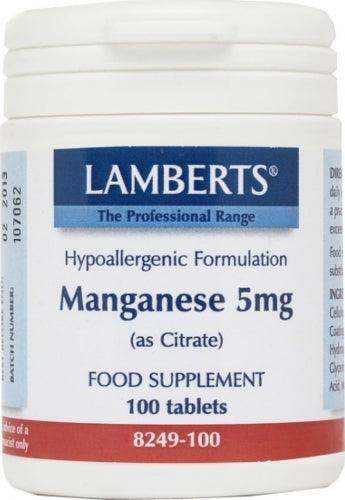
Manganese 5mg (as Citrate) 100 Tablets (Lamberts)
| Product Review Details | |
|---|---|
| Why it has been selected: |
This as a sensible mid-dose, UK-friendly tablet option—often the “sweet spot” for people who want moderate daily support without going high-dose. |
| Product description: |
A manganese citrate tablet offering a moderate 5mg dose. Citrate forms are commonly chosen for tolerability and practical, everyday supplementation. |
| Product reviews: |
Users typically value the straightforward dose and good overall value for a recognised UK supplement brand. |
| Product price: |
£9.56 |
| Where to buy: | |
|
Pros:
Cons: |
Moderate 5mg dose suits many routines Tablet convenience (easy adherence) Good balance of price and supply length
Tablets can include binders (varies by preference) Not ideal if a multi-mineral already supplies manganese adequately |
| How to use: |
Follow the label, typically with a meal. Consider spacing away from iron/calcium supplements if used at the same time. |
| Editor’s comments: |
Dr Afzal sees 5mg as a pragmatic middle-ground dose for many adults, provided total intake across all supplements is controlled. |
Trace Minerals Ionic Manganese 10mg Liquid (2 oz)

| Product Review Details | |
|---|---|
| Why it has been selected: |
For people who prefer ionic/liquid delivery and want a concentrated option, while still maintaining dosing precision. |
| Product description: |
A liquid ionic manganese supplement designed for rapid, easy dosing. Liquid ionic mineral products are often chosen for convenience and absorption preference. |
| Product reviews: |
Users commonly highlight ease of use and the practicality of drops compared to swallowing tablets. |
| Product price: |
£17.74 |
| Where to buy: | |
|
Pros:
Cons: |
Liquid ionic format for flexible dosing Useful for those who avoid tablets/capsules Strong option for structured supplement plans
Higher-strength liquid products require careful label adherence Not necessary if dietary intake + multi-mineral already covers needs |
| How to use: |
Use exactly as directed on the label; liquid minerals are typically measured in drops, often taken with water. |
| Editor’s comments: |
This style for users who are disciplined with dosing and want the convenience of a liquid routine. |
Trace Minerals Ionic Manganese 10mg (59 ml)

| Product Review Details | |
|---|---|
| Why it has been selected: |
A slightly smaller-bottle ionic manganese option for people who want the same style of dosing, often with easier storage or trial-size practicality. |
| Product description: |
A 59ml ionic manganese liquid delivering a defined 10mg strength, designed for easy daily administration when used as directed. |
| Product reviews: |
Often reviewed as convenient and easy to integrate into routines—especially for users who prefer liquids. |
| Product price: |
£16.79 |
| Where to buy: | |
|
Pros:
|
Liquid ionic format with simple administration More compact bottle size Useful for people avoiding pills
As with all higher-strength options, dose discipline matters May be unnecessary alongside multi-mineral stacks |
| How to use: |
Follow label directions. Consider spacing from iron/calcium supplements if used, as minerals can compete for absorption. |
| Editor’s comments: |
Dr Afzal’s clinical note: ionic liquids are best for users who prefer measured dosing and consistency—more is not better with trace minerals. |
Chelated Manganese 20mg (100 Tablets) (Carlson Labs)

| Product Review Details | |
|---|---|
|
Why it has been selected: |
A high-strength chelated tablet option for cases where a clinician specifically wants a more concentrated form—best reserved for targeted use rather than casual long-term stacking. |
| Product description: |
A 20mg chelated manganese tablet. Chelated minerals are often selected for bioavailability, though higher doses should be approached carefully for trace minerals. |
| Product reviews: |
Users often comment on perceived quality and brand reliability; higher-dose products are commonly chosen by people with specific supplement protocols. |
| Product price: |
£11.32 |
| Where to buy: | |
|
Pros:
Cons: |
Chelated form (often chosen for utilisation) High-strength option for targeted protocols Strong value for tablet count
20mg is high for routine daily use for many people Greater risk of overdoing total intake if stacking supplements |
| How to use: |
Follow label directions and avoid combining with other manganese-containing supplements unless clinician-advised. |
| Editor’s comments: |
This is not a “default daily” manganese for most users—its best use-case is structured, clinician-guided supplementation. |
Chelated Manganese (100 Tablets) (Solgar)

| Product Review Details | |
|---|---|
| Why it has been selected: |
A well-known, everyday chelated manganese option from a long-established brand—useful for people who want a mainstream, consistent tablet format. |
| Product description: |
A chelated manganese tablet using manganese glycinate chelate. Often chosen by users looking for a reputable brand and a simple daily tablet approach. |
| Product reviews: |
Commonly reviewed as dependable and easy to take; brand familiarity is a frequent reason people choose it. |
| Product price: |
£10.55 |
| Where to buy: | |
|
Pros:
Cons: |
Chelated form (popular for daily mineral routines) Recognised brand with consistent availability Good tablet count for the price
Not needed if already using a multi-mineral containing manganese Some users prefer capsules over tablets |
| How to use: |
Follow the label directions, typically taken with a meal. Avoid stacking manganese across multiple products. |
| Editor’s comments: |
This is a sensible “daily tablet” option for users who want a familiar brand—provided total manganese intake remains controlled. |
Features and Benefits of Manganese Supplements & Tablets
From a clinical and formulation perspective, high-quality manganese supplements share several defining characteristics.
Key Formulation Features
-
Controlled, trace-level dosing: Responsible formulations provide manganese in amounts aligned with dietary adequacy, avoiding excessive long-term exposure.
-
Bioavailable forms: Citrate and amino-acid chelated forms are commonly selected for their stability and tolerability.
-
Clear elemental labelling: Transparent labels stating elemental manganese content help prevent accidental over-supplementation, particularly when multiple mineral products are used concurrently.
-
Compatibility with immune-support strategies: In practice, manganese supplementation may sit alongside broader nutritional approaches within Immunity Supplements, or botanical support such as Echinacea and Goldenseal, where micronutrient sufficiency supports normal immune function.
Potential Benefits Within Normal Physiology
-
Supports normal bone and connective tissue formation
-
Contributes to mitochondrial antioxidant defence
-
Assists normal metabolic processes
-
Helps maintain balanced trace-mineral intake
From Dr Zeeshan Afzal’s perspective, manganese supplementation should be viewed as foundational nutritional support, not a high-impact intervention. This distinction is particularly important when comparing trace minerals with more commonly supplemented nutrients such as magnesium, which is explored in greater depth in the guide to the Best Magnesium Supplements 2026.
What Does Manganese Do in the Body?
Manganese is an essential trace mineral involved in normal enzyme function and metabolic processes. In practical terms, it supports the body’s ability to run key chemical reactions involved in energy production, connective tissue maintenance, and antioxidant defence. The NHS describes manganese as helping “make and activate some of the enzymes in the body.”
A clinically important point is that manganese is not a “headline mineral” like magnesium, yet it underpins multiple background processes. This includes enzymatic pathways involved in the metabolism of carbohydrates, fats and amino acids, plus structural pathways related to cartilage and bone matrix formation. For readers exploring broader oxidative-stress support, manganese is frequently discussed alongside antioxidant nutrients, though it should be viewed as a trace-mineral foundation rather than a stand-alone “antioxidant supplement.”
In UK supplement education resources, manganese is also recognised for its contribution to antioxidant enzyme systems (including superoxide dismutase) and normal connective tissue formation. HSIS notes manganese is “essential for the formation of certain enzymes,” including superoxide dismutase. HSIS – Manganese
Signs of Low Manganese Intake
Severe manganese deficiency is considered uncommon in the general population, but low intake can occur in individuals with limited whole-food variety, low plant-food intake, or diets dominated by refined foods. Importantly, symptoms linked to low manganese intake tend to be non-specific and overlap with broader nutrition issues, which is why it should not be self-diagnosed.
In practice, concern about low intake is usually raised in the context of overall trace mineral adequacy rather than manganese in isolation. This is one reason many clinicians first look at diet quality and a wider micronutrient picture before recommending a single trace mineral. For people building a trace-mineral routine, a broader view can be found within trace-mineral collections rather than focusing on one nutrient alone.
For food-first guidance, NHS resources emphasise that most people should be able to obtain what they need through a balanced diet. NHS guidance on manganese
Manganese Supplements vs Manganese From Food
Food sources of manganese include whole grains, nuts, legumes and vegetables; tea is also a notable contributor in the UK. One classic analysis of the British diet estimated an average manganese intake of 4.6 mg/day, with roughly half coming from tea and other beverages and a substantial portion from cereals. British Journal of Nutrition (Cambridge Core) – “Manganese in British food”
This helps explain why deficiency is rare: common dietary patterns already include manganese-containing staples. However, dietary intake can fall when people reduce whole grains and legumes or rely heavily on ultra-processed foods. NHS dietetics resources also summarise typical sources (for example, bread, nuts and beans). NHS Lanarkshire – Food sources of vitamins and minerals
Supplements may be considered where food intake is restricted, or where a clinician identifies a clear need. In general, food-first remains the safer baseline because trace minerals can accumulate if taken in excess over time. For readers looking at the wider mineral landscape, it is often helpful to review mineral categories holistically.
Types of Manganese Supplements Explained (Which Is Best?)
Manganese supplements appear in multiple forms, typically named after the compound they are bound to (for example citrate, gluconate, sulphate, or amino-acid chelates). The “best” form is usually the one that offers sensible dosing, clear elemental manganese labelling, and good tolerability for the individual.
In real-world buying decisions, the label matters more than the marketing: the product should state the elemental manganese amount (not just the compound weight), and it should avoid unnecessarily high daily doses unless clinically indicated. This is why high-dose products can be less suitable for routine “everyday” use, particularly when people are also taking multivitamins or multi-minerals.
Manganese Tablets vs Capsules vs Liquids
Tablets are usually the most cost-effective and convenient format, but they can contain binders that some people prefer to avoid. Capsules are often chosen for a “cleaner-feeling” supplement experience, especially among people sensitive to tablet excipients. Liquids are preferred when dose flexibility matters or when swallowing pills is difficult.
Liquid minerals can be useful for more precise intake, but they require consistent measuring and careful adherence to the label. This is especially relevant for trace minerals, where small changes in dose can matter more than with many vitamins.
How Much Manganese Do You Need Per Day?
UK consumer-facing guidance emphasises that most people can meet manganese needs through diet and that supplementation should not be excessive. The NHS states: “For most people, taking 4mg or less of manganese supplements a day is unlikely to cause any harm.”
This is a useful anchor for dose sanity checks because many products on the market exceed this threshold. A further NHS note indicates older people may be more sensitive, suggesting that lower supplemental intakes may be more prudent in that group. Where needs are unclear, it is safer to use lower-dose products or avoid routine daily supplementation unless clinician-led.
Is Manganese Safe to Take Daily?
Low-dose manganese supplementation is generally considered safe for healthy adults, but chronic excess exposure is associated with neurological risk in certain contexts. UK toxicology guidance highlights that “a chronic excess of manganese” can lead to neurological effects in humans, with the most severe cases associated with occupational exposure. UK Committee on Toxicity – Manganese Statement (PDF)
Daily use should therefore be conservative, time-limited where possible, and carefully managed to avoid “stacking” manganese from multiple products (for example, a multivitamin plus a standalone manganese plus a multi-mineral).
Manganese Side Effects & Interactions
The most common side effects are gastrointestinal, including nausea or stomach discomfort—especially when taken on an empty stomach. Taking manganese with food can improve tolerability. Interactions are also possible with other minerals because absorption pathways can compete.
A practical rule is spacing mineral supplements when someone is using iron or calcium in higher doses, as mineral–mineral competition can reduce absorption. For people managing multiple mineral products, reviewing the overall stack is often more important than switching forms.
Readers already using mineral blends for bone support should double-check labels to avoid overlap.
Who Should Avoid Manganese Supplements?
Manganese supplements are not appropriate for everyone. Individuals with liver disease or impaired bile excretion may have increased risk of manganese accumulation. People with known high manganese exposure (for example, certain occupational environments) should avoid additional supplementation unless a clinician advises otherwise.
UK government incident guidance summarises that high levels of manganese exposure can be harmful, particularly in non-dietary contexts. GOV.UK – Manganese general information
Pregnancy and breastfeeding should also be clinician-led for trace mineral supplementation, particularly where multi-supplement routines are already in place.
Manganese for Joints, Bone & Cartilage: What the Evidence Says
Manganese participates in connective tissue and cartilage-related enzymatic processes, but it should not be viewed as a stand-alone treatment for joint conditions. Where joint support supplements are discussed in research or in clinical settings, manganese is more commonly included as a supporting nutrient within multi-ingredient formulas rather than as a single “hero” ingredient.
For consumer decision-making, it is more realistic to frame manganese as a “background support” nutrient for normal connective tissue processes. People seeking joint support often benefit more from reviewing complete joint-support strategies and ensuring core nutrition is strong.
How We Evaluated the Best Manganese Supplements
The best options are typically those that:
-
Clearly state elemental manganese and avoid unclear proprietary blends
-
Use sensible daily doses aligned with UK consumer guidance
-
Offer a format that supports adherence (tablet, capsule, or liquid)
-
Minimise unnecessary additives where possible
-
Avoid duplication when a person is already using multi-minerals or multivitamins
A clinically sensible approach is to start low and only increase where there is a clear rationale—particularly because trace minerals are not “more is better” nutrients.
Where mineral stacks are involved, manganese is often reviewed alongside other trace minerals such as chromium and molybdenum to reduce overlap.
Manganese vs Magnesium, Zinc & Copper: What’s the Difference?
Confusion between manganese and magnesium is common due to name similarity, but they are distinct nutrients with different biological roles. Magnesium is a macromineral involved in muscle and nerve function, while manganese is a trace mineral primarily involved in enzyme activation and connective tissue-related pathways.
The NHS separately lists and discusses these minerals, reinforcing that manganese requirements are typically met via diet and that supplement dosing should remain cautious.
Best Time to Take Manganese
Manganese is typically best taken with food to reduce stomach upset. If someone is also taking iron or calcium, spacing doses can be useful to reduce absorption competition. Morning versus evening is less important than consistency and tolerance.
For individuals using broader metabolic routines, it may be helpful to keep mineral dosing structured and conservative, especially when combined with products marketed for metabolism or thyroid support.
What to Look for When Buying Manganese Tablets
A high-quality manganese supplement should prioritise:
-
Elemental manganese clearly listed (not just compound weight)
-
Conservative dosing aligned with UK consumer guidance
-
A format that matches adherence (tablets for simplicity, capsules for excipient sensitivity, liquids for dose flexibility)
-
No stacking with other manganese-containing products unless clinician-led
-
Transparent brand labelling and straightforward ingredient lists
Readers building wider mineral routines may also want to review related trace-mineral categories to avoid accidental overlap—particularly phosphorus and molybdenum—while keeping the stack simple.
Where immune support routines are already in place, the priority should be avoiding “kitchen sink” supplementation and keeping mineral dosing measured.
Best Time to Take Manganese
Manganese is best taken with food to improve tolerance. It should be spaced away from high-dose iron or calcium supplements to reduce absorption competition.
What to Look for When Buying Manganese Tablets
Key considerations include elemental manganese content, conservative dosing, clear labelling, and avoidance of stacking across multiple supplements. Chelated forms may improve tolerability, but dose remains the most important factor.
How Much Manganese Do I Need?
Manganese requirements are expressed as Adequate Intake (AI) rather than a strict recommended daily allowance. Needs vary by age, sex, and life stage, and are generally met through a balanced diet. Supplementation should be conservative, particularly when manganese is already present in multivitamins or fortified foods.
When Should I Take a Manganese Supplement?
Manganese supplements are typically taken with meals to improve tolerance. Timing is less important than consistency, but spacing manganese away from large doses of iron or calcium may help reduce mineral competition.
Should Children Take a Manganese Supplement?
Most children meet manganese requirements through food alone. Supplementation is rarely necessary unless advised by a healthcare professional, as children are more sensitive to excessive trace mineral intake.
Should Women Take a Manganese Supplement During Pregnancy?
Manganese is required during pregnancy in small amounts, but routine supplementation is not usually recommended unless prescribed. Excess intake should be avoided, making clinician guidance essential during pregnancy.
Crucial for Hormone Production
Manganese plays a supportive role in enzyme systems involved in hormone synthesis and regulation. While not a hormone itself, it contributes indirectly to metabolic pathways that influence endocrine balance.
Is Manganese a Metal or a Mineral?
Manganese is classified as a trace mineral in human nutrition. Chemically, it is a metal element, but nutritionally it is referred to as a mineral required in very small amounts for biological function.
Is Manganese Good for Bones?
Manganese contributes to normal bone formation by supporting enzymes involved in cartilage and bone matrix development. It works alongside nutrients such as calcium, vitamin D, and magnesium rather than replacing them.
Where Do We Get Manganese From?
Manganese is obtained primarily from plant-based foods, including whole grains, nuts, seeds, legumes, leafy greens, and tea. Smaller amounts are found in animal-based foods.
Can Manganese Be Absorbed Through the Skin?
There is no strong evidence that manganese is meaningfully absorbed through the skin in humans. Dietary intake and oral supplementation remain the primary and reliable routes of absorption.
Can I Take Manganese and Magnesium Together?
Manganese and magnesium can be taken together, but high doses of multiple minerals at the same time may compete for absorption. Some people prefer to separate mineral supplements across meals.
Manganese Benefits for Brain Health
Manganese supports brain health indirectly through its role in antioxidant enzymes such as manganese superoxide dismutase (MnSOD), which helps protect brain cells from oxidative stress when intake is within safe limits.
Manganese Benefits for Reproductive Health
Manganese is involved in enzyme systems related to reproductive function and normal development. Its role is supportive rather than therapeutic, and balance with other micronutrients is key.
Manganese Benefits for Gut Permeability
Manganese contributes to enzymes involved in tissue integrity and antioxidant defence, which may indirectly support gut barrier function. Evidence is emerging, but manganese should be viewed as part of a broader nutritional context.
Manganese and Cellular Health
At the cellular level, manganese supports mitochondrial function and antioxidant protection. Its role in enzyme activation helps maintain normal cellular energy processes and resilience against oxidative damage.
Frequently Asked Questions About Manganese Supplements
What is manganese used for in the body?
Manganese is a trace mineral that supports enzyme function involved in energy metabolism, antioxidant defence (via manganese superoxide dismutase), and normal connective tissue and bone formation.
What are manganese supplements commonly used for?
Manganese supplements are commonly used to support general mineral intake, antioxidant enzyme activity, bone health processes, and connective tissue support, particularly when dietary intake may be inconsistent.
Is manganese the same as magnesium?
No. Manganese and magnesium are different minerals with different roles. Magnesium is a major mineral required in larger amounts, while manganese is a trace mineral needed in much smaller quantities.
How much manganese should I take per day?
Adult adequate intake levels are around 2.3 mg per day for men and 1.8 mg per day for women. Supplement doses should be chosen carefully to avoid exceeding safe upper intake levels.
Is it safe to take manganese every day?
Manganese can be taken daily at appropriate doses, but long-term high intake may increase the risk of adverse effects. Daily use should stay within recommended limits and avoid duplication across supplements.
What happens if you take too much manganese?
Excess manganese intake over long periods may lead to neurological symptoms and other adverse effects. This is why respecting upper intake limits and avoiding supplement stacking is important.
What are the side effects of manganese supplements?
Side effects are uncommon at normal doses but may include nausea or stomach discomfort, particularly if taken on an empty stomach or at higher doses.
Can manganese supplements interact with other minerals?
Yes. Manganese can compete with minerals such as iron and calcium for absorption. Taking them at different times of day may help reduce this interaction.
Who should avoid manganese supplements?
People with liver disease, those with high occupational manganese exposure, and individuals already taking multi-mineral supplements containing manganese should be cautious or seek professional advice.
Is manganese safe during pregnancy or breastfeeding?
Manganese is required in small amounts, but supplementation during pregnancy or breastfeeding should be guided by a healthcare professional to avoid excessive intake.
Can you get enough manganese from food alone?
Many people can meet manganese needs through a balanced diet including whole grains, nuts, legumes, leafy greens, and tea. Supplements are mainly useful when intake is low or inconsistent.
What foods are high in manganese?
Foods rich in manganese include whole grains, oats, brown rice, nuts, seeds, legumes, leafy green vegetables, and black tea.
What is the best form of manganese supplement?
There is no single best form for everyone. Common forms include citrate, gluconate, sulfate, and chelated manganese. The best choice depends on dose, tolerability, and consistency of use.
Are liquid manganese supplements better than tablets?
Liquid supplements allow flexible dosing and may suit people who avoid tablets, while tablets and capsules are often more convenient for daily routines. Effectiveness depends more on dose than format.
Does manganese help joints or arthritis?
Manganese supports connective tissue processes, but evidence for joint benefits mainly comes from combination supplements rather than manganese alone.
Can manganese affect the brain or nervous system?
At normal dietary and supplement levels, manganese supports antioxidant defence in the brain. Chronic excessive intake, however, may negatively affect neurological health.
Is manganese included in multivitamins?
Many multivitamins and multi-mineral supplements already contain manganese. It’s important to check labels before adding a separate manganese supplement.
When is the best time of day to take manganese?
Manganese is usually best taken with a meal to reduce stomach upset. If also taking iron or calcium, spacing doses may help optimise absorption.
Do men and women need different amounts of manganese?
Men generally have slightly higher adequate intake recommendations than women, but both require only small amounts compared with major minerals.
Should manganese supplements be taken long term?
Long-term supplementation should be approached cautiously and ideally reviewed periodically, especially if other supplements or fortified foods are also used.






 Ocijenjeno izvrsno s 28,951+ recenzija
 100% jamstvo povratka novca