
Your cart is empty
This quantity of item cannot be added to the cart
Continue shopping
Ear Thermometers
4.8on Trustindex
browsing now
Order before 2pm for same-day dispatch
2766+ orders this week
-
 Quick view
Braun
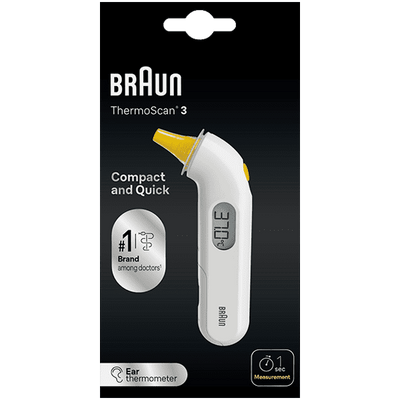
Braun ThermoScan 3 Compact Ear Thermometer IRT 3030
Medicine & Drugs£ 41.94UK delivery soon
Order within 2h 14m
In Stock
Authentic 30-day returns 12 viewing
Ear Thermometers
Our ear thermometers collection features reliable, clinically tested devices designed for quick and accurate temperature readings via the ear canal. These thermometers are ideal for families, healthcare settings and anyone who needs fast, hygienic and non-invasive temperature monitoring. They work especially well alongside essential items from related categories such as digital thermometers and medical equipment for a complete home health setup.
What Are Ear Thermometers?
Ear thermometers (tympanic thermometers) measure body temperature by detecting infrared heat emitted from the eardrum. This method closely reflects core body temperature, making it faster and often more accurate than oral, axillary or forehead readings when used correctly. They are widely used in clinical environments due to their speed and reliability.
Benefits and Features of the Welzo Ear Thermometer Collection
- Rapid readings: Most devices measure temperature in 1–2 seconds.
- High accuracy: Designed to capture heat directly from the eardrum.
- Suitable for children and adults: Non-invasive and comfortable.
- Hygienic use: Many models include disposable probe covers.
- Backlit displays: Read results easily, even at night.
- Memory function: Track temperature changes over time.
Why Are Ear Thermometers Important?
Monitoring temperature is essential for assessing illness, especially in children, where fever can develop quickly. Ear thermometers provide near-instant readings, making them ideal for restless children or nighttime checks. Unlike oral thermometers, they don’t require under-tongue placement, and unlike forehead scanners, they are less affected by external factors like sweat or ambient temperature.
How to Use Ear Thermometers
- Ensure the ear canal is clean and free from excess wax.
- Use disposable probe covers where recommended.
- Gently pull the ear upward and backward to straighten the canal.
- Insert the probe comfortably into the ear canal, without force.
- Press the measurement button and wait for the audible reading signal.
- Record or compare readings using built-in memory if available.
Types of Ear Thermometers Available
- Digital infrared ear thermometers: Standard home-use devices.
- Professional clinical models: Used in hospitals and GP practices.
- Multi-function thermometers: Devices offering ear, forehead and surface readings.
- Child-friendly thermometers: Designed for quick, gentle readings.
Related Monitoring & Health Categories
Expert Insights, Research & Safety Guidance
Clinical research shows that tympanic thermometers provide readings close to core body temperature when placed correctly. They are considered more reliable than forehead thermometers in cases where the patient is sweating or has been exposed to outdoor temperatures. However, accuracy may be reduced if:
- Earwax obstructs the canal
- The probe is not properly aligned
- A child’s ear canal is too small for certain models
Experts recommend choosing models with adjustable tip sizes or child-specific attachments for younger age groups. For tracking fever progression, thermometers with memory recall can offer valuable information to parents and clinicians.
How We Select Our Ear Thermometers on Welzo
We choose devices that meet recognised medical standards, including precise infrared sensors, ergonomic design and reliable manufacturer testing. Our selection focuses on durability, ease of use, hygienic features and consistent accuracy verified through user feedback and clinical research.
Internal Links to Trust & Quality Pages
Frequently Asked Questions
Are ear thermometers accurate for newborns?
Newborn ear canals may be too small for some models, so check manufacturer age recommendations. Many thermometers are suitable from 6 months onwards.
Can earwax affect temperature readings?
Yes. Excess earwax can block infrared heat detection and lead to lower or inconsistent readings.
Are ear thermometers safe for regular use?
Absolutely. As long as the probe is inserted gently, they are safe for daily or repeated use.
Is an ear thermometer better than a forehead thermometer?
Ear thermometers often provide more accurate readings when external temperatures or sweat may affect forehead scanners.
Do I need disposable probe covers?
Some models require them for hygiene, accuracy and to prevent cross-contamination; others use washable tips.
Why do readings vary between ears?
Differences in wax, ear canal shape or slight variations in positioning can cause small variations between ears.
Can adults and children use the same device?
Yes, most ear thermometers are designed for multi-age use, but check age suitability for smaller ear canals.
How often should I calibrate my ear thermometer?
Most modern devices do not require user calibration, but follow manufacturer guidance for cleaning and maintenance.
Does ambient temperature affect readings?
Ear thermometers are less affected than forehead scanners, but allow the device to adjust to room temperature before use.
Should I take readings from both ears?
If a result seems unusually high or low, comparing both ears can help confirm accuracy.
 Rated Excellent by 28,951+ Reviews
 100% Money Back Guarantee