


What Is Eumovate Cream Used For? Uses, How to Apply It and Side Effects


Related products
Written by Dr Muhammad Zeeshan Afzal, independent product reviewer and content creator for Welzo. Reviewed by Dr Sameer Nakedar, MBBS (London), MRCGP, PGCert. Fully rewritten and updated November 2026. Read how we write our content.
Eumovate cream is used to treat eczema, contact dermatitis and skin reactions to insect bites and stings. It contains clobetasone butyrate, a moderate-strength steroid (corticosteroid) that reduces inflammation, redness and itching. It sits one step above hydrocortisone in strength, which makes it useful for flare-ups that mild creams have not settled. Some packs can be bought from a pharmacy for adults and children aged 12 and over; others need a prescription. The key rule is short courses: do not use it for more than 7 days unless a pharmacist or doctor tells you to. This guide explains what Eumovate treats, where it should not be used, how to apply it and what side effects to look out for.
This article is general information, not medical advice. Always read the leaflet in the pack and follow the advice of your pharmacist or doctor.
Eumovate at a glance
| Question | Short answer |
|---|---|
| What is Eumovate cream used for? | Eczema, contact dermatitis, and reactions to insect bites and stings |
| What is the active ingredient? | Clobetasone butyrate |
| How strong is it? | Moderate. Stronger than hydrocortisone, weaker than Betnovate |
| Can I buy it over the counter? | Some packs are sold in pharmacies. Others are prescription-only |
| Who can use it? | Most adults and children aged 12 and over. Younger children only on a doctor's advice |
| How long can I use it? | No more than 7 days unless a pharmacist or doctor advises otherwise |
| Can I use it on my face? | Only if a pharmacist or doctor says so |
| Is it the same as clobetasol? | No. Clobetasol (Dermovate) is much stronger and prescription-only |
Key facts
- Clobetasone is classed by the NHS as a medium-strength steroid, so it is less likely to cause side effects than stronger steroid creams.
- It is usually applied in a thin layer once or twice a day.
- The limit for self-treatment is 7 days.
- The age limit for pharmacy use is 12 years.
- It should not be used on skin with acne, rosacea, cold sores, a skin infection, chickenpox or shingles.
- Clothing and bedding with cream on them catch fire more easily, so keep away from naked flames.
What is Eumovate?
Eumovate is the brand name for clobetasone butyrate. It comes as a cream and an ointment. It is a corticosteroid, a medicine that copies the action of hormones the body makes naturally to calm inflammation. It is not an anabolic steroid of the kind misused for muscle building.
Applied to the skin, it reduces the swelling, redness and itch of inflammatory skin conditions. It treats the flare, not the underlying tendency, so conditions such as eczema can return once it is stopped.
Terms used in this guide
- Topical corticosteroid: a steroid medicine applied to the skin.
- Potency: how strong a steroid cream is.
- Emollient: a moisturiser used to treat dry skin conditions.
- Fingertip unit: the amount of cream squeezed from the tip of an adult finger to the first crease. Used to measure how much to apply.
- Contact dermatitis: inflamed skin caused by something it has touched.
- Topical steroid withdrawal: a reaction that can follow stopping long-term steroid cream use.
What is Eumovate cream used for?
| Condition | How Eumovate helps |
|---|---|
| Eczema (atopic dermatitis) | Settles flare-ups of red, itchy, inflamed skin |
| Contact dermatitis | Calms reactions to irritants and allergens such as soaps, metals and plants |
| Insect bites and stings | Reduces itching and swelling |
| Nappy rash | Only when a doctor prescribes it |
| Maintenance between stronger steroids | A doctor may prescribe it to keep a condition under control between courses of a more potent cream |
A combination product containing clobetasone with an antibiotic and an antifungal is also available on prescription for inflamed skin that has become infected.
Is Eumovate used for psoriasis?
Eczema and dermatitis are the main uses. Doctors sometimes prescribe moderate steroids for psoriasis in sensitive areas such as skin folds, but psoriasis is not a condition to treat yourself with a pharmacy steroid. See a GP for diagnosis and a treatment plan.
Where Eumovate sits among steroid creams
UK steroid creams are grouped into four strengths. Choosing the lowest strength that works, for the shortest time, is the principle behind all steroid cream use.
| Strength group | Example | How it is obtained |
|---|---|---|
| Mild | Hydrocortisone | Pharmacy or prescription |
| Moderate | Eumovate (clobetasone) | Pharmacy for some packs, or prescription |
| Potent | Betnovate (betamethasone) | Prescription only |
| Very potent | Dermovate (clobetasol) | Prescription only |
The names clobetasone and clobetasol are easy to confuse. They are different medicines of very different strengths, so check the box. Compare the others in what is hydrocortisone cream used for? and what is Betnovate cream used for?
Who can and cannot use Eumovate
Most adults and children aged 12 and over can use it. Children aged 11 and under should only use it if a doctor advises.
Tell a pharmacist or doctor before using it if you:
- have ever had an allergic reaction or serious side effect from clobetasone or another steroid
- have acne or rosacea
- have cold sores, chickenpox or shingles
- have a skin infection
- have perioral dermatitis, a rash around the mouth
- are pregnant or breastfeeding
Steroids can make infections and acne worse, because they dampen the skin's immune response. That is why an infected or broken rash needs assessing first.
Where not to apply it
| Area | Advice |
|---|---|
| Face | Only if a pharmacist or doctor says so. Facial skin is thin and more prone to side effects |
| Genitals | Only if a pharmacist or doctor says so |
| Cuts and wounds | Do not use |
| Under dressings or plasters | Do not cover, unless a doctor tells you to. Covering increases absorption |
How to use Eumovate cream
- Wash and dry your hands.
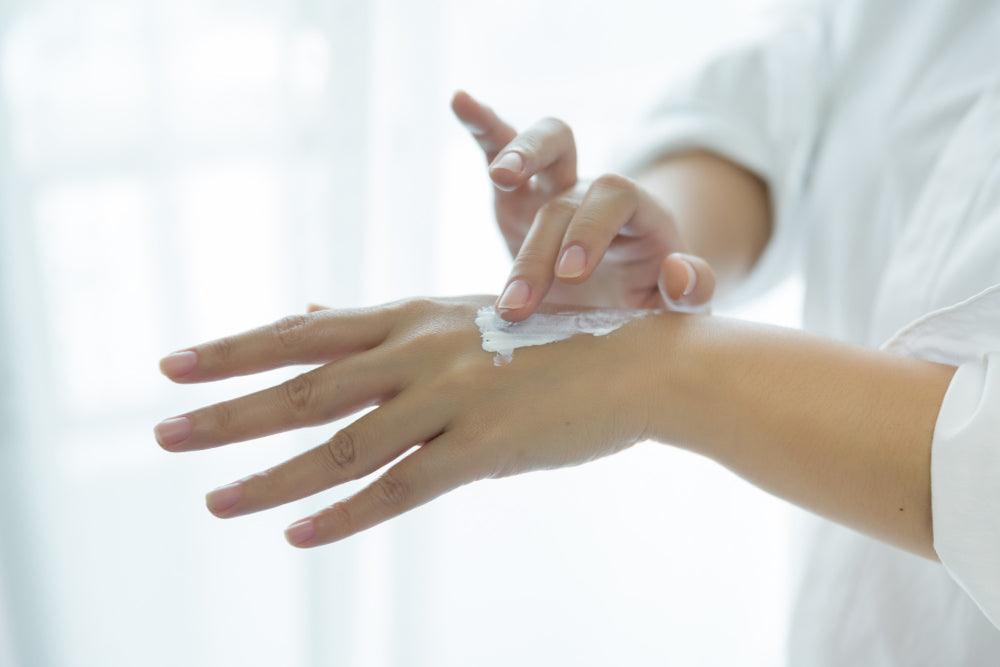
- Squeeze out the amount you need, measured in fingertip units. One fingertip unit covers an area about the size of two adult palms.
- Spread a thin layer over the affected skin only, smoothing it in the direction the hair grows.
- Wash your hands afterwards, unless you are treating your hands.
- Apply once or twice a day, as the leaflet or your prescriber directs.
- Stop after 7 days unless you have been told to continue.
Using it with moisturisers
Emollients are the foundation of eczema care and should be used every day, including when skin is clear. Leave a gap, ideally about 30 minutes, between applying an emollient and Eumovate so the steroid is not diluted. Browse Welzo's eczema range and body moisturisers, or read best emollient creams for eczema and is Cetraben a steroid cream?
Fire safety
Do not smoke or go near naked flames while using Eumovate. Fabric that has been in contact with creams and ointments burns more easily, even after washing.
Side effects
Used for a short time on a small area, Eumovate causes few problems. The risk rises with long-term use, large areas, thin skin and covered skin.
| Type | Side effects | What to do |
|---|---|---|
| Common | Thinning of the skin, an itchy rash, skin becoming lighter or darker, small visible blood vessels | Stop and speak to a pharmacist or doctor if these appear or the skin gets worse |
| Rare, with long-term use | Adrenal problems: being sick, weakness, weight loss, mood changes, dizziness | Call NHS 111 |
| Rare, with long-term use | Cushing's syndrome: weight gain, a puffy face, excess hair growth | Call NHS 111 |
| Emergency | Serious allergic reaction: swelling of the lips, mouth or throat, difficulty breathing | Call 999 |
Topical steroid withdrawal
If steroid creams are used continuously for a long time, stopping suddenly can cause a withdrawal reaction. The NHS describes redness or a change in skin colour, burning or stinging, intense itching, peeling and oozing open sores. Redness can be harder to see on brown or black skin. Keeping to short courses, as directed, is the way to avoid it. If you have used Eumovate for a long time, speak to a doctor before stopping, and do not restart it without advice if you have withdrawal symptoms. More in do steroid creams have side effects?
Pregnancy, breastfeeding and other medicines
| Situation | NHS advice |
|---|---|
| Pregnancy | Check with a pharmacist or doctor first. It is usually considered acceptable in small amounts for the shortest time |
| Breastfeeding | Usually acceptable, but check first. If you use it on your breasts, wash it off before feeding |
| Other medicines | Unlikely to be affected, but tell your pharmacist what you take |
| Food and alcohol | No restrictions |
When to see a GP
- Your skin has not improved after 7 days, or it is getting worse.
- The rash is weeping, crusted, painful or hot, which may mean infection.
- You need a steroid cream repeatedly for the same area.
- The rash is on your face, genitals or a large part of your body.
- The person affected is a child under 12.
- You are not sure what the rash is.
For long-term management, see treatment of eczema.
Myths and facts about Eumovate
| Myth | Fact |
|---|---|
| Eumovate is a mild steroid. | It is moderate: one level above hydrocortisone. |
| It is safe to use every day indefinitely. | Self-treatment is limited to 7 days. |
| It is the same as Dermovate. | Dermovate contains clobetasol, a very potent steroid. |
| Steroid creams always thin the skin. | Short courses used as directed rarely do. The risk comes with prolonged use. |
| It clears spots. | It should not be used on acne and can make it worse. |
| It cures eczema. | It settles flares. Daily emollients keep skin under control. |
| A thick layer works better. | A thin layer is all that is needed. |
| It is an anabolic steroid. | It is a corticosteroid, a different type of medicine. |
Frequently asked questions
How quickly does Eumovate work?
Itching and redness often start to ease within a few days. If there is no improvement after 7 days, see a pharmacist or GP.
Can I use Eumovate on my face?
Only on the advice of a pharmacist or doctor.
Can I use Eumovate for thrush or fungal infections?
No. A steroid alone can make fungal infections worse.
Can children use Eumovate?
Children aged 12 and over can. Under 12s need a doctor's advice.
Is Eumovate stronger than hydrocortisone?
Yes. Hydrocortisone is mild and Eumovate is moderate.
Cream or ointment: which is better?
Creams suit moist or weeping skin and are less greasy. Ointments suit dry, scaly skin.
Can I use it on insect bites?
Yes, for reactions to bites and stings, provided the skin is not broken or infected.
What if I forget to apply it?
Apply it when you remember, unless it is nearly time for the next application. Do not use extra to catch up.
Can I use it on sunburn?
It is not a sunburn treatment. Ask a pharmacist for advice.
Does it affect driving or alcohol?
No.
Which eczema creams are worth trying alongside?
See our eczema cream reviews.
The bottom line
Eumovate cream is a moderate-strength steroid for flare-ups of eczema, contact dermatitis and insect bite reactions that milder treatment has not settled. Use a thin layer on the affected skin once or twice a day, for no more than 7 days, and keep it off the face, genitals and broken or infected skin unless a professional advises otherwise. Keep moisturising every day, and see a GP if the rash does not clear or keeps coming back.
References
- NHS. Clobetasone.
- NHS. Topical corticosteroids.
- NHS. Atopic eczema: treatment.
- Medicines and Healthcare products Regulatory Agency. Topical corticosteroids: information on the risk of topical steroid withdrawal reactions.
- Electronic medicines compendium. Product information for clobetasone butyrate cream.
Medical disclaimer: this article is for information only and is not a substitute for professional medical advice, diagnosis or treatment. Always read the patient information leaflet and ask your pharmacist or doctor if you are unsure.



 Rated Excellent by 31,000+ Reviews
 100% Money Back Guarantee